




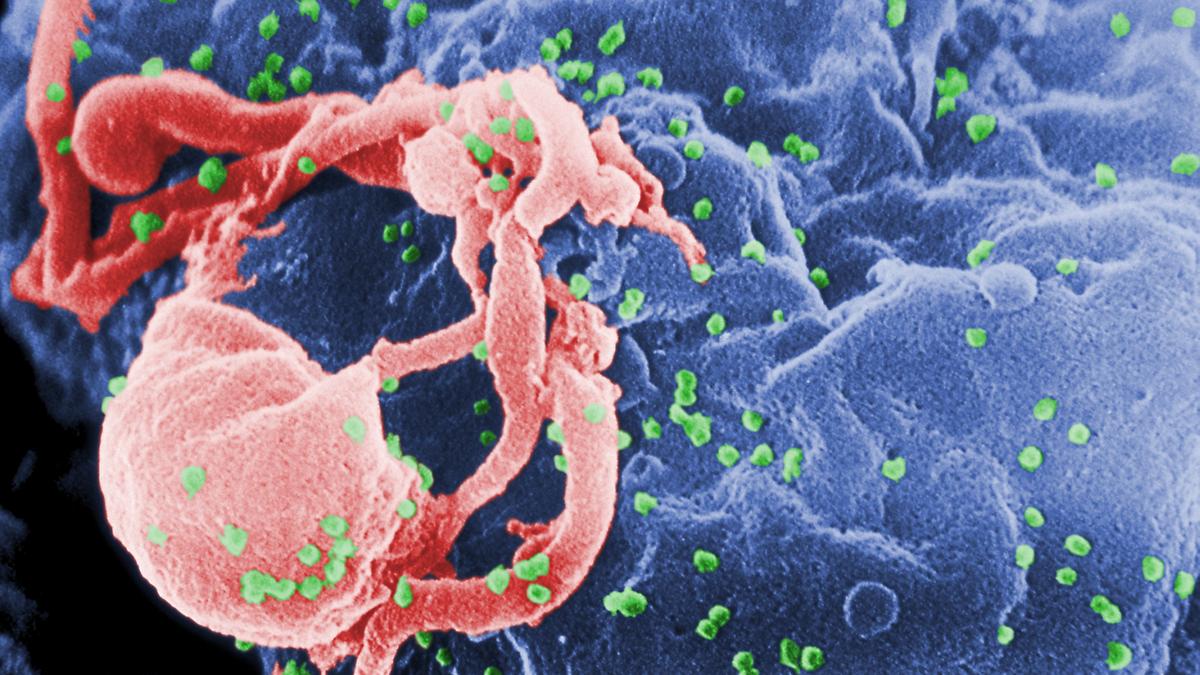
A false-coloured scanning electron micrograph of HIV-1 budding (in green) from cultured lymphocyte, 1984. HIV has more variants circulating in a single patient at any given point of time than influenza cumulatively generates in one year in all influenza patients around the world combined, creating a vaccine development nightmare.
| Photo Credit: U.S. CDC
In early 1981, Michael Gottlieb, an assistant professor at the University of California Los Angeles Medical Centre, wanted to teach some tenets of immunology to a post-doctoral fellow in his laboratory. Dr. Gottlieb asked the post-doc to select a patient from the hospital who displayed some immunological features that they might find interesting. The post-doc found a patient who had a relatively rare infection called pneumocystis pneumonia and had been admitted after sudden, unexplained weight loss.
During the course of their discussion, the hospital doctors referred four more patients with the same infection. Dr. Gottlieb published a paper detailing these five cases in a small American journal called Morbidity and Mortality Weekly. At the time, Dr. Gottlieb had no idea his paper was about to change the field of immunology forever.
That paper was the first report of acquired immunodeficiency syndrome (AIDS).

No vaccine for AIDS
Today, nearly half a century after Dr. Gottleib’s landmark publication, AIDS still has no vaccine or cure. This anomaly in humanity’s otherwise remarkable track record in tackling major infectious diseases is a result of several factors. Chief among them is that the replication of the human immunodeficiency virus (HIV), which causes AIDS, is an incredibly error-prone process that results in multiple variants of the virus circulating.
The sheer number of all the different strains circulating in the world is in fact the biggest challenge to an HIV vaccine today.
To put it in perspective, HIV has more variants circulating in a single patient at any given point of time than influenza cumulatively generates in one year in all influenza patients around the world combined. And influenza is the second-best virus in terms of genetic variation.
Starring role for B-cells
When the immune system encounters a virus, one of its responses is to produce antibodies highly specific to proteins on the virions’ surface. Each antibody is unique to a small piece of a given protein, and the immune system can generate antibodies against any given fragment of any protein.
The immune system does this by starting with a pool of specialised cells that produce antibodies, called B-cells. Each B-cell produces an antibody unique to one protein fragment. When a B-cell encounters a similar protein fragment on a foreign object — say, a virus or a bacteria — it begins to divide and refine the antibody until it binds perfectly to the target. These antibodies then bind to their corresponding pieces on the viral surface, rendering them incapable of further infection. The body then retains some of these specific antibody-producing cells in case of a future infection.
A vaccine aims to generate these antibodies prior to viral infection so that whenever a virus enters the body, the antibodies can neutralise the virus and prevent it from initiating an infection. The vaccine basically provides the immune system with a head-start by allowing the body to make antibodies without an infection with the real virus.
bNAb, a sliver of hope
However, when multiple variants of the same virus exist, generating antibodies against all the different variants simultaneously becomes very difficult. In the case of most viruses, the immune system ultimately does catch up. But against HIV, it doesn’t because of the sheer volume of different variants that are circulating, overwhelming the immune system’s ability to generate new antibodies. In fact, by the time the immune system makes antibodies against a few strains, the virus will have produced hundreds more.
In the early 1990s, scientists noticed that in a small subset of HIV-infected individuals, a new kind of antibody was being produced that could neutralise a large number of circulating viral strains. These broadly neutralising antibodies (bNAb) worked by targeting areas of the viral proteins that the virus couldn’t afford to change, since doing so would make it lose infectivity. Scientists have since discovered many bNAbs, and they are classified into different groups based on the region of HIV they target. Some of these bNAbs can effectively neutralise more than 90% of circulating strains.
But there is a catch: a body usually takes years to make bNAbs, and by then, the virus has already evolved to escape them. It takes years because the parental B-cell that makes the bNAbs is incredibly rare in the starting pool.
Light at the tunnel’s end?
The challenge, therefore, has been to make the immune system produce these bNAbs in large numbers in response to a vaccine. The route to doing this, called germline targeting, has three steps.
In the first step, those B-cells that can mature into cells that can produce bNAb are identified and engaged to increase their population and prepare them for the second-step, where a booster dose will guide these cells into generating stronger bNAbs against HIV. The third and final step is to refine these bNAbs such that they can neutralise a wide range of HIV strains.
After years of painstaking failures, researchers have established a possible roadmap for the first two steps of germline targeting for two groups of bNAbs. Four papers recently published in Science journals outlined two promising nanoparticle-based vaccine candidates: N332-GT5 and eOD-GT8. The teams, based out of the Scripps Research Institute and the Massachusetts Institute of Technology, both in the U.S., showed that using these novel vaccines, it may be possible to engage B-cells to make two different classes of bNAbs.
HIV demands patience
The teams demonstrated the efficacy of their vaccine candidates in two forms, protein and mRNA. The latter is important because mRNA vaccines are easy to develop and produce. In both cases, the antibodies generated in response to the vaccine were shown by structural analysis to bind to the HIV proteins in a manner similar to that of established bNAbs. Further, the groups also demonstrated the efficacy of their vaccine candidates in two different animal models, mice and macaques. These animals can now be used as model systems for future studies. The candidate vaccines are currently being evaluated in a phase-1 clinical trial to assess their performance in humans.
The research groups have also reported a possible candidate for step II of germline targeting. A protein fragment called g28v2 appears to be able to guide the cells into making bNAbs. Further research in this direction to evaluate its properties is ongoing.
While these four papers do imply progress in developing a B-cell based vaccine for HIV after decades of frustrating wait, we must refrain from celebrating too early. Results from mouse and macaque models don’t always translate to positive results in the human system. The strategies reported by these publications do have enormous potential for vaccine development against other RNA viruses such as influenza, various coronaviruses, and hepatitis C — but our past failures have also taught us to remain sceptical with HIV until the very end.
Arun Panchapakesan is an assistant professor at the Y.R. Gaithonde Centre for AIDS Research and Education, Chennai.