



A good old game of carrom has really stood the test of time. Set up a board and people around will flock to it while practising their finger gymnastics. You may not have noticed but the game often starts with an underappreciated ceremony: a pinch of magic powder strewn over the board that somehow energises the sluggish coins, helping them glide smoothly with just a tiny push.
What did that little bit of powder do?
Fixing friction
Friction is a barely visible force that surrounds us and slows us down every time we move. Isaac Newton told us a long time ago that if something moves, it will continue to do so unless stopped. Then why doesn’t a car just continue moving once it has been pushed? That way we could have just reached from one place to another without spending any money on fuel – and we wouldn’t have to worry if its price is rising or falling.
The reason is friction. Even if we make roads as smooth as possible, there will always be some friction that will slow the car. The invisible air also creates friction for aeroplanes and birds. The tricky part even for our rockets is the phase when they are getting out of the earth’s atmosphere. The air’s friction creates a lot of heat – the same heat you generate when you rub your palms against each other on a cold day. In outer space, there is no air and spacecraft move more easily, often for very large distances with just one push.
Where does this friction come from?
Any surface – such as a carrom board or your desk – may seem to be completely smooth and straight, but that isn’t really the case. In fact, no perfectly uniform surface exists in the universe . If you look at any surface very closely, you will notice tiny protrusions: basically a few places that have bumps and others that have dips, like a camel’s back.
The surfaces of a carrom board surface as well as a carrom coin also have bumps and dips. When the coin tries to move on the board, the bumps and dips on both surfaces will hit each other, slowing the coin. This is the friction at play. Friction can also arise if there are things to stick on both surfaces, like some oily dirt. In short, friction arises because of forces or interactions between two surfaces.
Think of the carrom coin as a car moving on a road. If the road is smooth, the car will move easily. But if there are bumps and dips, the tires will have a hard time moving, and slow down the car. The rougher the surface, the more friction there is.
We fix a broken road by filling up the potholes. Similarly, that little bit of fine powder fills up all the tiny invisible holes on your carrom board, and then the coins move easily.
Dosa pan and air tracks
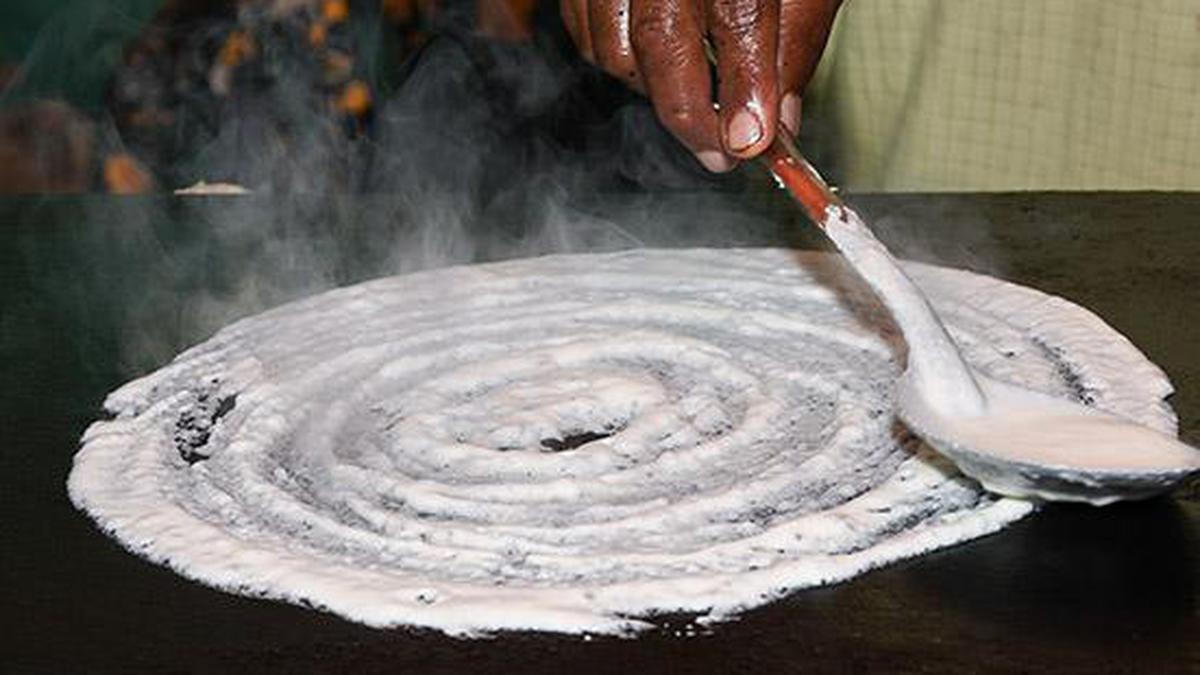
You may wonder: isn’t there a simple way of removing all friction? Well, people have found amazing ways to do this. The simplest version is something you have been doing at home, and for a long long time. If you have ever made dosa or some besan chilla, you may have sprinkled some water on the hot pan before or after. The water droplets move on the pan as if they have no friction. This is often to check if the pan is hot enough. But why does the water not stick to the pan?
This is because as soon as the water drops hit the hot surface, a thin layer of steam is formed below the drops. So the water drops are really floating on the pan. Given the surfaces are no longer in touch, they have very little friction, allowing the drops to glide around.
In one of the first physics courses at IIT Kanpur, where I teach, new students perform experiments to verify Newton’s laws, like the one I mentioned earlier. But then Newton’s laws are only true when there is no friction. So we need to make objects move without friction first.
One ingenious way is to conduct an experiment in which an object is made to move on an air track. Some amount of air is continuously pumped from within rails using powerful air blowers. If an object is not very heavy, it can ‘float’ above the track by sitting on the air, and move as if there is no friction. As a result, the students can now test Newton’s laws for themselves.
In fact, superfast trains that use the principle of magnetic levitation do the same thing. Here, the whole passenger train floats on a strong magnetic field created by the tracks. There is thus much less friction and the trains can move at a great speed.
The trouble with electrons
Just like cars have a tough time moving over a broken road, electrons find it hard to move through metal, such as a copper wire. That is why we pay our electric bills: so that someone somewhere can continuously apply some voltage to the wires, and the electrons pass into them and come to our houses.
What could be stopping electrons inside a material? Just as roads have potholes, any material around us has impurities. For example, any copper wire will have a trace presence of some other metals, such as zinc or aluminium. The atoms of these metals create ‘friction’ for electrons and make them slow down as they pass through. So if we are able to remove this friction, we will be able to get the wire to conduct an even greater current without applying any voltage.
You may even be thinking that if we can remove all the impurities from a material, we can escape paying electric bills. Unfortunately, this will not be possible. Even though Newton’s laws are sufficient to explain how carrom coins move on a board or cars move on a road, they are not sufficient to explain electrons.
Here, the laws of quantum mechanics are at play. A careful study of quantum mechanics and its applications to materials tells us there is another way of getting rid of friction for electrons – by the help of a phenomenon called superconductivity. If you are more interested in learning about superconductors and their fascinating properties, a physics course may be worth thinking about.
So the next time you curse the rising petrol bills, remember that you are not alone. The real problem is friction – which cars, carrom coins, and even electrons are struggling with.
The author is an assistant professor at IIT Kanpur.