




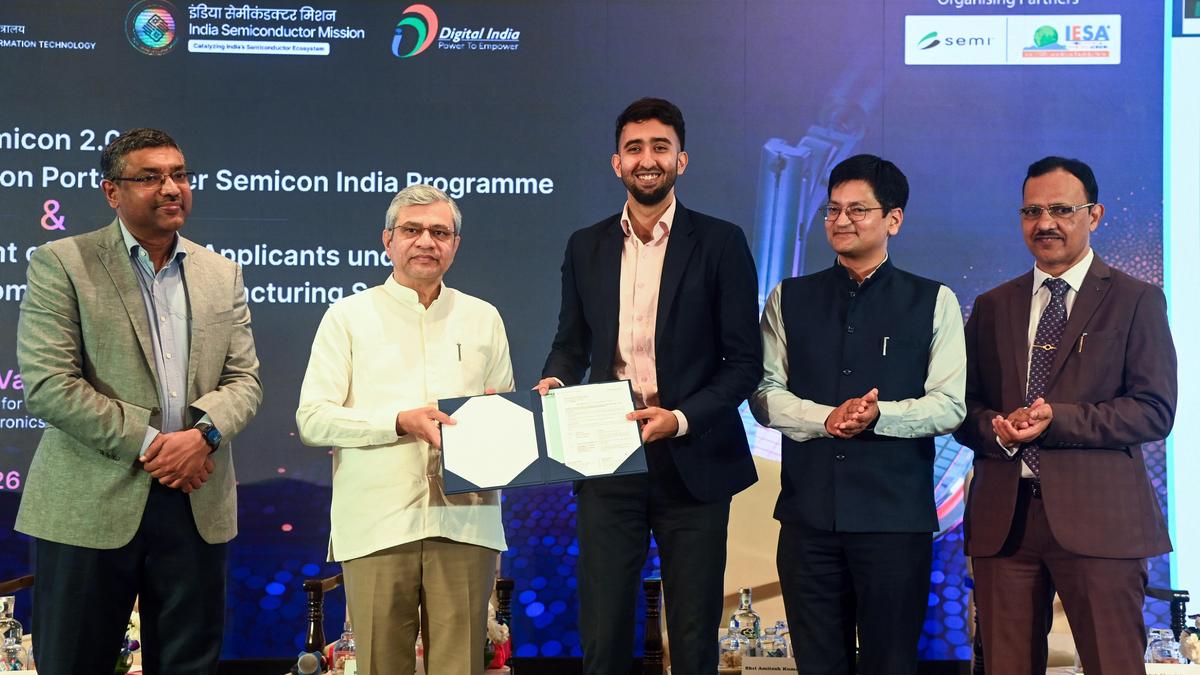
Union Minister for Electronics & Information Technology Ashwini Vaishnaw presents an approval letter to an approved applicant during the launch of the Semicon 2.0 web application portal and announcement of approved applicants under ECMS, in New Delhi on Friday, November 6, 2026.
| Photo Credit: ANI
The government on Friday approved 12 new projects under the Electronics Component Manufacturing Scheme (ECMS), taking the total number of approved applications to 118 and pushing committed investments to ₹77,051 crore — nearly 30% above the original target of ₹59,350 crore. The latest approvals entail investments of ₹7,503 crore.
The biggest investment commitment among the new projects is a ₹3,546-crore copper foil facility by Indo Asia Copper Ltd in Amreli, Gujarat. The incentives under ECMS are turnover-linked, with government support contingent on the companies commencing production.
The latest approvals underline the government’s attempt to deepen domestic manufacturing across the electronics value chain rather than remain confined to final-product assembly.
“We are going deep in practically every sector,” IT Minister Ashwini Vaishnaw said. “Today we are making, in the entire battery, the cell; we are making copper foils, we are making copper clad laminates for PCBs… In a sense, throughout that value chain, we are going deep with each program, with each approval, we are going deep into that value chain.”

The cumulative investment commitments have overshot the original target by ₹17,701 crore. Projected production has also risen to ₹5.73 lakh crore from the initial target of ₹4.56 lakh crore, an increase of nearly 26%.
“The overall investment which we have approved, the original target was ₹59,350 crore,” IT Secretary S. Krishnan said. “The investment we have already approved is ₹77,051 crore. The overall production which was targeted was ₹4,56,000 crore originally. Now it has gone up to ₹5,73,000 crore.”

The scheme’s employment target of 91,600 people was also close to being achieved, Mr. Krishnan added.
The 12 projects cover several critical segments, including anode material, cathode active material, printed circuit boards (PCBs), capital goods, polypropylene film, heat sinks, specialty ceramics, relays and camera rims. Tamil Nadu accounts for four projects, Gujarat and Maharashtra two each, while Punjab, Uttar Pradesh, Madhya Pradesh and Karnataka account for one each.
Capital equipment push
A key priority is developing domestic capabilities in capital equipment used to manufacture electronic components, an area where India remains dependent on overseas suppliers.
Mr. Vaishnaw acknowledged that attracting global equipment manufacturers would be difficult, given their reluctance to move production away from their home countries and the high precision required in manufacturing such machinery.

“We know that most equipment manufacturers would never like to go out of their parent countries,” he said. “Still, we want to make an attempt. We know that their governments will not like their companies to come out of their parent countries and set up units in India. We know that; still, we want to make an attempt. We know that the precision which is required for many of these equipments will be difficult to build in our country, but still we want to make an attempt, and that is why we have taken this tough task in our hands as part of our mission, and we will be successful.”
Separately, MeitY launched a web application portal for the second phase of the India Semiconductor Mission, marking another step in the government’s efforts to strengthen the domestic semiconductor ecosystem.
Published – November 06, 2026 05:01 pm IST