




Skip to content
  • Facebook
  • X
  • Linkedin
  • WhatsApp
  • YouTube
  • Associate Journalism
  • About Us
  • Privacy Policy
  • 033-46046046
  • editor@artifex.news
Artifex.News

Artifex.News

Stay Connected. Stay Informed.

  • Breaking News
  • World
  • Nation
  • Sports
  • Business
  • Science
  • Entertainment
  • Lifestyle
  • Toggle search form
  • Earthquake of 4.6-magnitude shakes Kashmir
    Earthquake of 4.6-magnitude shakes Kashmir Nation
  • Access Denied
    Access Denied Nation
  • 17 Bodies Found After Mi-8 Helicopter With 22 Onboard Crashes In Russia
    17 Bodies Found After Mi-8 Helicopter With 22 Onboard Crashes In Russia World
  • RCB’s Record Broken, SRH Script T20 Cricket History With Huge Milestone
    RCB’s Record Broken, SRH Script T20 Cricket History With Huge Milestone Sports
  • West Bengal CID reaches Mamata Banerjee’s residence in forgery allegations
    West Bengal CID reaches Mamata Banerjee’s residence in forgery allegations Nation
  • EPFO to hold outreach drive on job schemes
    EPFO to hold outreach drive on job schemes Nation
  • Six tourists killed, three others missing after boat capsizes in Pakistan’s Swat Valley
    Six tourists killed, three others missing after boat capsizes in Pakistan’s Swat Valley World
  • “Sports Unites Everyone”: Harbhajan Singh Hails Heartwarming Neeraj Chopra-Arshad Nadeem Picture
    “Sports Unites Everyone”: Harbhajan Singh Hails Heartwarming Neeraj Chopra-Arshad Nadeem Picture Sports
The 2026 Nobel-winning insights into how Govts should stabilise economies

The 2026 Nobel-winning insights into how Govts should stabilise economies

Posted on October 12, 2026 By admin


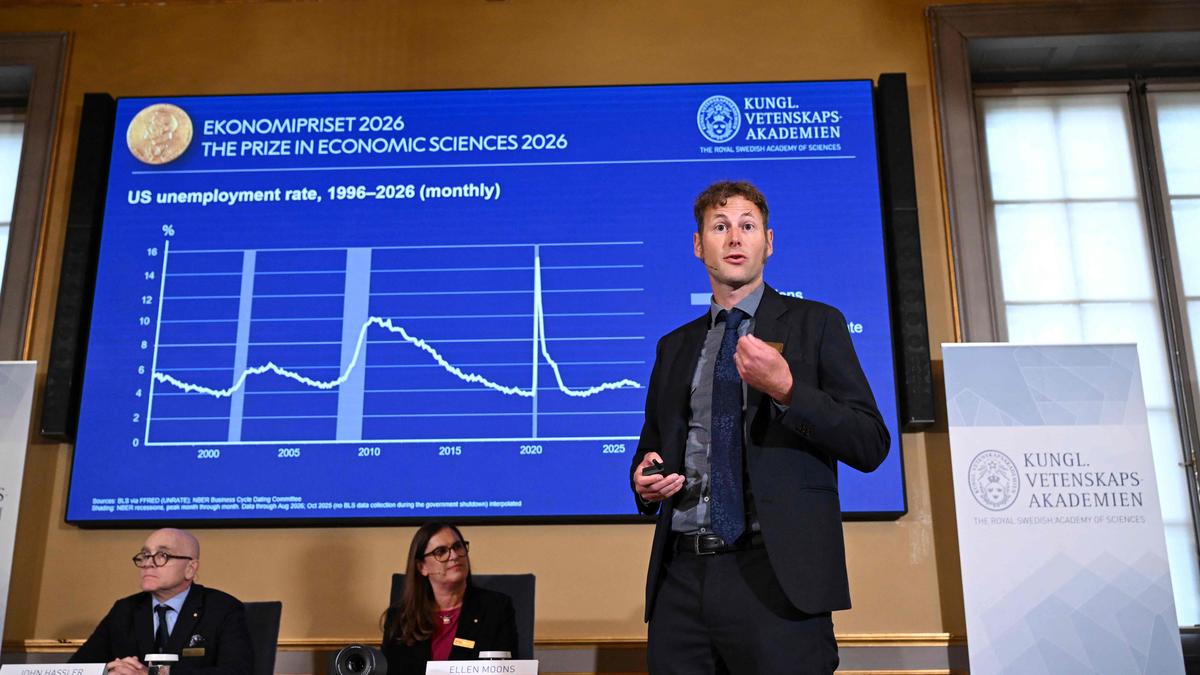
The 2026 Nobel Prize for Economics has been jointly awarded to American economists Robert E. Hall and Michael Woodford for providing an empirical foundation for determining how governments should incorporate the demand behaviour of households and the supply and pricing behaviour of companies when devising policies to stabilise the economy.

According to the citation of the 2026 Sveriges Riksbank Prize in Economic Sciences in Memory of Alfred Nobel, commonly called the Economics Nobel, the two economists were awarded the prize for establishing the “microeconomic foundations of macroeconomic stabilisation”. 

The research done by Mr. Hall and Mr. Woodford also provides an empirical basis, as Mr. Woodford himself explained on Monday, for the idea that the effectiveness of economic policy is also determined by how well the government communicates why it is implementing those policies. 

Mr. Hall is currently the Robert and Carole McNeil Joint Hoover Senior Fellow and Professor of Economics at Stanford University while Mr. Woodford is the John Bates Clark Professor of Political Economy at Columbia University.

Nobel Prize 2026 Winners | Full List

Why stabilisation needed a change

Stabilisation policy loosely captures the various instruments and steps governments use to control wild swings in growth, output, inflation, unemployment and business cycles. 

Through most of the 20th century, the theories of theoretical economic titan John Maynard Keynes held sway, that government policy must step in to stabilise the economy. That is, demand can be boosted through loose monetary policy and increased transfers from governments to households while excess demand can be reined in by tightening such policies. 

However, the experience of the U.S. economy in the 1970s showed that this framework was not enough. The attempts by the U.S. government and Federal Reserve to tame inflation and unemployment led to high unemployment and high and accelerated inflation. 

Stabilisation policy as a whole came under pressure and some argued it should be abandoned entirely. Mr. Hall and subsequently Mr. Woodford rebuilt this framework. 

How households consume

Mr. Hall worked on the demand side and provided an understanding of consumption demand. 

The earlier system had assumed a mechanical relationship between aggregate disposable income and aggregate consumption demand. That is, the assumption was that consumption had a direct relationship with higher or lower levels of disposable income. 

Mr. Hall found that, while current disposable income matters, expectations about the future path of matters almost as much. That is, if a household is expecting future constraints, this will affect its current spending. 

In a paper in 1978, Mr. Hall brought empirical backing to this idea and substantially changed the way consumption theories could be quantified.

How companies set prices

Mr. Woodford, on the other hand, focused on supply, particularly firms and how they set prices, and combined both his work and Mr. Hall’s into a composite. 

In a series of papers starting in the 1990s, Mr. Woodford showed that prices set by firms do not adjust on a continuous basis. Instead, firms set the price for a period of time. For example, the price of ice-cream is set at the start of summer and not changed through the season. 

Understanding this brought an element of ‘forward-lookingness’ into the supply side. That is, if prices are going to be set for a period of time, companies need to understand what that period of time is going to look like. 

Mr. Woodford succeeded in deriving a formula from this theory for how aggregate inflation relates to expectations and current levels of output, and combined this with Mr. Hall’s theory of demand. 

He laid out the full framework in a 2003 monograph titled Making Things Happen: A Theory of Causal Explanation. It laid the groundwork for understanding business cycles, what causes them, how they play out, the impact of these on stabilisation policy, and delivered key insights such as the importance of policy transparency. 

Why transparency is important

“One of the themes in my work is that government authorities shouldn’t view stabilisation of the economy as an exercise that is simply conducted by people pulling levers to control the economy independently of what people in the economy understand about this,” Mr. Woodford said on Monday during the press conference announcing the Nobel results. 

He explained that his work has stressed that the understanding of consumers of what policy is likely to be like in the future is “crucial” to the effects of policy.

“And so, creating a framework that allows governments to talk to the public about what they’re doing, I think is also important,” Mr. Woodford said. “And that was one of the key goals of trying to develop an analytical framework, not simply to use it on people, but to also talk to people about why the things that are being done are being done.”

Published – October 12, 2026 06:05 pm IST


Source link

Business Tags:2026 Nobel Prize in Economics, 2026 Nobel Prize in Economics explained, nobel prize in economics

Post navigation

Previous Post: Waste management facility facing closure gutted in Kochi

Related Posts

  • Profit Jumps 27% As Volumes, Margins Beat Street Estimates Business
  • RBI allows resident Indians to open Foreign Currency Accounts in IFSC, Gujarat
    RBI allows resident Indians to open Foreign Currency Accounts in IFSC, Gujarat Business
  • Access Denied Business
  • Access Denied Business
  • Access Denied Business
  • Access Denied Business

More Related Articles

Sensex, Nifty climb in early trade on buying in IT, bank stocks Sensex, Nifty climb in early trade on buying in IT, bank stocks Business
Cotton production to drop in the 2025-2026 season Cotton production to drop in the 2025-2026 season Business
Rupee falls 26 paise to 83.40 against U.S. dollar in early trade Rupee falls 26 paise to 83.40 against U.S. dollar in early trade Business
Pre-poll spending spike lifts fiscal deficit to 86.5% by Feb. Pre-poll spending spike lifts fiscal deficit to 86.5% by Feb. Business
Indian IT saw deal recovery in May: BNP Paribas Indian IT saw deal recovery in May: BNP Paribas Business
Trump’s Move to Send US Ships to Mideast Renews Iran Threat Business
SiteLock

Archives

  • October 2026
  • September 2026
  • August 2026
  • July 2026
  • June 2026
  • May 2026
  • April 2026
  • March 2026
  • February 2026
  • January 2026
  • December 2025
  • November 2025
  • October 2025
  • September 2025
  • August 2025
  • July 2025
  • June 2025
  • May 2025
  • April 2025
  • March 2025
  • February 2025
  • January 2025
  • December 2024
  • November 2024
  • October 2024
  • September 2024
  • August 2024
  • July 2024
  • June 2024
  • May 2024
  • April 2024
  • March 2024
  • February 2024
  • January 2024
  • December 2023
  • November 2023
  • October 2023
  • September 2023
  • August 2023
  • July 2023
  • June 2023
  • May 2023
  • April 2023
  • March 2023
  • February 2023
  • January 2023
  • December 2022
  • November 2022
  • October 2022
  • September 2022
  • August 2022
  • July 2022
  • June 2022
  • May 2022

Categories

  • Business
  • Nation
  • Science
  • Sports
  • World

Recent Posts

  • The 2026 Nobel-winning insights into how Govts should stabilise economies
  • Waste management facility facing closure gutted in Kochi
  • Highground, Shamabala and Golden Eye impress
  • Sunil Bharti Mittal conferred France’s highest civilian award
  • Zelenskyy urges U.S. to ensure Russia respects energy ceasefire

Recent Comments

  1. Lonniedounc on UP Teacher Who Asked Students To Slap Muslim Classmate
  2. Michaeldoown on UP Teacher Who Asked Students To Slap Muslim Classmate
  3. Roberthek on UP Teacher Who Asked Students To Slap Muslim Classmate
  4. Wesleysiz on UP Teacher Who Asked Students To Slap Muslim Classmate
  5. HectorTOk on UP Teacher Who Asked Students To Slap Muslim Classmate
  • Access Denied Business
  • Prize money for every round a new feature in National two-wheeler racing
    Prize money for every round a new feature in National two-wheeler racing Sports
  • Vietnam BrahMos deal already signed, Indonesia pact in final stages: Defence Secretary R.K. Singh
    Vietnam BrahMos deal already signed, Indonesia pact in final stages: Defence Secretary R.K. Singh World
  • Access Denied Sports
  • Access Denied
    Access Denied Nation
  • Donald Trump Warns Of TikTok Risks, But Fears Ban Makes Facebook Stronger
    Donald Trump Warns Of TikTok Risks, But Fears Ban Makes Facebook Stronger World
  • Access Denied
    Access Denied Nation
  • Shiv Sena MP Prataprao Jadhav
    Shiv Sena MP Prataprao Jadhav Nation

Editor-in-Chief:
Mohammad Ariff,
MSW, MAJMC, BSW, DTL, CTS, CNM, CCR, CAL, RSL, ASOC.
editor@artifex.news

Associate Editors:
1. Zenellis R. Tuba,
zenelis@artifex.news
2. Haris Daniyel
daniyel@artifex.news

Photograher:
Rohan Das
rohan@artifex.news

Artifex.News offers Online Paid Internships to college students from India and Abroad. Interns will get a PRESS CARD and other online offers.
Send your CV (Subjectline: Paid Internship) to internship@artifex.news

Links:
Associate Journalism
About Us
Privacy Policy

News Links:
Breaking News
World
Nation
Sports
Business
Entertainment
Lifestyle

Registered Office:
72/A, Elliot Road, Kolkata - 700016
Tel: 033-22277777, 033-22172217
Email: office@artifex.news

Editorial Office / News Desk:
No. 13, Mezzanine Floor, Esplanade Metro Rail Station,
12 J. L. Nehru Road, Kolkata - 700069.
(Entry from Gate No. 5)
Tel: 033-46011099, 033-46046046
Email: editor@artifex.news

Copyright © 2023 Artifex.News Newsportal designed by Artifex Infotech.