

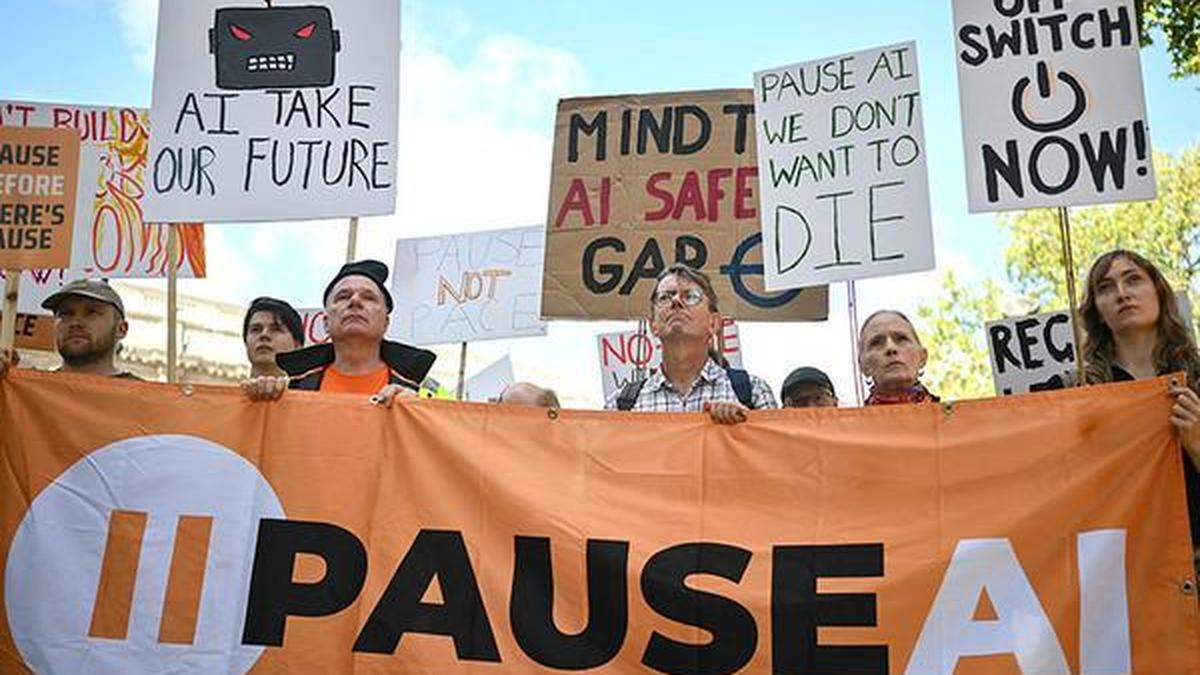
People hold placards and a banner during a “emergency protest” by civic action group PauseAI UK outside Downing Street in central London on September 16, 2026, after news that AI researcher Jacob Coxon had decided to leave the industry.
| Photo Credit: AFP
Several experts on a United Nations artificial intelligence committee have warned against the apocalyptic rhetoric used by some professionals in the sector regarding AI risks.
“As scientists, it’s very important to invest in the science, to really understand what we know (from) what we don’t know, and investing in fear is not that helpful,” said Joelle Barral, an executive at Google DeepMind and a member of the International Scientific Panel on AI, an independent body.
Former Anthropic employee Jacob Coxon, who previously worked at OpenAI, said in early September that AI developers believed the technology “could kill us all by the end of the decade”. A research engineer who left Google DeepMind in July made similar comments, saying it might already be “too late to avoid” humanity’s eradication by AI.
“We have to change the way we talk about AI risk because for a very long time, it’s either existential and everything is going to die and the killer robots are coming, or it doesn’t really matter,” Nobel Peace Prize laureate Maria Ressa, an investigative reporter, said at the same event, held in New York on September 21 on the sidelines of the UN General Assembly.
The International Scientific Panel on AI was created in 2025, with its members selected in February 2026. Its mandate is to advance the scientific understanding of AI and inform UN deliberations. Yoshua Bengio, considered one of the fathers of AI and a co-chair of the panel, said it was important to distinguish between what scientists actually know about AI risks and what can only be “plausibly extrapolated” from that evidence.
Published – September 22, 2026 03:39 pm IST