The story so far:
The 18th BRICS summit in New Delhi to be held in September, with India as the Chair, is expected to push for mechanisms to facilitate cross-border payments between members, including links between digital payment systems and central bank digital currencies (CBDCs), according to a report in The Hindu businessLine. Ahead of the summit, finance ministries’ and central bank representatives from BRICS countries met in Jaipur on August 12-13 to discuss financial cooperation, payments, and the wider use of national currencies in settling trade between members.
How do current cross-border payments work?
Sending money from one country to another requires a chain of transactions. Let’s say, an importer in Cape Town is buying passenger cars from an exporter in Chennai. The payment does not travel directly from the South African bank to the Indian one. It travels via a series of intermediaries called correspondent banks that hold accounts with each other. Since the South African bank does not hold an account with the Indian one (and vice versa), the payment is routed through a larger international bank that deals with both and is typically headquartered in London or New York. Because very few banks hold both rupees and rand, the payment involves converting rand to dollars and dollars to rupees where, in essence, the dollar acts like a vehicle currency, even though no American is involved in the trade.

What is SWIFT?
Now, apart from the money, there are also instructions that travel between the banks. This is handled by SWIFT (Society for Worldwide Interbank Financial Telecommunication), which is a Belgium-based cooperative and overseen by the National Bank of Belgium along with the G-10 central banks, including the U.S. Federal Reserve. SWIFT is a messaging network, like a secure post-office. It enables institutions to exchange payment instructions through it and settle amounts separately. It is used directly by more than 11,000 institutions in over 200 countries. Smaller banks reach it indirectly through larger banks that are part of the SWIFT network, which is why it has become crucial and hard to displace.

What are the costs involved in each step?
Every intermediary charges a fee and the currencies are converted twice (rand to dollar and dollar to rupees). So the foreign exchange margins are paid twice. A 2019 BRICS survey of cross-border payment systems, conducted by Brazil, found that Brazilian respondents reported foreign exchange margins of 2.5% with the figure rising to 8.5% for payments in Africa and, in some cases, as high as 20%.

While speed of transactions used to be a major issue, SWIFT claims that its SWIFT Global Payments Innovation has helped reduce transaction times significantly. Some structural delays remain even as the transaction chain has also become thinner. The Bank for International Settlements (BIS) found that active correspondent banking relationships fell by 20% between 2011 and 2018 with regional declines varying from 12% to 30% and Latin America being the worst affected. The reasons for this decline were largely commercial. Payment volumes kept growing during this period, even as they travelled through a smaller network.
Why does BRICS want to change this system?
For developing economies, though, payments in a handful of dominant currencies such as the U.S. dollar, the euro and the Japanese yen expose countries to the monetary policies of the countries that issue them. The 2024 BRICS report under Russia’s chairmanship argued that this part of the financial system is monopolised by a single institution, raising transaction costs. Alternatives to the system suffer from the fact that they have to convince a large number of banks and regulators to join before being useful. A bank that uses an alternative system to deal with sanctioned entities — several Russian banks were cut off from SWIFT in 2022, following Russia’s invasion of Ukraine — also risks sanctions, which deters others from joining. A sanctions-hit Russia has pushed hardest for an alternative and is also the reason why others are wary of joining one.

What changes can be envisaged in the BRICS discussions?
The idea being explored is a payment system where, instead of payments moving through several correspondent banks with dollar conversions, national payment systems would connect to each other directly. This could be done in pairs as India and Singapore have already done for remittances by linking the former’s Unified Payments Interface (UPI) and the latter’s PayNow systems. But building bilateral systems individually will not scale appropriately.
An alternative could be via a shared hub that each country joins. One such effort is Project Nexus, designed by the BIS and handed over to a company set up by six central banks, including India’s Reserve Bank of India. It is set to go live only in 2027. Notably, it is not a BRICS initiative.
The BRICS discussions would extend this idea to the use of central bank digital currencies. Here, central banks issue digital versions of their currencies for use between banks — a settlement asset, not the retail digital rupee held by individuals — and exchange them on a common platform. Both legs of a currency swap would occur at the same instant or not at all, removing the risk of paying out before the other side pays, which speeds up settlement and reduces the capital banks must set aside against such transactions.
The 2024 BRICS report claims transactions settled this way would yield significant cost savings. Only one such platform runs today – mBridge, built by the BIS with the central banks of China, Thailand, Hong Kong, and the UAE, which the BIS handed to its participants and left in October 2024. Over 95% of its settlement volume is in China’s digital yuan, according to People’s Bank of China figures reported by Reuters.
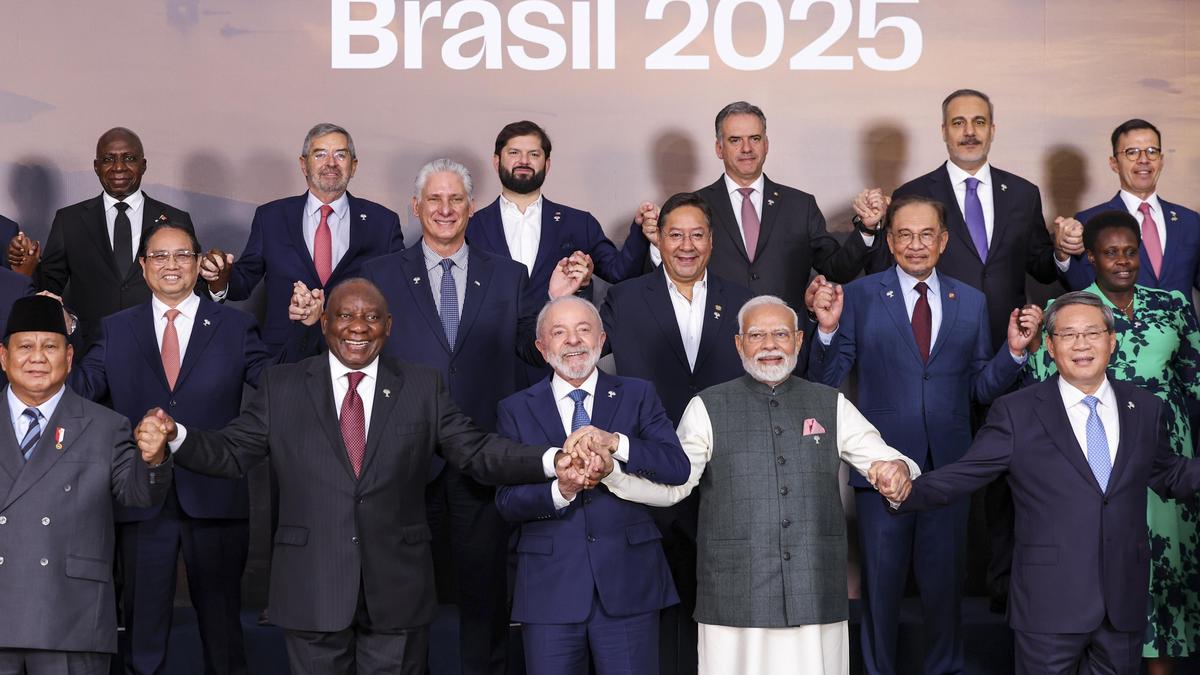
The Kazan declaration of BRICS in 2024 agreed to “discuss and study the feasibility” of an independent settlement system called BRICS Clear, but the Rio declaration the following year did not mention it.
What is India’s position?
India’s own proposal, reported in January, is that members link their CBDCs for trade and tourism payments. Indian officials have been careful to frame the payment systems as a means of cutting transaction costs and speeding up settlement rather than as initiatives to displace the dollar — even as Russian proposals, and those of some Brazilian economists, have gone further, towards alternative financial systems that would reduce dependence on the dollar.
U.S. President Donald Trump, in November 2024, had threatened to impose 100% tariffs on BRICS countries if they moved away from the dollar and a further 10% tariff on countries aligning with vaguely defined “anti-American” BRICS policies during last year’s Rio summit. The threats were not carried out. But even though they were not targeted at payment systems, this could perhaps be a reason why Indian officials have framed discussions only as a matter of reducing transaction costs.
Published – September 06, 2026 02:16 am IST