


It was in about 430 BCE that the crucial, mind-altering, breathtaking idea of ‘everything’ being made up of atoms emerged. A cheerful Greek philosopher, Democritus, who spent a truckload of time observing nature, eventually figured out the foundational maxim of many sciences today and coined the Latin word “atomos”, which is where “atom” comes from.
I must have been in 5th or 6th standard when I read about Democritus, solely because he was in the way of me reading stuff about ancient civilisations, case in point being Ancient Greece. Later, I found out that it was only in the 1950s that we “saw” atoms for the first time through a microscope and even later in the 80s that we imaged it. Now, there is a huge gap between 430 BCE and the 1950s. So how did this guy Democritus, without a glimmer of the modern technological resources, logically and intuitively figure out such a fundamental structure (which at the time was completely abstract and challenging the dominant views) that is the root of much science today?
Concrete to Abstract
Master toymaker and science educator Arvind Gupta, while explaining in an email, how toys help make science fun, revealed something crucial — “From the concrete to the abstract is a cardinal principle of education.”
Concrete to abstract.
| Photo Credit:
Magnific
He explains how learning through toys reflects the sentiment. “If the children see friction, electromagnetic induction, and centrifugal force in a toy, they intuitively understand it. The theory is important and it will come later.” One could start with “wooden blocks, lego, tangram, string games, puzzles, etc.” instead of “definitions and formulae”. What if Democritus saw nature as a puzzle too? If we had a time machine, maybe we could go ask him that directly but till then, we could listen to Arvind. After all, he has made science fun for millions of students in our country.
Who is Arvind Gupta?
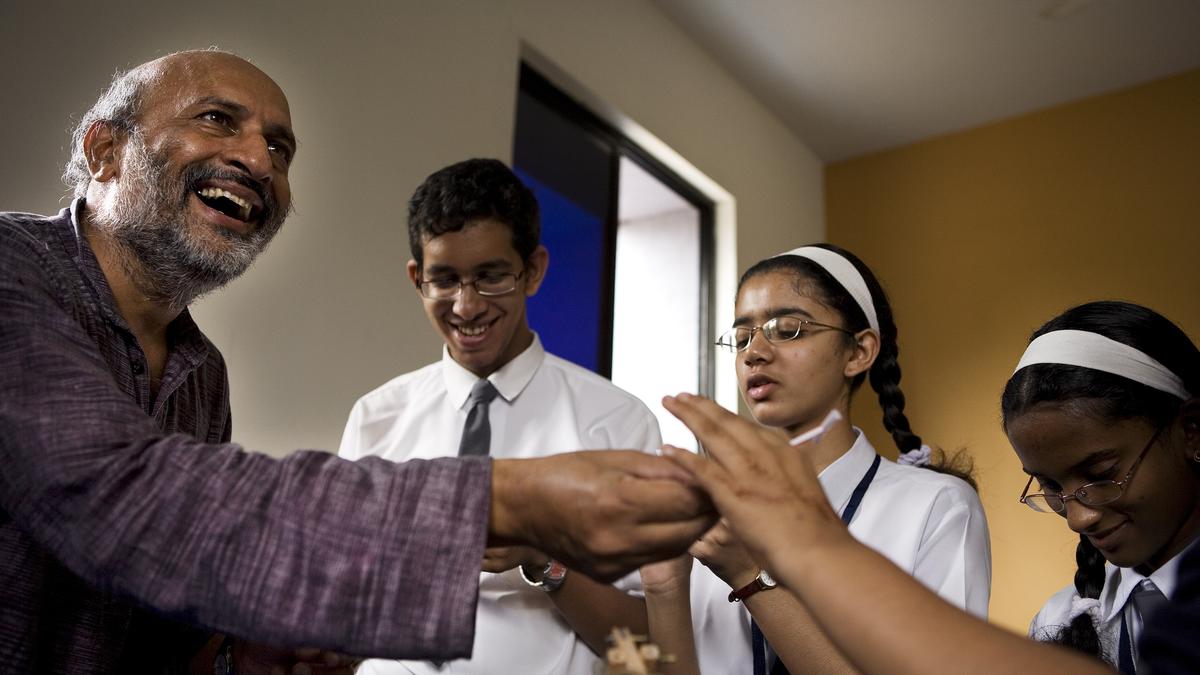
Arvind Gupta is an Indian toy inventor, science educator, author, and translator who is renowned for making science fun using toys and making those toys from trash.
He received the Padmashree award in 2018 for his extensive work in developing low-cost teaching aids as well as making science accessible to rural children.
His website features multiple instructions, videos, and guides on making toys which are freely available without copyright restrictions.
He heavily draws inspiration from the life, people, and simple things around him.
Getting hooked
Based on this principle, Arvind says that “an inspired teacher will introduce a subject with a concrete activity”. He says that “the first steps in science should be absolutely exhilarating for children”.
He gives me an example of what happens when students love science that way — “Walter Lewin, the legendary Physics teacher at MIT, included a physics demonstration in every lecture. He was so popular that even after his retirement he was brought back on popular demand!”
Doing science
Arvind Gupta makes toys out of trash materials as well as everyday things. He recounts one experience where students in his classroom were thrilled when they realised they didn’t need expensive items to make a simple electric motor. “Years back, I was demonstrating the Simple Electric Motor to engineering students. They had read about Faraday’s Laws of Electromagnetic Induction, but they had never seen it in use. The Electric motor takes less than 10 minutes to make and if you have a 1.5-volt torch battery it takes just five rupees to make it.”

Arvind Gupta makes toys out of trash materials as well as everyday things.
| Photo Credit:
Special Arrangement
Benjamin Franklin might understand this sentiment as his famous kite experiment in 1752 (demonstrating light is a form of electrical discharge) operated with simple items like a silk handkerchief and cedarwood. Arvind recognises the consumerist society where “buying more” is the slogan. He says they chose to make toys in this manner because “we sincerely believe that our work should help the poorest children on Earth”. This is the reason why Arvind’s toys are made from throwaway plastic bottles, old newspapers, and so on.
In his more than four-decade-long career, Arvind has visited more than 3000 schools across India, conducted workshops, made countless toys, and made many short films in a variety of local languages, all to help science become easily accessible and affordable for understanding and learning.
Positive changes
When asked about how things in the Indian academic atmosphere have changed compared to how it was when he first started, Arvind said that “in the last 40 years there has been a visible shift in pedagogical thinking — from chalk and talk and boring lectures to activities”.
He states that an “official acknowledgement” of this is “the tens of thousands of Atal Tinkering Labs” that have been set up in India.
“The government has realised that schools should be ‘active’ and not passive places.”
What Democritus signals to me now is likewise. His interaction with nature was active, hence why he was able to logically deduce ‘atoms’. In fact, Democritus’ idea was so unfitting with the rest of the Greek theories on the origin of life. Now imagine if this guy was passively fed those other theories, had accepted it, and never ventured to actively observe nature?
The spirit of true education points directly to this need for active engagement with the world.
What needs improvement?
Arvind says that outside of his control, one change he would like to bring about, “which will go a long way in changing the Indian educational system” is this: “In NEET and JEE, 50% weightage should be given to the class 12th marks. Also 25% weightage should be allocated to projects and other activities the child has done from classes 6 to 11. Only 25% percentage to be given to the final NEET or JEE exams. This will break the monopoly of coaching classes and restore the prestige of State Boards. Also, this will encourage schools to become “activity” schools.”
Practical stints
Before he was formally known to the world as a toy inventor and educator, Arvind was an IIT Kanpur graduate and had worked across many industries. He had key takeaways and notes that “in many countries students work for or in some factory or industry before they enter an engineering college”. He notes that this training and prior stint with an industry is important. “This practical stint with an industry helps students to become better engineers. Industries should encourage school students to do short stints with them. This is enlightened self-interest. In this way, in the future industries will get better engineers.”
Global examples
If we are thus looking at practices outside of India that could be helpful to the Indian education system, then surely there must be more from which we can borrow inspiration. When asked if there was anything that a global education system has implemented (to make science fun) which he finds exemplary, Arvind explained the science culture of the Netherlands.

NEMO Museum.
| Photo Credit:
Wikimedia Commons
“Dutch (Netherlands) science culture is highly interactive. The NEMO Science Museum in Amsterdam is designed entirely around sensory learning, encouraging kids to experiment with giant bubbles, shadow tunnels, and rooftop physics.” He notes that the stereotypical government science centres in India do little to “capture the imagination of the children”. In India, “there are very few places where children can go and actually build things”, says Arvind.
So, we listened to Arvind . If not for toys, there is one value that his philosophy reflects: go out, engage with people, engage with the world, dot things, make things, and learn!