

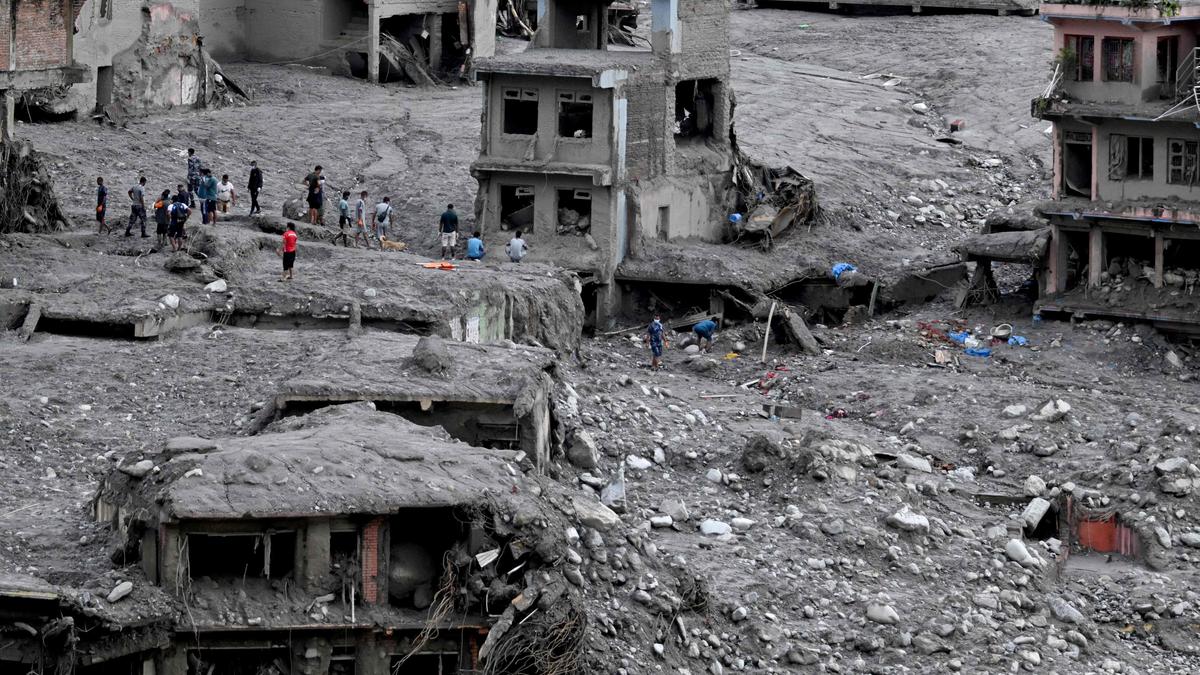
“We are paying the ultimate price for a global crisis we did not create,” Nepal’s Foreign Minister Shisir Khanal declared on September 1, 2026, after a catastrophic glacial collapse that killed over 1,200 people. But in the aftermath of this “Himalayan tsunami”, Nepal is doing something that is quite unprecedented. Instead of just issuing the usual appeals for humanitarian aid, Kathmandu has launched a diplomatic offensive. They are demanding direct climate compensation from the world’s three biggest emitters: the United States, China, and India. By shifting foreign policy from seeking charity to enforcing legal liability, Nepal has turned a devastating tragedy into a global test of climate justice, which forces the international community to confront the harsh limits of adaptation.
The third pole paradox
The immediate challenge before these major emitters is reconciling the glaring climate injustice that Nepal actually represents. Nepal only contributes a negligible 0.1% of global greenhouse gas emissions, and generates almost all of its electricity from renewable hydropower sources. And yet, its geography places it at the absolute ground zero of global warming. The Hindu Kush Himalayas, often referred to as the “Third Pole”, are warming at nearly twice the global average, melting the glaciers at 10 times their historical norms.

This accelerated melt is not occurring in a vacuum, however. It is driven by global “teleconnections”, meaning that warming in the North Eurasian Arctic disrupts planetary waves and the stratospheric polar vortex, which directly destabilises the South Asian monsoon. The August 26 disaster, which was triggered by a massive glacial collapse on the Nepal-China border, demonstrated how extreme events in the cryosphere can cascade down into densely populated valleys. The major powers basically mistook Nepal’s crisis for a localised weather event that could be managed with temporary relief. But the Himalayan ecosystem is sustained by a delicate climatic balance that is now failing under the weight of Northern Hemisphere pollution.
Economic and cultural impacts
Nepal’s strategy for economic sovereignty rested heavily on harnessing its 43,000 MW of commercially viable hydropower to become a regional energy exporter. It had only recently achieved a net-exporter status. The August floods, however, crippled approximately 10% of the country’s installed capacity, wiping out older, surface-level plants like Devighat while completely burying under-construction projects in mud. Overnight, a nation that was banking on energy exports to narrow its trade deficit with India was forced to halt its exports and instead import power to survive the winter. Rebuilding is going to require climate-resilient, underground engineering, driving up future project costs by 10% to 12%. The total damages are estimated between $4 billion and $7 billion, which amounts to roughly a tenth of Nepal’s entire GDP.
Also Read | Nepal flash floods: A wake-up call against infrastructure building spree across Himalayas, warns geo-scientist C.P. Rajendran
Beyond the economic ruin, a profound socio-cultural erasure is also being seen. The changing climate has altered the very fabric of the Himalayas. We see this from the rapid weathering of 15th-century Tibetan monasteries in Mustang to entire villages having to relocate as natural springs dry up. Thawing permafrost is creating dangerous new methane hotspots, while vector-borne diseases like dengue and malaria are climbing up to previously cold altitudes. The conflict here is no longer just environmental; it is basically existential.
Geopolitical indictments of the big three
In its pursuit of climate justice, Nepal has explicitly named the United States (U.S.), China, and India as the primary architects of its misery. The case against the U.S. is anchored in historical liability, because America accounts for over 20% of cumulative global emissions since 1850. If you factor in consumption-based carbon accounting, which reveals how the West offshored its emissions to manufacturing hubs, the true liability of the developed nations is even higher.
China, which is the current top annual emitter, faces a different sort of indictment: geographic proximity and upstream negligence. During a bilateral meeting in Kathmandu back in May 2026, Nepali officials pleaded for real-time data-sharing on glacial lakes and avalanches from the Tibetan region. Beijing provided only heavy rain forecasts in response. When the glacial lake burst on 26 August, the lack of transboundary early-warning systems proved to be fatal.
India, meanwhile, presents an “equity paradox”. For decades now, New Delhi has shielded itself in global forums by citing its low per-capita emissions and demanding “common but differentiated responsibilities” from the West. Nepal is now taking that exact logic and applying it regionally: as South Asia’s economic and emitting giant, India owes a differentiated responsibility to its smaller, vulnerable neighbours. Yet, India’s geopolitical manoeuvring, such as refusing to buy power from Nepali projects built by Chinese contractors, has only complicated Nepal’s recovery efforts, expanding the friction horizontally across the region.
The climate finance trap
Consider the global climate finance architecture of the 21st century. At COP27 in 2022, vulnerable nations successfully fought to establish the Fund for Responding to Loss and Damage (FRLD), which was then operationalised a year later at COP28. But in practice, the mechanism is severely handicapped by slow-moving bureaucracy. The FRLD board is not even scheduled to hold its next regular meeting until December 2026. For a country in ruins, waiting months for a standard UN review is a luxury it cannot afford to take.
By bypassing the normal channels and launching an unprecedented, out-of-cycle demand on September 1, just six days after the disaster happened, Nepal has forced the board to decide if it can react to a real-time emergency, or if it is merely another paper-pushing exercise.
As a matter of fact, the entire global fund currently holds a mere $700 million in pledges. More tragically, under the fund’s pilot phase rules, individual grants are capped at between $5 million and $20 million, which means a $20 million payout for a $7 billion catastrophe lays bare the inability of the current system to provide meaningful compensation to anyone. Furthermore, with the fund being temporarily hosted by the World Bank, debt-saddled developing nations fear that “compensation” might ultimately morph into crippling loans later down the line.
The burden of proof
Any form of financial compensation or funding discussed at the Conference of the Parties (COP) is strictly climate change-related and does not cover purely geological phenomena. However, the devastating August 2026 Nepal floods are not classified as a purely geological phenomenon; they are recognised as a climate-related disaster.
While the event involved massive movement of rock and earth (which are geological elements), international bodies and scientists classify the disaster under the Himalayan hazard system driven by global climate change. Now, the onus is on Nepal to prove that it was a climate change event and not a geological phenomenon.
However, there were a few climate change-related incidents that happened in the same Rasuwa region last year:
July 2025 (Bhotekoshi river): Nepal’s Rasuwa region experienced severe flash flooding. The cause was a transboundary GLOF, triggered when a glacial lake located just across the border in Tibet burst its banks, sending a cascade of water down into Nepal and destroying the crucial Miteri (Friendship) Bridge.
August 16, 2024 (Thame valley): The Thyanbo glacial lake (specifically the Upper and Lower Ngole Cho lakes) suddenly breached its natural moraine dam. It released over 7,70,000 cubic metres of water in under 25 minutes down the Khumbu region. The resulting torrent swept away half of Thame village, destroying homes, a school, a clinic, and local bridges.
Trapped in this financial labyrinth, the major powers have resorted to a familiar playbook. Rather than recognising any legal liability, China and India have flooded Nepal with traditional disaster relief like helicopters, rescue teams, and medicines.
But Nepal’s diplomatic gambit has already altered the landscape. Even if Kathmandu does not immediately extract a multi-billion-dollar cheque from the major emitters, its resolute stance has exposed the profound inadequacies of global climate diplomacy. Nepal has shifted the framework from charity to liability, setting a disruptive precedent for the entire Global South that the world’s heavy emitters will find increasingly difficult to just ignore.