





In March 2026, IIT Kharagpur—the oldest Indian Institute of Technology (IIT) that has been training thousands of minds to design bridges, cars, and computer chips for the last 75 years did something unprecedented. It formally applied to the National Medical Commission (NMC) to offer a postgraduate medical degree, the Doctor of Medicine (MD).
(Sign up for THEdge, The Hindu’s weekly education newsletter.)
It was not an isolated move. In August 2026, an alumnus of IIT-Kanpur pledged a massive ₹400 crore boost —building on a landmark ₹100 crore donation in 2022 — to expand its medical school and 450-bed super-specialty hospital to offer postgraduate programs in super-specialty medicine.
Within days, IIT-Madras stepped up to announce an even bolder vision: offering not just an MD, but an MBBS and a Ph.D. in medicine through its School of Medical Sciences, started in 2023.
A century-old assumption — that engineering colleges build engineers and medical colleges make doctors — is falling apart.
The quiet convergence
For over six decades, the Indian Institutes of Technology (IITs) have served as India’s temples of engineering excellence. So why are they suddenly stepping into healthcare and running hospitals?
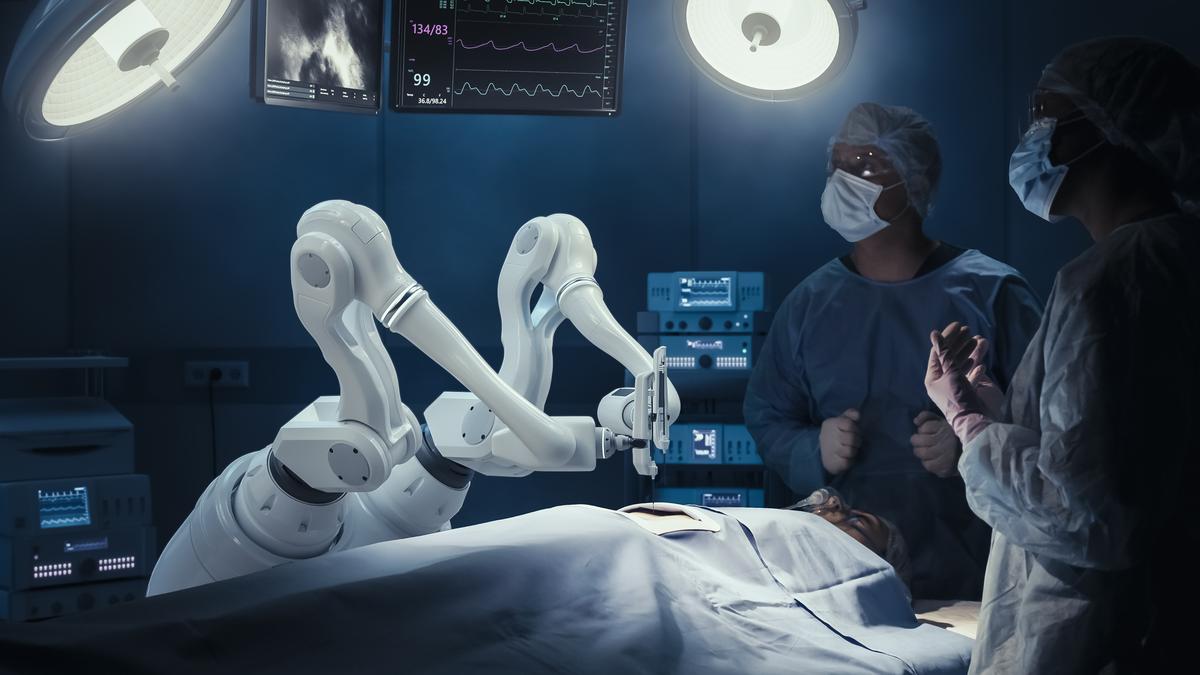
The short answer is: modern healthcare is no longer just about stethoscopes and prescriptions. It is driven by algorithms, microfluidics, robotic surgery, and biocompatible materials. Walk into a high-tech operating theatre today, and you will find as much engineering as medicine: robotic arms, real-time imaging, AI-assisted diagnostics, and 3D-printed implants.
Medicine is not the only sector witnessing this shift. Nursing and allied health are also transitioning. IIT Guwahati’s School of Health Sciences and Technology already trains students jointly with AIIMS Guwahati and the National Institute of Pharmaceutical Education and Research (NIPER). Meanwhile, IIT Kharagpur’s hospital project includes explicit plans for a nursing college and a paramedical training school alongside its medical courses.
India’s premier technology institutes have realised that the major challenges of this century — climate change, cancer, cognition, and clean energy — cannot be solved from inside a single-discipline silo. Engineering schools that just focus on engineering risk becoming mere component suppliers to the institutions that have a massive impact on solving these problems.
Research and pharma co-innovation
While the IITs made headlines with plans for traditional medical degrees, the Indian Institute of Science (IISc), Bengaluru, has pursued a distinctly different, research-first pathway into medical education.
Now established as the Tata IISc Medical School following a partnership with the Tata Group, the campus is executing an ambitious clinical and research infrastructure rollout.
The foundation stone for the 832-bed non-profit multi-specialty hospital — supported by a landmark ₹425 crore donation — was laid by the Prime Minister way back in June 2022 and was originally scheduled to be functional by December 2024. Now it is slated to become fully operational by late 2026 and admit the first batch of students in its flagship integrated dual-degree MD-Ph.D. program in July 2027.
What sets IISc apart from traditional medical colleges — and even peer technical institutes — is its structural integration with the global and domestic pharmaceutical and biotechnology industries. Instead of treating industry interactions as post hoc research grants, IISc embeds pharmaceutical co-innovation directly into its medical school ecosystem.
Specialised research hubs on campus — such as the Cipla Foundation Centre for Pulmonary Medicine — are integrated into the curriculum to deliver advanced respiratory care, targeted clinical trials, and drug development training alongside specialised units like the Centre for Brain Research (CBR).
The bigger opportunity
Hidden beneath the admissions headlines is an even bigger opportunity. Cross-disciplinary campuses are where medical devices, diagnostics, and therapeutics actually get invented.
This is because the clinicians who understand the patient’s pain points and the engineers who can build the solutions are finally standing in the same hallway.
For a country that imports the vast majority of its high-end medical devices, the economic and social benefits of getting this right are immense: indigenous implants, affordable diagnostics, and AI tools designed for Indian disease burdens and price points. This vision aligns with the National Education Policy (NEP) 2020, which actively pushes higher education institutions to break down rigid disciplinary walls and evolve into Multidisciplinary Education and Research Universities (MERUs).
Top-tier medical institutions like AIIMS, CMC Vellore, and JIPMER built their reputations on a time-tested formula: elite NEET-UG entry, massive patient volumes, and clinical research deeply embedded in bedside patient care.
What the IITs and IISc are betting on is a completely different edge: training doctors and physician-scientists who are fluent in engineering and computational tools—like signal processing, AI/ML, medical robotics, genetics, and device design—from day one, inside the very institute building those tools.
However, a technical institute’s medical degree will only be distinct if its curriculum, admissions, and thesis requirements are deliberately built around that engineering core. Otherwise, it risks simply becoming a smaller, newer, and less clinically proven version of a standard MBBS.
The private university precedent
The IITs and IISc may be among the top public institutions attempting this, but private universities have been testing the waters for decades.
Manipal Academy of Higher Education (MAHE) started India’s first self-financing private medical college in 1953, later building the Manipal Institute of Technology and expanding into an Institution of Eminence. Decades of shared governance birthed a robust biomedical engineering department, a bio-incubator spinning out medical-device startups, and an ICMR-MAHE Centre for Advanced Research explicitly bridging clinical and engineering expertise.
Amrita Vishwa Vidyapeetham co-located its medical and engineering schools under one university umbrella, running a dedicated M.Tech in Biomedical Engineering with research spanning biosensors, prosthetics, and drug-delivery systems.
The lesson for public tech campuses is double-edged. While shared governance and funding work over the long haul, interdisciplinary outputs tend to be concentrated in dedicated programs rather than completely reshaping what every single graduate becomes.
As institutes weigh how to execute this cross-disciplinary vision, they generally find themselves standing at crossroads between two distinct administrative approaches.
On one side lies the research partnership model, best exemplified by long-standing collaborations like AIIMS Delhi working alongside IIT Delhi. Under this framework, institutions enjoy low capital expenditure and virtually zero regulatory risk, as degree-granting authority remains cleanly divided between the parent specialised units. However, these initiatives rely heavily on inter-faculty MoUs and individual relationships, which can fade as leadership changes.
On the other side lies the integrated campus model, pursued by pioneers such as the IITs at Kanpur, Kharagpur and Madras, and IISc Bengaluru. Here, a single institution builds or manages its own hospital and native “Physician-Scientist” track. While this guarantees complete curriculum control and seamless continuity, it comes with a steep price tag: massive upfront infrastructure costs, heavy operational risk, and the administrative burden of running a 24×7 clinical facility.
Challenges ahead
As the IITs step into clinical medicine, they face a reality check: setting up and running a world-class hospital is fundamentally different from commissioning a quantum computing lab.
The journey of IIT Kharagpur’s hospital project reads like a case study in institutional perseverance. It all began in 2007 when late President A.P.J. Abdul Kalam laid the foundation stone for the B.C. Roy Institute of Medical Science and Research. By 2012, the Centre sanctioned an initial grant of roughly ₹230 crore, with officials ambitiously promising an MBBS-ready medical college by 2018.
However, constructing and commissioning a high-capacity teaching hospital from scratch proved far more complex than anticipated, leading to repeated deadline slippages between 2018 and 2021. When the pandemic hit between 2020 and 2022, the facility was repurposed to serve as a COVID-19 quarantine center, eventually expanding to about 160 general beds and 90 ICU beds—still well short of its original 400-to-750 bed vision.
By early 2026, despite a fresh ₹300 crore investment and Board of Governors clearance, the undergraduate MBBS remained on hold. Adapting to these realities, the hospital performed its historic first surgery in 2025 and pivoted toward a pragmatic 20-seat postgraduate MD program, submitting its formal application to the NMC by March 2026.
Even the IISc has seen a delay of about two years in commissioning its hospital.
.
Housing engineering, medicine, and nursing on one campus has challenges in execution:
Faculty recruitment and pay clashes: Engineering professors can join straight out of Ph.D. programs, whereas clinical faculty require years of hospital practice after an MD. Standard academic pay scales are rarely competitive enough to attract top neurosurgeons or cardiologists from private practice. As a result, tech institutes end up hiring practicing doctors on hospital-linked appointments, creating a two-tier faculty dynamic that must be carefully managed.
24×7 operational risk: A failed lab experiment wastes mere time and effort; a hospital failure involves a human life. Hospitals require continuous staffing, blood bank licenses, patient-safety audits, bio-waste management, and medico-legal liability coverage—a rhythm entirely alien to an academic calendar.
Capital intensity: A major super-specialty facility requires hundreds of crores of investment before a single student walks in. Unlike engineering labs funded by grants, hospitals require continuous subsidies in operations, insurance link-ups, and government health-scheme empanelment to attract patients and stay afloat.
Multiple regulators: An integrated technical campus is simultaneously answerable to the Ministry of Education, the National Medical Commission (for medical degrees), the Indian Nursing Council (for nursing), and the Pharmacy Council of India. Each body has its own inspection schedules and minimum norms, and none are obliged to coordinate with the others. Crucially, the draft HECI regulations do not close this inter-regulatory gap.
Collaborative integration
The classic example is the Harvard-MIT Program in Health Sciences and Technology (HST), running since 1970. The regulatory and degree-granting authority remains clearly separated—degrees are awarded by the respective parent unit—while teaching and research are integrated across campuses.
Several benchmark partnerships across India prove that deep collaborative integration works without single-institute degree ownership. Since 1971, the joint Biomedical Engineering Centre between AIIMS Delhi and IIT Delhi has accumulated five decades of shared device, implant, and imaging research without either campus altering its core degree authority.
Similarly, the three-way pipeline between CMC Vellore, IIT Madras, and SCTIMST requires students to physically rotate across all three campuses every semester, combining clinical exposure with engineering rigor. Even IIT Kharagpur itself maintains an inter-institutional MoU with AIIMS Kalyani for joint research and clinical training, proving that collaborative pipelines can operate alongside internal hospital ambitions.
The IIT leaders point out that full degree ownership allows an institute to train “physician-scientists” from year one rather than relying on post hoc MoUs, while ensuring institutional continuity without depending on leadership changes.
Restructing courses
The traffic is starting to flow in reverse direction, too. Medical institutions are embedding engineering capabilities right inside their campuses.
However, duplicate infrastructure is expensive. A medical college’s advantage is patient access and clinical data; an engineering college’s edge is computational power and specialized labs. Rather than building engineering departments from scratch, medical colleges benefit far more by establishing joint-degree pipelines with established technical institutes—much like the CMC Vellore-IIT Madras model.
The underlying drive pushing IITs and IISc into medicine applies to India’s broader engineering ecosystem. They can achieve meaningful cross-disciplinary integration with life sciences without building multi-crore hospitals. This can be done by: Integrating curriculum by offering biotechnology and bio-engineering as cross-listed electives or minors. Partnering with local hospitals for joint student capstone projects and co-supervised dissertations. Establishing joint research initiatives with medical colleges via simple MoUs.
For premier institutes and policymakers, a pragmatic roadmap includes: focusing initially on PG, PhD, and M. Tech-PhD programs in partnership with existing medical schools before taking on massive capital investments and the intense regulatory burden of undergraduate MBBS programs. Establishing distinct, clinically competitive contracts for hospital faculty right from the start. Pushing for a formal inter-regulator coordination mechanism across HECI- the NMC, the pharmaceutical council, and the Nursing Council to streamline multidisciplinary campus reviews.
The way forward
Beyond educating full-time medical students, the IITs are uniquely positioned to address an urgent challenge in modern healthcare: upskilling the existing workforce of practicing clinicians who graduated before AI, computer vision, and health informatics became mainstream. They can design targeted, short-term executive programs tailored for senior physicians and surgeons, in areas such as interpreting AI-assisted radiology scans, evaluating diagnostic algorithm accuracy, and understanding predictive analytics for patient outcomes.
The foray of the IITs and IISc into medical education is a necessary natural evolution. In an era where AI diagnoses disease, surgical humanoid robots assist in operating theatres, and bio-printers fabricate body tissue, keeping India’s best doctors and engineers in separate silos is not a prudent strategy.
While regulatory gaps and operational hurdles remain real, starting with postgraduate programs and research in partnership with medical schools and industry offers a pragmatic path forward. With smart policy reforms and flexible operating models, the marriage between the stethoscope and the algorithm could fundamentally redefine the future of Indian healthcare—ensuring quality, access, and inclusivity.
(Professor O.R.S. Rao is the Chancellor of the ICFAI University, Sikkim. Views are personal)