





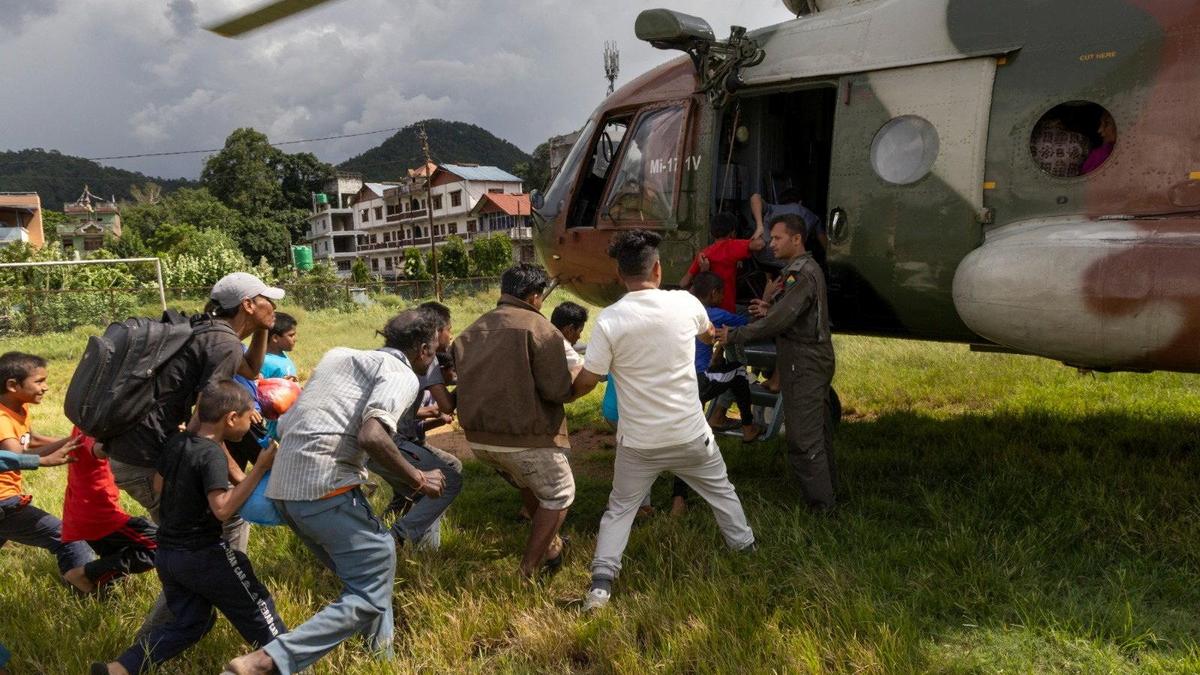
People affected by flash floods and landslides are airlifted in an army helicopter in Nuwakot district, Nepal, August 28, 2026.
| Photo Credit: Nepal Army/Handout via REUTERS
Poor weather hampered aerial rescue operations in Nepal on Saturday (August 29, 2026) as the search for hundreds of missing people in areas devastated by catastrophic flash floods along the border with China entered its fourth day.
Rescue workers and military personnel have been working around the clock since Wednesday’s (August 26, 2026) disaster, which killed nearly 600 people and left almost 2,500 missing. Some survivors have been pulled from the mud, while crews continue searching several locations for those still missing.

But Brig. Gen. Raja Ram Basnet, a Nepali Army spokesperson, said on Saturday (August 29, 2026) that helicopter operations were on hold until weather conditions improved.
Search and rescue efforts continued at several locations in Nepal and China’s Tibet, including the Upper Trishuli-1 Hydropower Project in Nepal’s Rasuwa district and the severely damaged Gyirong border crossing on the Chinese side.
The floods have killed 616 in Nepal, according to the police on Saturday (August 29, 2026). Chinese state media had earlier confirmed seven dead, taking the total killed to at least 623 dead.

The number of missing soared past 2,400 on Friday (August 28, 2026) as emergency teams said they had recovered 623 bodies — with some of the dead possibly swept downstream as far away as India.
Nepali Army spokesperson Brig. Gen. Raja Ram Basnet said rescue efforts would continue at the hydropower construction site, where authorities believe more than 100 people are trapped in a tunnel filled with thick mud.
Gen. Basnet said rescuers had used baskets and ropes to reach some people, but the operation remained difficult because of 4 to 5 feet (1.2 to 1.5 meters) of mud and the limited number of places where helicopters could land.

He said rescue teams had also been forced to relocate temporarily when authorities issued warnings about possible further flooding.
Rescuers have been on high alert for more flooding from a new lake that formed high up in the Himalayan mountains after the initial floods Wednesday. Experts warned that the lake, created after a glacier collapse that triggered the floods, was starting to overflow.
Monitoring data from the Chinese Ministry of Water Resources showed late Friday (August 28, 2026) that the lake had dwindled in size. The water level dropped by 10 meters (32 feet) from the high point on Thursday (August 25, 2026) morning, Chinese broadcaster CCTV said.

The broadcaster was showing Saturday images of rescuers getting to Gyirong Port, the hard-hit border crossing with Nepal. Some reached the area by foot and via rafts. Some were dropped down from drones flown to the area. “Anyone, anyone?” rescuers yelled, according to footage by the broadcaster.
It was not immediately known how many people were at the border checkpoint building when the floods hit.
More than 3,700 people have been rescued in Nepal so far. Hundreds of the missing are foreigners who were in the area to work, trek or make a pilgrimage to a sacred peak.
Published – August 29, 2026 10:38 am IST