


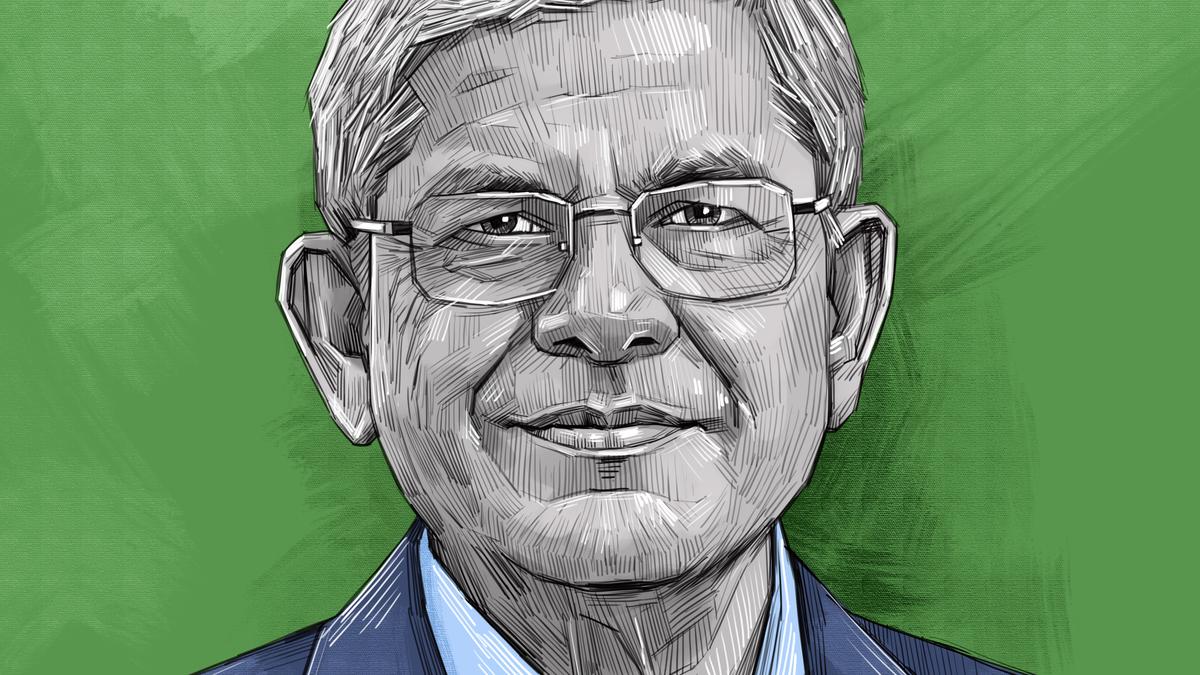
In 1961, General Ayub Khan’s military government of Pakistan wanted to further entrench its control over East Pakistan and made the celebration of Rabindranath Tagore’s birth centenary illegal. The crackdown had the opposite outcome, as colleges and universities in East Pakistan erupted. The protests shaped a generation of leaders who would take important positions subsequently as Bangladesh became a free country a decade later. Mirza Fakhrul Islam Alamgir, the new President of Bangladesh, graduated from Dhaka University during those early years when agitational politics energised the demand for a new country.
There are many legends about Mr. Alamgir, one of which is that he is a master of marathon meetings, sustained simply by cups of tea. The late Khaleda Zia was also known for her energy and her tireless engagement with the cadre of the Bangladesh Nationalist Party (BNP). But the only other person who used to spend longer hours at the BNP Chairperson’s office in Dhaka’s Gulshan was Mr. Alamgir. In 2015, one night, Begum Zia, on hearing that Mr. Alamgir was leaving the office at 2 a.m., chided him for working so late, as the Sheikh Hasina government had tightened political space and BNP leaders were under pressure. “They can detain you for plotting protests in the city if they find you without adequate party workers around,” Begum Zia told him.
Among his friends and colleagues, President Alamgir is known for his personal bravery and integrity. G.M. Quader, younger brother of the late President Gen. Ershad, who has known Mr. Alamgir for more than 50 years, says: “Sacrificing self-interest is rare in politics, but Mirza Fakhrul Islam Alamgir has sacrificed a lot for the BNP at a time when the party was under tremendous pressure. It was he who kept the party alive on the ground as Tarique Rahman lived in the U.K.”
The period following the end of the last BNP government in 2006 was not easy for the party or its cadre and officials. After the interim government, Ms. Hasina took charge in 2009, beginning an era in which the BNP remained under sustained pressure. During this period, it was Mr. Alamgir, the party’s general secretary, who handled much of its political work. His emergence as President of Bangladesh marks the high point of a political career that has seen many of the highs and lows of Bangladesh’s political history.
Starting as a student activist in East Pakistan, Mr. Alamgir was initially associated with the leftist student movement that opposed Gen. Ayub Khan’s dictatorship. He was sent to study economics in Dhaka University where he joined the East Pakistan Students Union, the student wing of the Communist Party of Bangladesh.
His father, Mirza Ruhul Amin, had tried his luck with mainstream Pakistani politics and was elected to the provincial assembly.
By the end of the 1960s, with the political breakdown inside Pakistan, Mirza Ruhul Amin’s career came to a standstill, and he joined a peace committee in Thakurgaon to preserve local peace and amity as the Pakistani military attacked commoners. Eventually, he too had to take refuge in India, like many others, because of the atrocities by the Pakistani forces.

During the 1971 war, Mr. Alamgir left Dhaka and went to Thakurgaon and organised local resistance against Pakistani police and military forces. Decades later, in 2018, in a video message against the Hasina-led government, Mr. Alamgir said he too had fought against the Pakistani forces like millions of other youngsters of Bangladesh.
Beginning of political career
Mr. Alamgir’s active political career formally began when Gen. Ziaur Rahman took charge after the November 7, 1975 military uprising in Dhaka. Later, several leftist and socialist leaders joined Ziaur Rahman’s political party, the BNP, and Mr. Alamgir was one of them. His first experience of working for a BNP government came in 1979, when he served as secretary to Deputy Prime Minister S.A. Bari. He returned to teaching after the overthrow of the BNP government following the assassination of Ziaur Rahman in 1981.
During the next eight years, he taught economics in Dhaka and nurturing his links with the BNP that was being revived by Khaleda Zia. His father had reinvented his political career at this time and served as a Minister in the government of Hossein Mohammed Ershad. Mr. Alamgir left the government job towards the end of the 1980s when he won the chairmanship of the municipality of Thakurgaon in 1988 as an Independent. He revived his links with the BNP once again in 1992 when Khaleda Zia was serving as PM.
He became a state Minister for agriculture in 2001 when Khaleda Zia became PM once again. He subsequently handled civil aviation and tourism as well. Mr. Alamgir came into national limelight during the difficult years of the BNP when Khaleda Zia was out of power and later in prison, and Tarique Rahman was forced into exile in the U.K. It was during this period, when Sheikh Hasina steered Bangladesh from 2009 onwards, that Mr. Alamgir took on much of the party’s responsibility.
In an interview with The Hindu in February this year, Mr. Alamgir, who was then in charge of the Ministry of Local Governance, Rural Development and Cooperatives, described the period under Ms. Hasina as “very difficult”. “It was difficult for us personally but it was more difficult for our families as many of our party workers and leaders were jailed on multiple occasions during the Hasina years.” On October 28, 2023, the BNP had given a call for a major rally in Dhaka that rattled the Hasina government. To scuttle the rally, the Awami League government detained him. The BNP boycotted the January 2024 election claiming that the government had rigged the polls and contesting in such circumstances was pointless. Following the overthrow of Ms. Hasina on August 5, 2024, Mr. Alamgir provided the BNP with the leadership it needed and took part in dialogues with the interim government aimed at stabilising the country.
The Hasina factor
Mr. Alamgir believes New Delhi should hand over Ms. Hasina to Dhaka. “We believe Hasina has really committed serious human rights violations. There is a popular demand to punish her and we believe that India should hand her over to us. But not handing over Sheikh Hasina to Bangladesh will not be a deterrent to build trade and commercial ties. We want to build even better ties,” said Mr. Alamgir in February 2026.
G.M. Quader described Mr. Alamgir as a pragmatist who wants to build relations with important stakeholders such as India, and said the biggest test before him as the President of Bangladesh will be whether he can bring his pragmatic approach into politics and administration. “Bangladesh’s politics needs to be more inclusive as we need to discuss all challenges before the country in a transparent manner. Hopefully, as President of the country, Mirza Fakhrul will be able to convince the government of Bangladesh to be just that,” Mr. Quader told The Hindu.
Published – August 23, 2026 02:22 am IST