



Skip to content
  • Facebook
  • X
  • Linkedin
  • WhatsApp
  • YouTube
  • Associate Journalism
  • About Us
  • Privacy Policy
  • 033-46046046
  • editor@artifex.news
Artifex.News

Artifex.News

Stay Connected. Stay Informed.

  • Breaking News
  • World
  • Nation
  • Sports
  • Business
  • Science
  • Entertainment
  • Lifestyle
  • Toggle search form
  • Naveen Patnaik On Assault On Army Officer’s Friend
    Naveen Patnaik On Assault On Army Officer’s Friend Nation
  • Tata Steel employees remember Ratan Tata as visionary, guardian
    Tata Steel employees remember Ratan Tata as visionary, guardian Business
  • IPL 2026 openers analysis | Tale at the top — the crests and troughs of willow-wielders
    IPL 2026 openers analysis | Tale at the top — the crests and troughs of willow-wielders Sports
  • Access Denied Sports
  • No Imminent Threat From ISIS To US Homeland: White House
    No Imminent Threat From ISIS To US Homeland: White House World
  • Ugandan woman held in Bengaluru over Chittoor drug seizure
    Ugandan woman held in Bengaluru over Chittoor drug seizure Nation
  • Tennis Ramkumar-Myneni Pair One Win Away From Men’s Doubles Gold
    Tennis Ramkumar-Myneni Pair One Win Away From Men’s Doubles Gold Sports
  • Women’s T20 World Cup: Indian middle-order needs to fire
    Women’s T20 World Cup: Indian middle-order needs to fire Sports
Why lab-grown diamonds are a sustainable alternative to mined stones

Why lab-grown diamonds are a sustainable alternative to mined stones

Posted on August 3, 2026 By admin


For centuries, diamonds have been regarded as symbols of eternal love, characterised by their rarity, scintillation and lustre. But behind the glamour of these stones lies a cold, hard truth: an industry plagued by forced labour, civil violence, and pollution.

Some of the world’s largest diamond mines, such as the Argyle mine in Australia and the Diavik mine in Canada, have reached a point of exhaustion in recent years. This depletion has worsened year by year, and production is now at a multi-decade low. After all, natural diamond mines are only a finite source. It is estimated that the 40 diamond mines accounting for 90% of global production spread throughout Botswana, Russia and other countries have a lifespan of no more than 50 years.

The hidden cost

However, the problems associated with natural diamonds extend beyond dwindling supplies. Diamond mining requires large amounts of water and energy and causes considerable damage to the surrounding ecosystems. It is often associated with deforestation, displacement, soil erosion and water pollution. Massive open-pit excavations can also trigger landslides and mudslides.

Moreover, labourers suffer from a plethora of diseases as a result of working in diamond mines. A study by Gill Nelson et al. in 2011 found that workers are at risk of asbestos exposure and may develop asbestos-related diseases, including asbestosis, pleural plaques, and mesothelioma.

Then come the blood diamonds, which are mined diamonds involved in illicit sales and used to fund military action. It is nearly impossible to deduce a diamond’s geographic origin. Although the Kimberley Process was introduced to verify that diamonds are conflict-free, regulatory gaps continue to allow blood diamonds to be smuggled across borders. As a result, these diamonds contribute to political and civil conflict.

These concerns raise an important question: can the beauty and durability of diamonds be preserved without the social and environmental costs of mining? In recent years, the answer appears to be yes, through the use of lab-grown diamonds.

A sustainable alternative emerges

The first proven synthetic diamonds were made by GE (General Electric) in 1954, under a project codenamed “Project Superpressure.” They utilised the HPHT (High Pressure, High Temperature) process, which mimics the conditions under which natural diamonds form in the Earth’s mantle.

In 1962, another method known as CVD (Chemical Vapour Deposition) was first used. This process involves depositing diamond material onto diamond seeds through chemical reactions involving carbon-rich gases.

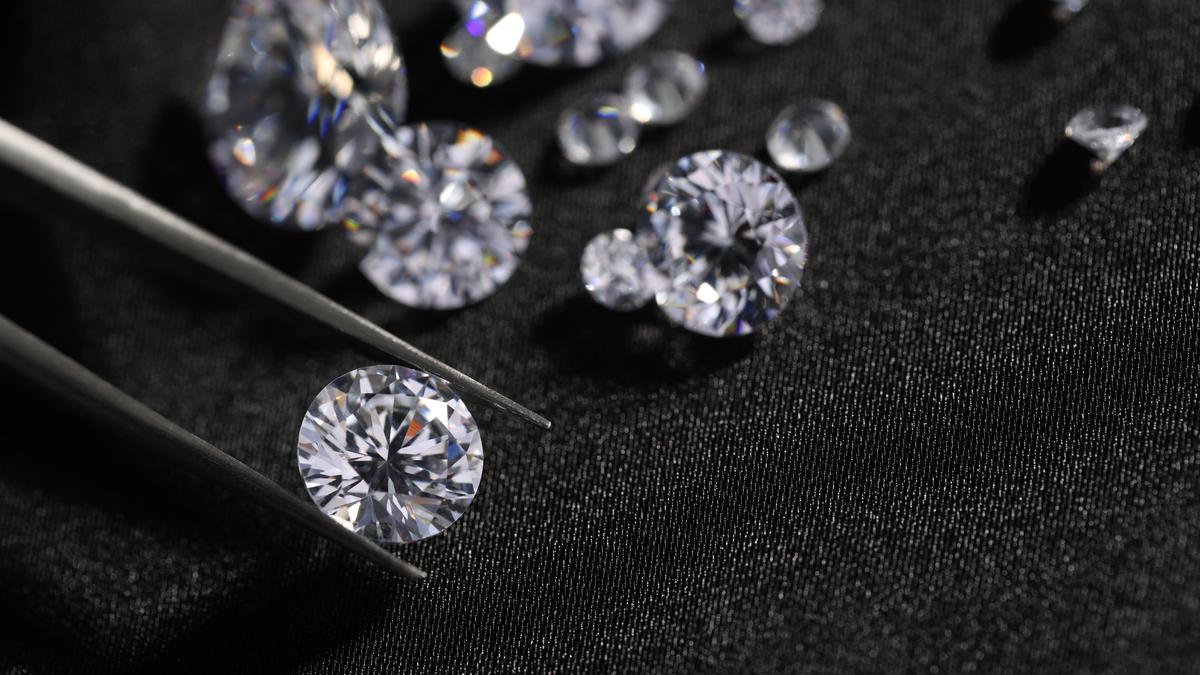
Lab-grown diamonds are chemically, physically and optically identical to their natural counterparts. Until 2018, they were sold at a modest discount to mined diamonds. Due to improvements in the efficiency of laboratory equipment, the price of lab-grown diamonds has continued to decline over the years. Now more affordable and traceable, lab-grown diamonds preserve the qualities that have made diamonds desirable since time immemorial while avoiding much of the damage linked to conventional production.

India’s push for lab-grown diamonds

India has also begun to recognise the potential of lab-grown diamonds as a sustainable and economically viable alternative to mined stones. In the Union Budget 2023-24, the Government of India announced measures to encourage indigenous production of lab-grown diamonds, including support for research into HPHT and CVD technologies.

As part of this initiative, in 2023, the Indian Institute of Technology Madras (IIT Madras) was awarded a five-year grant of approximately ₹243 crore by the Ministry of Commerce and Industry to establish the India Centre for Lab-Grown Diamond (InCent-LGD).

The centre aims to develop domestic expertise in diamond seeds, machinery, and manufacturing processes.

To put things into perspective, Table 1 consolidates the results of the 2025 Natural Diamond Council report and a 2021 study by Vladislav Zhdanov et al. to compare attributes of natural and lab-grown diamonds.

The staggering variation in carbon emissions for lab-grown diamonds can be attributed to the energy source used for production. Diamonds created using coal-heavy power grids have higher carbon emissions, while those manufactured using renewable energy sources have a much lower carbon footprint.

The latter aligns with the United Nations Sustainable Development Goals (SDGs), which emphasise the transition to cleaner energy systems and more sustainable manufacturing practices. Furthermore, the use of renewable energy in diamond production reflects the principles of a circular economy, where resources are utilised more efficiently and environmental impacts are minimised throughout a product’s life cycle.

Although lab-grown diamonds are not entirely free from environmental concerns, the next generation of consumers is increasingly drawn to them as a more sustainable alternative to mined diamonds. This shift in public perception reflects a growing emphasis on ethical sourcing, environmental responsibility, and product traceability.

Their advantages become even more significant when one considers the wide range of applications diamonds have in modern society. They are used in heavy-duty industrial processes, including cutting and drilling, as well as in quantum computing, protective coatings that extend equipment lifespan, semiconductor manufacturing and several other fields.

For a material so deeply woven into both industry and culture, selecting the more economical and sustainable option becomes no longer a choice — it is a responsibility.

(Prof. N. Arunachalam is currently working as a Professor, Department of Mechanical Engineering and also leading the HPHT technologies development activities for growing diamond in lab as part of India Centre for Lab-grown Diamond (InCent-LGD), IIT Madras. Dr. S. Boominatha Sellarajan is working as a Principal Project Scientist at InCent-LGD, IIT Madras, Dr. U. Vishnuja is working as Project Manager at InCent-LGD, IIT Madras. Miss. Anupama Janakiraman is an 11th Std. student studying at Sishya School, Adyar, Chennai).

Published – August 04, 2026 08:30 am IST



Source link

Science

Post navigation

Previous Post: Sudan army drone attack on Darfur court kills 35
Next Post: West Indies bowled out for 344 in 2nd test against Pakistan

Related Posts

  • Sci-Five | The Hindu Science Quiz: on semi-conductors
    Sci-Five | The Hindu Science Quiz: on semi-conductors Science
  • Can space oncology revolutionise cancer treatment?
    Can space oncology revolutionise cancer treatment? Science
  • The perfect flaw: how a diamond defect is changing quantum physics
    The perfect flaw: how a diamond defect is changing quantum physics Science
  • The saga of the Piltdown man, archaeology’s biggest fraud!
    The saga of the Piltdown man, archaeology’s biggest fraud! Science
  • What scientists make of R&D allocations in the 2025 Union Budget
    What scientists make of R&D allocations in the 2025 Union Budget Science
  • No brain, no problem: Tiny jellyfish can learn from experience
    No brain, no problem: Tiny jellyfish can learn from experience Science

More Related Articles

What is the best time to take examinations? What is the best time to take examinations? Science
Boeing’s beleaguered Starliner capsule leaves space station and heads home without any astronauts Boeing’s beleaguered Starliner capsule leaves space station and heads home without any astronauts Science
Scientists explain Mount Everest’s anomalous growth in new study Scientists explain Mount Everest’s anomalous growth in new study Science
New species of finless snake eel named after Kanniyakumari New species of finless snake eel named after Kanniyakumari Science
Collision with NASA spacecraft altered shape of asteroid Dimorphos Collision with NASA spacecraft altered shape of asteroid Dimorphos Science
What India needs from the ‘Vigyan Puraskar’ awards and what it can get | Explained What India needs from the ‘Vigyan Puraskar’ awards and what it can get | Explained Science
SiteLock

Archives

  • August 2026
  • July 2026
  • June 2026
  • May 2026
  • April 2026
  • March 2026
  • February 2026
  • January 2026
  • December 2025
  • November 2025
  • October 2025
  • September 2025
  • August 2025
  • July 2025
  • June 2025
  • May 2025
  • April 2025
  • March 2025
  • February 2025
  • January 2025
  • December 2024
  • November 2024
  • October 2024
  • September 2024
  • August 2024
  • July 2024
  • June 2024
  • May 2024
  • April 2024
  • March 2024
  • February 2024
  • January 2024
  • December 2023
  • November 2023
  • October 2023
  • September 2023
  • August 2023
  • July 2023
  • June 2023
  • May 2023
  • April 2023
  • March 2023
  • February 2023
  • January 2023
  • December 2022
  • November 2022
  • October 2022
  • September 2022
  • August 2022
  • July 2022
  • June 2022
  • May 2022

Categories

  • Business
  • Nation
  • Science
  • Sports
  • World

Recent Posts

  • Tamil Nadu Budget 2026: TVK government merely changed names of DMK’s schemes, criticises Udhayanidhi Stalin
  • Come 15th, we’ll be ready with all the answers: Gambhir
  • Bihar model schools makeover: Principals vow to follow renaming, repainting directives
  • Vijay government’s debut Budget strikes a balance between welfare and fiscal prudence
  • Yakshagana entering formal academic sphere a welcome move: Patla Satish Shetty

Recent Comments

  1. Arturocew on UP Teacher Who Asked Students To Slap Muslim Classmate
  2. RobertMix on UP Teacher Who Asked Students To Slap Muslim Classmate
  3. JamesSmalo on UP Teacher Who Asked Students To Slap Muslim Classmate
  4. JamesSmalo on UP Teacher Who Asked Students To Slap Muslim Classmate
  5. LouieExtip on UP Teacher Who Asked Students To Slap Muslim Classmate
  • Keir Starmer and Trump to discuss foreign affairs, investment after pomp-filled royal welcome to U.K.
    Keir Starmer and Trump to discuss foreign affairs, investment after pomp-filled royal welcome to U.K. World
  • “Same As Sachin Tendulkar And MS Dhoni”: Kapil Dev’s “Irreplaceable” Remark For India Duo
    “Same As Sachin Tendulkar And MS Dhoni”: Kapil Dev’s “Irreplaceable” Remark For India Duo Sports
  • Germany’s standing in international order under scrutiny after UNSC loss
    Germany’s standing in international order under scrutiny after UNSC loss World
  • Andrei Belousov | Putin’s war manager
    Andrei Belousov | Putin’s war manager World
  • RBI approves ₹2.11 lakh crore dividend payout to govt for 2023-24
    RBI approves ₹2.11 lakh crore dividend payout to govt for 2023-24 Business
  • Access Denied
    Access Denied Nation
  • More than seven decades of science for peace
    More than seven decades of science for peace Science
  • Access Denied World

Editor-in-Chief:
Mohammad Ariff,
MSW, MAJMC, BSW, DTL, CTS, CNM, CCR, CAL, RSL, ASOC.
editor@artifex.news

Associate Editors:
1. Zenellis R. Tuba,
zenelis@artifex.news
2. Haris Daniyel
daniyel@artifex.news

Photograher:
Rohan Das
rohan@artifex.news

Artifex.News offers Online Paid Internships to college students from India and Abroad. Interns will get a PRESS CARD and other online offers.
Send your CV (Subjectline: Paid Internship) to internship@artifex.news

Links:
Associate Journalism
About Us
Privacy Policy

News Links:
Breaking News
World
Nation
Sports
Business
Entertainment
Lifestyle

Registered Office:
72/A, Elliot Road, Kolkata - 700016
Tel: 033-22277777, 033-22172217
Email: office@artifex.news

Editorial Office / News Desk:
No. 13, Mezzanine Floor, Esplanade Metro Rail Station,
12 J. L. Nehru Road, Kolkata - 700069.
(Entry from Gate No. 5)
Tel: 033-46011099, 033-46046046
Email: editor@artifex.news

Copyright © 2023 Artifex.News Newsportal designed by Artifex Infotech.