



On May 21, India recorded its highest peak demand of 270.8 gigawatt (GW) during the day, an increase of approximately 90 GW from the same window in 2019. While power generators often meet India’s summer peak, the demand again increases at night, especially due to the use of air conditioners. This underscores the need for longer-term energy storage to ensure the grid remains reliable during prolonged periods of low solar and wind generation.
India’s current energy storage roadmap only offers a partial solution. The 2026 Long-Term National Resource Adequacy Plan envisages 80 GW of battery energy storage and 94 GW of pumped hydroelectric energy storage (PHES) by FY2035-36. This translates to average discharge durations of roughly 4 and 6 hours, respectively.
This could be enough to address short-term fluctuations but may not suffice during adverse weather conditions, such as heatwaves.
In this context, long-duration energy storage (LDES) technologies, which are capable of delivering power for days rather than hours, could turn out to be the missing pillar of India’s green energy transition.
Diverse landscape
LDES refers to technologies that store energy and discharge it as power or thermal energy over extended periods, from 8 hours to days, weeks, or seasons. By storing energy when renewable generation is abundant and supplying it during periods of peak demand or low generation, LDES can provide the reliability and flexibility to support a renewable-heavy grid.
Further, unlike short-duration energy storage systems, which discharge energy for less than 8 hours and smooth intra-day demand fluctuations, LDES provides the endurance needed to balance supply and demand for prolonged periods, ease grid congestion, and provide grid resilience and stability.
Several LDES technologies are available today, each at different stages of development and commercial readiness, including PHES, compressed-air energy storage (CAES), thermal storage, hydrogen-based storage, and flow batteries.
Of these, PHES remains the benchmark because of its mature infrastructure and a high energy efficiency of 70-80%. CAES has a similar level of market readiness but a slightly lower efficiency of 40-70%. Thermal storage stands out for its long discharge duration — around 200 hours — and an energy efficiency of 55-90%. However, researchers are still developing it.
Although chemical energy storage, such as with hydrogen, has even higher discharge durations of up to 1,000 hours, it is not efficient. Vanadium flow batteries — an example of electrochemical energy storage — are commercially ready, come in different sizes, and have an efficiency of 80-85% across durations of 10-24 hours.
Scientists are also working on more cutting-edge solutions like iron-air batteries. In all, the LDES landscape is diverse and worth looking forward to.

A schematic diagram of a vanadium flow battery.
| Photo Credit:
Kavin Teenakul (CC BY-SA)
Costs of long-term storage
The longer the time over which a technology discharges energy, the better its economics. At the same time, storing more energy also costs more. So for discharge durations beyond six hours, short-duration energy storage systems are unlikely to prove cost-effective.
The LDES Council is an international body that brings together industry leaders, technology developers, investors, policymakers, and other stakeholders to accelerate the innovation and commercialisation of LDES technologies. It has projected a significant decrease in LDES costs by 2030, making it an economically feasible storage solution.
According to a study by Pacific Northwest National Laboratory, a research body under the U.S. Department of Energy, PHES and CAES are the most cost-effective and commercially viable technologies at present, at $0.12/kWh and $0.10/kWh, respectively.

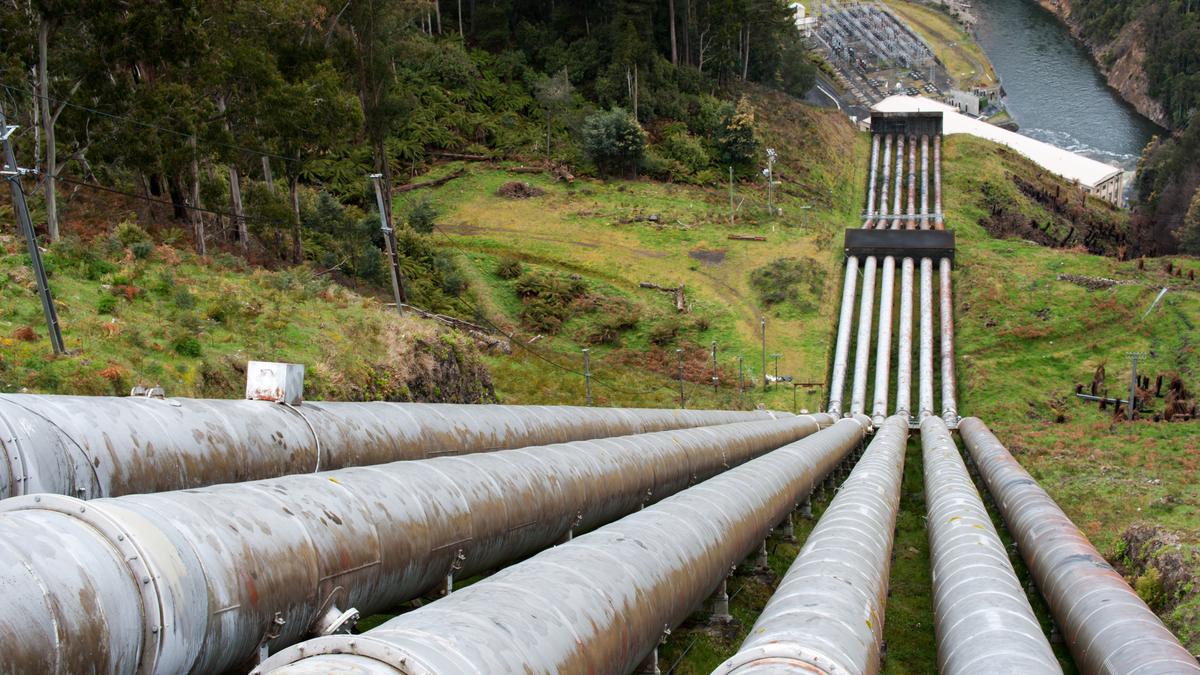
However, both technologies need specific site conditions. PHES requires two water reservoirs at different heights so that water can be pumped to the upper reservoir when surplus electricity is available and released downhill to generate power when needed. Thus, the site must have enough land for the reservoirs, an optimal height difference for the water to flow down with force, and of course water.
Likewise, CAES needs large underground spaces, such as salt caverns or depleted gas fields, that can safely hold high-pressure air without major leaks.

Energy from a source such as sunlight is used to compress air, giving it potential energy. The stored potential energy is later converted to electricity via a generator.
| Photo Credit:
RCraig09 (CC BY-SA)
Where such sites are not available, other LDES options, such as hydrogen, thermal storage or vanadium flow batteries — which depend less on specific land, water, and subterranean conditions, may be more suitable.
India’s position on LDES
The California Public Utilities Commission, California’s primary utility regulator responsible for overseeing electricity, natural gas, telecommunications, and other public utility services, has set an LDES procurement target of 2 GW. It has said this capacity will be deployed between 2031 and 2037.
Similarly, to unlock investments and accelerate deployment, the U.K. has launched a financial framework for LDES that provides a safety net for investors. Among other measures, it will ensure LDES projects have a minimum revenue, even in poor market conditions.
Per a 2026 report by the Central Electricity Authority, India’s PHES potential is about 267 GW. The report also said India plans to install PHES projects with an aggregate capacity of 100.8 GW by 2035-2036. Of this, 11.6 GW is currently under construction.
In early 2025, India also launched a 160-MWh carbon dioxide battery storage system at the National Thermal Power Corporation (NTPC) in Kudgi, Karnataka. It works by cycling carbon dioxide between liquid and gas phases and has an operational life exceeding 25 years. This was followed by inaugurating the country’s first MWh-scale vanadium redox flow battery system — a 3-MWh facility installation at NTPC in Greater Noida.

Proposed roadmap
Policy and regulations: While the Long-Term National Resource Adequacy Plan acknowledges the role of energy storage in maintaining power grid reliability, it does not specifically recognise the need for LDES.
To address this gap, LDES should be incorporated into the Ministry of Power’s National Framework for Promoting Energy Storage Systems, accompanied by guidelines on its deployment and integration into grid operations.
Similarly, while the National Electricity Plan outlines projected capacities for battery ESS and PHES, it does not provide technology-specific assessments or deployment pathways for LDES.
Given the growing importance of LDES in a renewable-rich power system, future planning exercises should include estimates of LDES requirements and identify technologies best suited to India’s extreme weather and geographical conditions.
Faster environmental and land clearances, transmission alignment, and clear regulatory classification are also important to unlock investments.
Market development and finance: The incentive structure, including subsidies and viability-gap funding, must be technology-agnostic and incentivise co-location opportunities with data centres. As the market matures, the focus must shift to long-term revenue contracts, tariff structures, and procurement frameworks.
Stakeholder awareness: Intense efforts should be made to build awareness among all stakeholders of the available LDES solutions, and their grid use cases should be presented. As part of this effort, dispatch centres should be directed to post staff for skill enhancement and training to support optimal dispatch, multi-day charge–discharge decisions, state-of-charge management across seasons, and coordination across storage assets with proper guidelines and protocols for LDES.
Without planning to include LDES, however, India’s clean energy future could be forced to rest on favourable weather and market conditions.
Aedna Kurian is an analyst and Ammu Susanna Jacob is a senior research scientist in the Energy Storage group, at the Center for Study of Science, Technology and Policy (CSTEP), a research-based think-tank.