




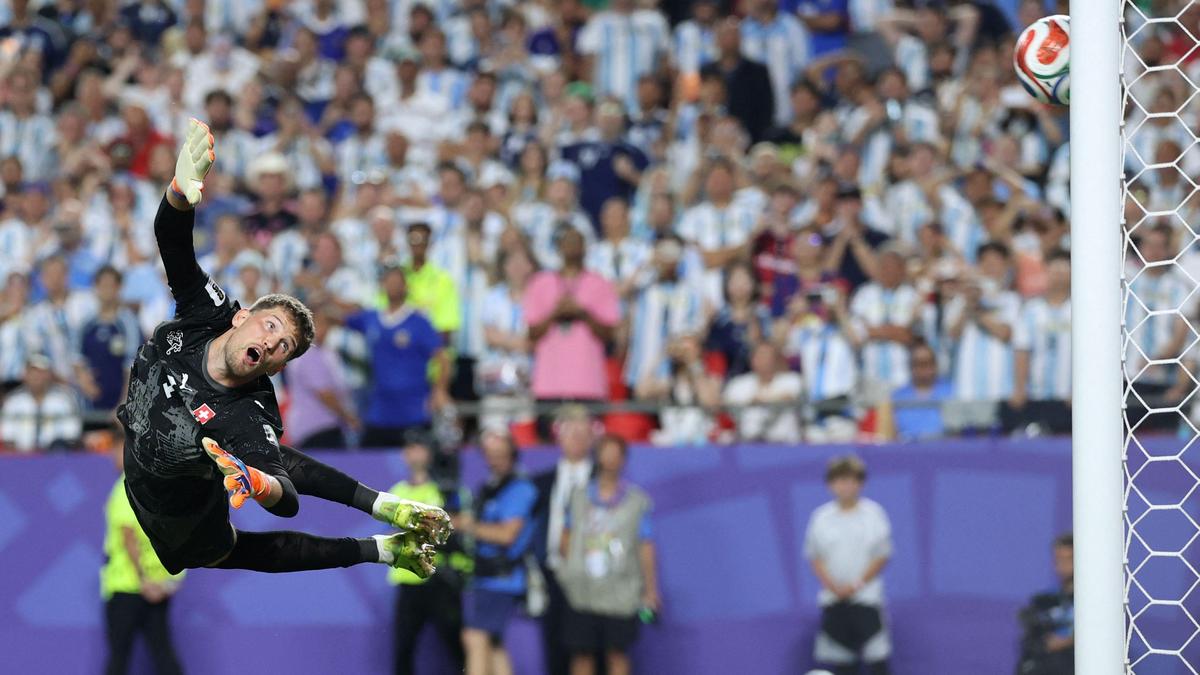
Switzerland’s goalkeeper Kobel fails to keep out Argentina’s Alvarez shot from outside the box.
| Photo Credit: AFP
The World Cup has not only grown larger but has also been more prolific.
Ahead of the final, the tournament has produced 307 goals in 103 matches, an average of 2.98 per game, comfortably higher than Qatar 2022, where 172 goals were scored across 64 matches at an average of 2.69.
Sixteen per cent of the goals have come from outside the penalty area, while the Qatar edition had recorded eight percent goals from outside the box.
Former World Cup winner Jurgen Klinsmann, a member of the Technical Study Group, attributed the increase to teams defending deeper and crowding the penalty area, leaving opponents with little choice but to shoot from range.
“There’s no space. Eight, nine players are in the box or outside the box, so it is definitely a recipe for shots from the outside,” the former Germany and United States coach said. “There has been a little bit of a defensive attitude from quite a lot of coaches with a lower block to defend.”
The congestion, Klinsmann added, also makes it harder for goalkeepers to see the ball as it travels through a forest of bodies. “More goals happening from shots from distance, 20-22 yards outside the box through a lot of people, which makes it very difficult for goalkeepers,” he said. “It’s something fun for us coaches to watch. We saw some beautiful goals that way.”
No team has embraced the trend more effectively than Argentina. Lionel Scaloni’s side has scored five goals from outside the penalty area through Lionel Messi (2), Giovani Lo Celso, Julian Alvarez and Enzo Fernandez, equalling the highest tally by any team at a single World Cup since such records have been kept (1966).
In a tournament of nearly three goals per match, some of its most important ones have arrived from the least inviting distances.
Published – July 19, 2026 05:56 pm IST