


Wildlife ecology in India looks different today than it did a decade ago. Climate change, habitat fragmentation, invasive species, and rapid development are all reshaping ecosystems faster than scholars can document them. Thus, ecologists are interested in how biodiversity has changed as well as how it is likely to change next.
Just these questions shaped the second Indian Wildlife Ecology Conference (IWEC), at Ashoka University in Sonepat, Haryana, on July 10-12, where researchers from across India came together to discuss the future of wildlife ecology in the country. Conceived by the late wildlife biologist Ajith Kumar as a national platform for India’s wildlife ecologists to exchange ideas, IWEC has grown into a forum where researchers from universities, government agencies, NGOs, and field stations together figure out where the discipline is heading — using insights into evolutionary history, long-term monitoring, public policy, technology, and public health.
The inaugural conference, held in 2024, demonstrated the breadth of this community. At the second conference, this year, the participants repeatedly returned to the same question: how can ecologists anticipate ecological change? As Indian ecology reaches towards prediction across biological scales, disciplines, and even the divide between science and policy, much of that ambition still depends on staying close to the ground, to fieldwork and local institutions.
Biodiversity at scale

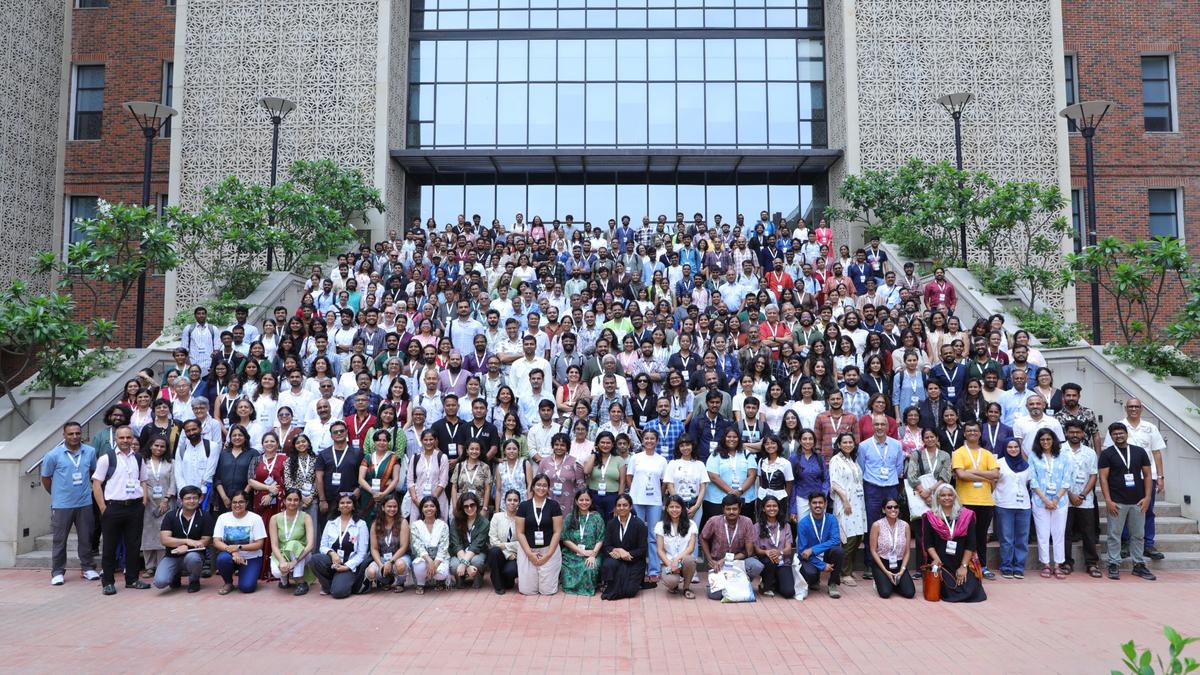
The IWEC 2026 venue.
| Photo Credit:
Ankita Rathore/Special arrangement
The conference’s three paired plenary sessions showed how wildlife ecology is expanding across biological scales, taking in evolutionary history, ecosystem change, bird conservation, citizen science, and animal physiology. The throughline was that predicting the future requires evidence spanning both the deep past and the decisions animals every day make to survive.
The opening plenary traced biodiversity through deep evolutionary time. Jahnavi Joshi (CSIR-Centre for Cellular and Molecular Biology, Hyderabad) spoke of how geological history and climate gradients shaped the diversity of woody plants in the Western Ghats. Using phylogenetic analyses, she examined whether different parts of the mountain range function as evolutionary ‘cradles’, where new species originate, or ‘museums’, where ancient lineages persist. She argued that both patterns can help predict how species will respond to future environmental change.
Mahesh Sankaran (National Centre for Biological Sciences, Bengaluru) turned to the future of India’s montane grasslands under climate change, drawing on projections from the UN Intergovernmental Panel on Climate Change to show how rising temperature, increasingly variable rainfall, and extreme weather will reshape these already vulnerable ecosystems, alongside other human-driven pressures such as altered nutrient cycles and land-use change.
Evolutionary history has set the stage and long-term monitoring is today tracking how biodiversity is changing. Ashwin Viswanathan (Nature Conservation Foundation, Mysuru) spoke of citizen-science platforms such as eBird India generating observations at scales impossible in conventional field studies, helping researchers track migration and species distributions. His example of choice was the rusty-tailed flycatcher, whose migration across Uttarakhand and eastern India researchers reconstructed using citizen-science data.

Ashwin Viswanathan delivering his talk ‘What birds can teach India’s citizen science movement’.
| Photo Credit:
Ankita Rathore/Special arrangement
Asad Rahmani (Bombay Natural History Society) — who has been surveying the pressures on the country’s birds such as habitat loss, infrastructure, and climate change — pointed to the drying of Kashmir’s Shallabugh wetland and urged scientists and citizens alike to speak up for wildlife. Anusha Shankar (Tata Institute of Fundamental Research, Hyderabad) described physiology as an underutilised lens connecting processes across biological scales, drawing on energy expenditure and body temperature measurements in hummingbirds.
Maria Thaker (Indian Institute of Science, Bengaluru) likewise drew on studies of the spiny-tailed lizard to show how desert reptiles regulate body temperature and adjust their nutritional requirements across seasons. “Lizards, like other ectothermic vertebrates, can behaviourally thermoregulate, but will not be able to handle future climate warming,” she said.
Rather than just record where species occur, researchers are also increasingly trying to understand the mechanisms that determine how organisms and ecosystems respond to environmental change. The emphasis is moving from description towards prediction. Yet every one of these predictive tools, including from physiological measurements to citizen-science records, rests on long, even tedious periods of observation.

Understanding to action
However, scientific understanding alone cannot conserve biodiversity. A special session, called ‘Leveraging Global Policies for Local Conservation in India’, turned the focus to how ecological knowledge can inform decision-making in India while recognising that conservation everywhere is shaped by the interplay of science, governance, and society. The discussion, moderated by Asmita Kabra (Ashoka University), asked how international biodiversity commitments could be adapted to India’s ecological and social realities. Its speakers agreed global frameworks succeed only where local institutions and evidence-based implementation back them up.
In particular, Jagdish Krishnaswamy (Indian Institute for Human Settlements, Bengaluru) called for experts to move beyond species-centred conservation to protect the ecological processes that sustain entire landscapes. Following the success of India’s protected areas, he argued that the next frontier is conserving landscapes beyond their boundaries and integrating biodiversity, livelihoods, and climate resilience.

Attendees at the conference read a poster.
| Photo Credit:
Ankita Rathore/Special arrangement
Vivek Menon (Wildlife Trust of India), in turn, said conservation centred on species remains indispensable because “the natural world sustains us, but we are losing the species that sustain it”. He added that while conservation cannot completely halt biodiversity loss, “it significantly reduces how fast it occurs”.
International agreements can provide a common framework, Menon and Krishnaswamy argued, but lasting conservation depends on effective local institutions and the communities that share these landscapes with wildlife. In other words, predictions and commitments are both only as effective as the institutions and communities that can act on it.

Spider silk on the breeze
While the plenary sessions highlighted what wildlife ecologists are studying, the conference’s panel discussions noted how the discipline itself was changing. Advances in artificial intelligence, genomics, environmental DNA, and computational tools are transforming ecology research, allowing scientists to ask questions that would have been difficult, or even impossible, just a decade ago. Yet throughout the conference, speakers also cautioned against viewing technology as a replacement for ecological understanding.
In a discussion called ‘Extinction of Experience: The Decline of Field-based Ecology’, moderated by Robin Vijayan (Indian Institute of Science Education and Research, Tirupati), panellists discussed how ecology is adapting to rapid advances in artificial intelligence and genetics. These tools have expanded the scope of ecological research, the panel noted, but could not substitute for the understanding that comes from directly engaging with nature. “Unless and until we have field logic, we won’t be able to analyse our data well,” Bilal Habib (Wildlife Institute of India) said.
Another panel examined the complex issue of free-ranging dogs through the intersecting lenses of ecology, public health, animal welfare, and urban governance. And rather than advocate a single approach, the discussion laid out the scientific and policy challenges of managing free-ranging dog populations in Indian cities and their edges.
Panellists also reflected on how terminology shaped public discourse. Chandrima Home (Srishti Manipal Institute of Art, Design, and Technology, Bengaluru) argued that the label “free-ranging dogs” captured these populations more accurately than “stray” or “feral”, since only a small fraction comes into conflict with wildlife or livestock. Other speakers discussed the role of Animal Birth Control programmes alongside the need to improve waste management and stronger municipal governance, arguing that dog populations track food availability as closely as any carnivore does in the wild. As Anindita Bhadra (IISER Kolkata) put it, “We want our cities to be smart, but we can’t manage our garbage.”
Both, in fact, made the same case from opposite directions: that technology cannot replace field logic and that a problem like free-ranging dogs cannot be solved by ecology alone.

Across disciplines

Wild deer graze at a field inside the Similipal tiger reserve sanctuary in Odisha, January 20, 2021.
| Photo Credit:
BISWARANJAN ROUT/The Hindu
The conference’s parallel symposia carried this range of inquiry further as researchers also presented work on river ecosystems, disease ecology, bats, insects, behavioural ecology, environmental DNA, wildlife corridors, and conservation technologies, drawing ecology into the conversation through genetics, physiology, epidemiology, and the social sciences.
Sara Kamat, a PhD scholar at Bharati Vidyapeeth (Deemed-to-be University), Pune, has used advanced molecular methods to map how seasonal changes in diet shape the gut microbiome of Indian grey wolves, offering insights into how carnivores persist in changing environments. Swapnil Kiran (CSIR-CCMB Hyderabad) spoke about her work on quantifying the economic burden of snakebite mortality and morbidity in rural India using a community-based ecological epidemiology approach. Sibasish Sahoo (Amity University, Noida) has documented how Asian elephants change the way they behave in the mining landscapes of Keonjhar, Odisha, to navigate increasingly fragmented habitats, utilising a mix of field-based, spatial, and analytical ecological methods. The three researchers’ work was a reminder of how wide ecological methods range today.
Overall, over three days and 197 talks, the throughline described a discipline that has become ambitious — especially more integrative and more willing to speak to policy and public health — even as it remains, at its core, a science of the ground. In a special address, philanthropist and one of the conference’s sponsors Rohini Nilekani likened wildlife ecologists to the breeze that carries a spider’s silk, allowing it to cast a web that would otherwise be impossible to build. Likewise, individual strands of conservation become meaningful only when they connect.
Ankita Rathore is a science communicator and writer whose work focuses on science and technology policy, research, and higher education.