



Skip to content
  • Facebook
  • X
  • Linkedin
  • WhatsApp
  • YouTube
  • Associate Journalism
  • About Us
  • Privacy Policy
  • 033-46046046
  • editor@artifex.news
Artifex.News

Artifex.News

Stay Connected. Stay Informed.

  • Breaking News
  • World
  • Nation
  • Sports
  • Business
  • Science
  • Entertainment
  • Lifestyle
  • Toggle search form
  • Access Denied
    Access Denied Nation
  • Access Denied
    Access Denied Nation
  • Access Denied
    Access Denied Nation
  • Access Denied
    Access Denied Nation
  • Mexico Discusses Aliens After Lawmaker Presents ‘Extra-Terrestrial’ Bodies
    Mexico Discusses Aliens After Lawmaker Presents ‘Extra-Terrestrial’ Bodies World
  • Artificial Intelligence “Exciting, Scary” Threat And Opportunity For Journalists: Study
    Artificial Intelligence “Exciting, Scary” Threat And Opportunity For Journalists: Study World
  • Russia says Ukraine used Western rockets to destroy bridge in Kursk region
    Russia says Ukraine used Western rockets to destroy bridge in Kursk region World
  • Hundreds Feared Trapped As Massive Landslides Hit Kerala’s Wayanad
    Hundreds Feared Trapped As Massive Landslides Hit Kerala’s Wayanad Nation
Military technology’s environmental impact: A bird’s nest made of fibre-optic cable

Military technology’s environmental impact: A bird’s nest made of fibre-optic cable

Posted on July 9, 2026 By admin


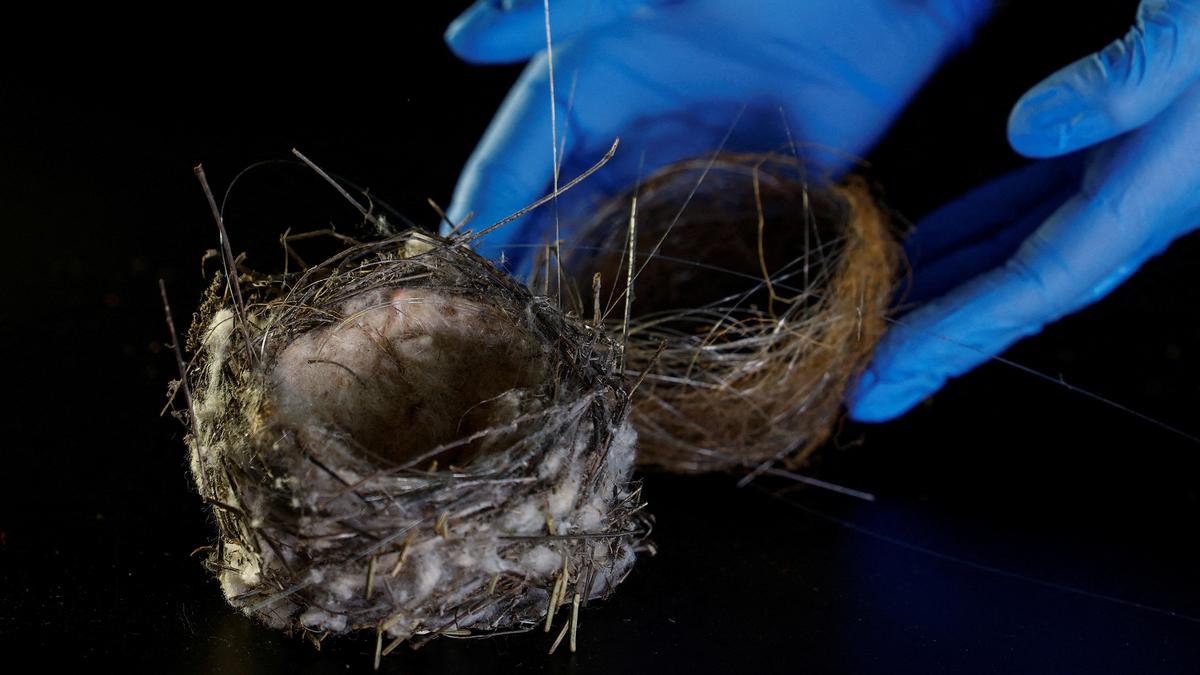
A researcher shows a bird’s nest containing fragments of fibre-optic cable collected near the front line during Russia’s war against Ukraine, in Kyiv.
| Photo Credit: Reuters

cienceA bird’s nest found near Ukraine’s front line has caught the attention of researchers, not because of the bird that built it but because of what it was made from. Mixed in with the usual twigs, grass and small branches were strands of fibre-optic cable, the same kind now used by military drones flying over some of the most fiercely contested parts of the battlefield.

Also read | Ukraine’s vast forests devastated in hellscape of war

Birds have always built nests with whatever they can find. Plastic bags, bits of cloth, fishing line and electrical wire have all been found woven into nests in different parts of the world. But military-grade fibre-optic cable is something researchers have not seen before.

The nest was first reported by Reuters, and while it looks like an unusual wildlife story at first glance, it also raises a much bigger question. Once military technology has done its job, what happens to everything it leaves behind? In many parts of eastern and southern Ukraine, the answer is already scattered across the landscape. Fields, forests and abandoned villages are now littered with broken drones, damaged batteries, shattered propellers, pieces of carbon fibre and long strands of fibre-optic cable left behind after drone missions. It is a kind of battlefield waste that did not exist on this scale before the war, reflecting how quickly drones have transformed modern combat.

When Russia invaded Ukraine in February 2022, drones were already being used to monitor enemy positions, gather intelligence and direct artillery fire. But as the war settled into a long and grinding conflict, drones became much more than flying cameras.

Cheap first-person-view, or FPV, drones fitted with explosives quickly became one of the most effective weapons on the battlefield. They could be flown directly into tanks, bunkers and military vehicles, giving soldiers a relatively inexpensive way to destroy equipment worth millions of dollars. Almost overnight, drones became essential to both armies.

That also meant finding ways to stop them became just as important. Instead of trying to shoot every drone out of the sky, both Russia and Ukraine invested heavily in electronic warfare, which focuses on disrupting the connection between a drone and its operator. Radio signals can be jammed, satellite navigation can be interfered with and communication links can be cut, making it much harder for drones to complete their missions.

As electronic jamming became more effective, drone operators looked for another solution. That is where fibre-optic drones came in. Unlike conventional FPV drones, these drones carry a spool of ultra-thin fibre-optic cable that slowly unwinds as they fly. Instead of receiving commands through radio waves, they remain connected to the operator through the cable itself, making them far more resistant to electronic jamming.

The technology itself is not entirely new. Fibre-optic guidance has existed in military systems for years. What is new is how widely it is now being adapted for drones in Ukraine, where both armies are constantly searching for an advantage. The system solves one problem but creates another.

Unlike radio signals, fibre-optic cable does not disappear once a mission is over. Every drone leaves a trail behind. Some cables remain stretched across open fields, others become tangled in trees or wrapped around bushes, while many simply lie where they fall after a drone is destroyed or reaches its target. After thousands of drone missions, those cables have become another part of the landscape.

That is how some of them eventually found their way into a bird’s nest. The birds were not looking for military equipment. Like birds anywhere else, they were simply collecting material lying on the ground around them. Researchers are now trying to understand whether those cables create new risks for wildlife or whether birds are simply treating them like any other synthetic material. The cables are lightweight and strong, which could help hold nests together, but they could also create problems such as entanglement or remain in the environment for years before breaking down.

For now, there are very few answers because this is something scientists have only just begun to study. What is clear is that the war is leaving behind more than destroyed buildings and damaged infrastructure. It is also leaving behind materials that are slowly becoming part of the environment itself.

The First World War left behind trench systems and contaminated land across Europe. In Vietnam, Agent Orange devastated forests and caused environmental damage that lasted for decades. In countries such as Cambodia and Bosnia, landmines and unexploded ammunition continue to threaten people and wildlife years after peace agreements were signed. The environmental impact changes with every conflict because the way wars are fought keeps changing. Ukraine could eventually add something new to that list.

Published – July 09, 2026 07:34 am IST



Source link

Science Tags:environmental impacts of the russia ukraine war, environmental pollution by drones, russia ukraine war environmental issues, war environmental pollution, war impacts on environment

Post navigation

Previous Post: West Asia war LIVE: Missile alerts sound in Bahrain and Qatar after U.S. launches new round of airstrikes against Iran
Next Post: Western Europe records its hottest June as heatwaves surge

Related Posts

  • ICAR, Penn State team makes tool small enough to edit plant genomes
    ICAR, Penn State team makes tool small enough to edit plant genomes Science
  • New state of matter is a solid-liquid hybrid
    New state of matter is a solid-liquid hybrid Science
  • What is the technology behind manufacturing a semiconductor chip? | Explained
    What is the technology behind manufacturing a semiconductor chip? | Explained Science
  • ‘We look forward to work with ISRO and get the Indian astronaut into space’
    ‘We look forward to work with ISRO and get the Indian astronaut into space’ Science
  • China’s spacecraft carrying rocks from the far side of the moon leaves the lunar surface
    China’s spacecraft carrying rocks from the far side of the moon leaves the lunar surface Science
  • The first man to experience jet streams
    The first man to experience jet streams Science

More Related Articles

India to convey its plans to build a new research station in Antarctica at Antarctic Treaty Consultative Meeting India to convey its plans to build a new research station in Antarctica at Antarctic Treaty Consultative Meeting Science
How is global warming affecting sea breeze? How is global warming affecting sea breeze? Science
A planet on the edge: are Saturn’s rings older than they look? A planet on the edge: are Saturn’s rings older than they look? Science
‘Rest of the world rooting for Gaganyaan mission,’ says Group Captain Prasanth Balakrishnan Nair ‘Rest of the world rooting for Gaganyaan mission,’ says Group Captain Prasanth Balakrishnan Nair Science
Ahead of Gaganyaan, ISRO CE-20 engine already has a notable legacy Ahead of Gaganyaan, ISRO CE-20 engine already has a notable legacy Science
First robot leg with ‘artificial muscles’ jumps nimbly: study First robot leg with ‘artificial muscles’ jumps nimbly: study Science
SiteLock

Archives

  • July 2026
  • June 2026
  • May 2026
  • April 2026
  • March 2026
  • February 2026
  • January 2026
  • December 2025
  • November 2025
  • October 2025
  • September 2025
  • August 2025
  • July 2025
  • June 2025
  • May 2025
  • April 2025
  • March 2025
  • February 2025
  • January 2025
  • December 2024
  • November 2024
  • October 2024
  • September 2024
  • August 2024
  • July 2024
  • June 2024
  • May 2024
  • April 2024
  • March 2024
  • February 2024
  • January 2024
  • December 2023
  • November 2023
  • October 2023
  • September 2023
  • August 2023
  • July 2023
  • June 2023
  • May 2023
  • April 2023
  • March 2023
  • February 2023
  • January 2023
  • December 2022
  • November 2022
  • October 2022
  • September 2022
  • August 2022
  • July 2022
  • June 2022
  • May 2022

Categories

  • Business
  • Nation
  • Science
  • Sports
  • World

Recent Posts

  • Western Europe records its hottest June as heatwaves surge
  • Military technology’s environmental impact: A bird’s nest made of fibre-optic cable
  • West Asia war LIVE: Missile alerts sound in Bahrain and Qatar after U.S. launches new round of airstrikes against Iran
  • Monsoon tracker LIVE | Orange alert issued in Delhi
  • Russia denounces NATO summit decisions on aid for Ukraine, defence

Recent Comments

  1. Matthewben on UP Teacher Who Asked Students To Slap Muslim Classmate
  2. Matthewben on UP Teacher Who Asked Students To Slap Muslim Classmate
  3. Matthewben on UP Teacher Who Asked Students To Slap Muslim Classmate
  4. Matthewben on UP Teacher Who Asked Students To Slap Muslim Classmate
  5. Matthewben on UP Teacher Who Asked Students To Slap Muslim Classmate
  • Access Denied
    Access Denied Nation
  • Access Denied Sports
  • Access Denied
    Access Denied Nation
  • “No Regrets”: Sam Konstas’ Bold Take On Shoulder-Barge With Virat Kohli
    “No Regrets”: Sam Konstas’ Bold Take On Shoulder-Barge With Virat Kohli Sports
  • Virat Kohli vs Australia Fans Yet Again? India Great Shuts Up Crowd After Star Departs, Rohit Sharma Reacts. Watch
    Virat Kohli vs Australia Fans Yet Again? India Great Shuts Up Crowd After Star Departs, Rohit Sharma Reacts. Watch Sports
  • It Makes More Sense For IOC To Give 2036 Olympics To India: Anurag Thakur
    It Makes More Sense For IOC To Give 2036 Olympics To India: Anurag Thakur Sports
  • Access Denied Sports
  • Row Over Hatemonger Yati Narsinghanand’s Remark, Stones Thrown In Maharashtra, 21 Cops Injured
    Row Over Hatemonger Yati Narsinghanand’s Remark, Stones Thrown In Maharashtra, 21 Cops Injured Nation

Editor-in-Chief:
Mohammad Ariff,
MSW, MAJMC, BSW, DTL, CTS, CNM, CCR, CAL, RSL, ASOC.
editor@artifex.news

Associate Editors:
1. Zenellis R. Tuba,
zenelis@artifex.news
2. Haris Daniyel
daniyel@artifex.news

Photograher:
Rohan Das
rohan@artifex.news

Artifex.News offers Online Paid Internships to college students from India and Abroad. Interns will get a PRESS CARD and other online offers.
Send your CV (Subjectline: Paid Internship) to internship@artifex.news

Links:
Associate Journalism
About Us
Privacy Policy

News Links:
Breaking News
World
Nation
Sports
Business
Entertainment
Lifestyle

Registered Office:
72/A, Elliot Road, Kolkata - 700016
Tel: 033-22277777, 033-22172217
Email: office@artifex.news

Editorial Office / News Desk:
No. 13, Mezzanine Floor, Esplanade Metro Rail Station,
12 J. L. Nehru Road, Kolkata - 700069.
(Entry from Gate No. 5)
Tel: 033-46011099, 033-46046046
Email: editor@artifex.news

Copyright © 2023 Artifex.News Newsportal designed by Artifex Infotech.