




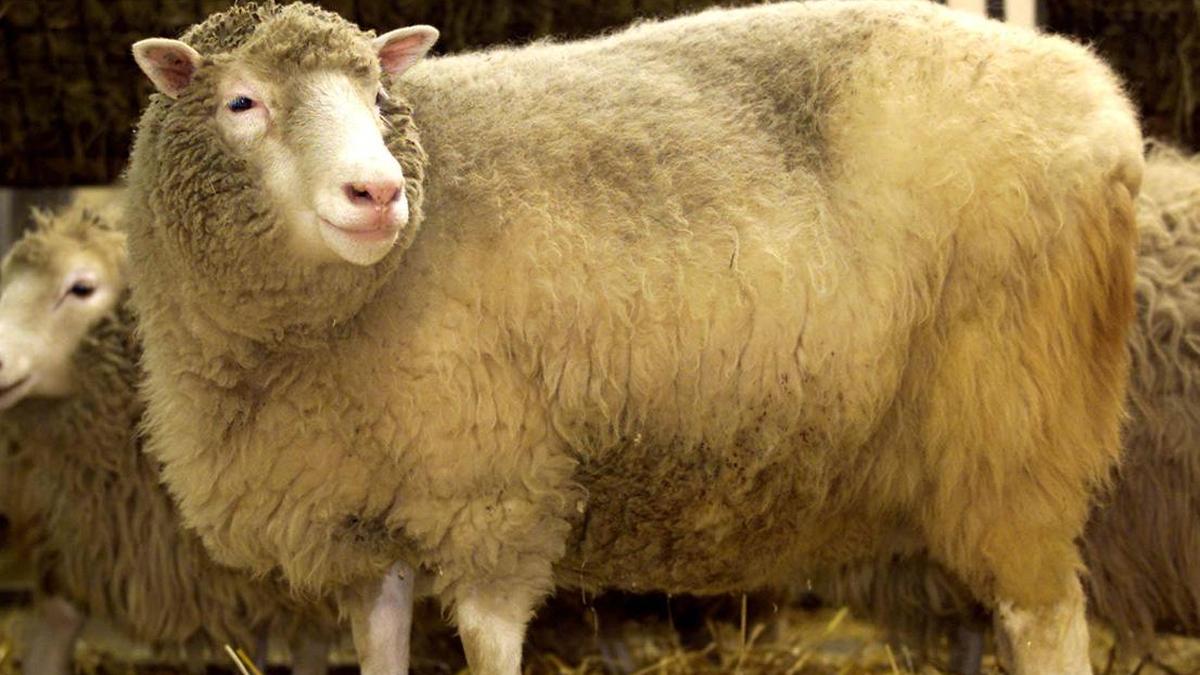
Have you ever encountered clones? In case you wish to jump the gun and answer in the negative, it might be prudent to think a wee bit longer. This is because the concept of cloning is intertwined with something that occurs naturally.
With that clue, you might have deduced that the closest we have to human clones today – or always have had for that matter – are identical twins. Agreed, their genetic makeup isn’t 100% the same, but monozygotic twins are nature’s genetic clones – these individuals are almost genetically identical to each other.
These twins, as the name suggests, come from a single zygote, or fertilised egg. When this egg splits in half and develops as two zygotes instead of one in utero, we have two persons in the place of one. Twins are, however, kind of clones of one another, and not that of another individual – the meaning more often associated with the word.
It is in this context that Dolly the sheep has become the poster child of cloning. While she might be the sheep that you instantly identify with cloning, she wasn’t the first animal to be cloned. In fact, she wasn’t even the first mammal to be cloned.
In the early 1960s, British developmental biologist John Gurdon made cloning possible and succeeded in producing tadpoles from the adult cells of a frog. Among mammals, the first ever cloned animal was another sheep that was cloned from an embryo cell. This sheep was born in Cambridge, U.K. in 1984.
Why is Dolly special?
Dolly, in fact, wasn’t even the first sheep that scientists at the Roslin Institute at Midlothian, Scotland cloned. Two other sheep, Megan and Morag, were cloned from embryonic donor cells in 1995, the same year that the institute had success with Dolly.
Why then – you might be wondering – is Dolly treated with such reverence? That’s because she was the first mammal to have been cloned from an adult cell, something that was thought to be impossible at that time.
As recently as the early 1990s, the dominant school of thought was that it was impossible to clone from adult cells that had already differentiated into specific cells. The likes of Megan and Morag were cloned from DNA that was extracted from cells in early stages of development, even before they differentiated.
Researchers at Roslin Institute were working on producing genetically modified farm animals that could then pass on a desired trait to the generations that followed. Cloning was their next step in this research.
In order to clone Dolly, English embryologist Ian Wilmut and his colleagues took a cell from the udder – mammary gland – of an adult Finn Dorset sheep and extracted its nucleus. Following the extraction, it was implanted into an empty egg cell from a Scottish Blackface sheep. Normal development in a test tube was confirmed after six days, after which the embryo was transferred into a surrogate mother, another Scottish Blackface.
Best kept secret
As Finn Dorsets have a white coat and the Scottish Blackface have a black coat, telling if the lambs were those of the surrogate mother or a clone of the donor was going to be easy. There was, however, the gestation period to contend with.
A number of normal eggs were produced and implanted into surrogate ewes by scientists. They needed 276 attempts to create a successful clone from an adult cell, but when one of the surrogates gave birth to a lamb 148 days later on July 5, 1996, the white coat and the white face was a clear indicator that they had achieved something historic.
Originally codenamed 6LL3, the lamb was given the name Dolly after American singer and actress Dolly Parton. Despite the sensational nature of what they had achieved, those involved had to stay mum for a little longer… for their own sake.
Even in the 1990s, research funding for institutes like Roslin depended upon publication in prestigious scientific journals like Nature. These top-tier journals demanded that word should not go out before the publication date.
In Dolly’s case, everyone involved was certain that it would be big news once the word got out. They maintained absolute silence as they diligently worked on the paper that was published in the February 1997 issue of Nature.
In the abstract of their article “Viable offspring derived from fetal and adult mammalian cells” in Nature, Wilmut wrote that “The fact that a lamb was derived from an adult cell confirms that differentiation of that cell did not involve the irreversible modification of genetic material required for development to term.”
“The fact that a lamb was derived from an adult cell confirms that differentiation of that cell did not involve the irreversible modification of genetic material required for development to term.”Ian Wilmutin Nature
While Wilmut became the face of the team, he was vocal about everyone’s contributions, be it the scientists, embryologists, surgeons, veterinarians and the farm staff. He was open in his praise of British biologist Keith Campbell, who believed that they had to get the cells at the right stage of their cycle for cloning to work. It was Campbell who discovered that the nucleus of the adult cells must be extracted when the cell is not dividing – in its dormant or “quiescent” phase.
The Roslin team decided to announce their breakthrough on February 22, 1997, choosing a time to coincide with the publication of the scientific paper. The media frenzy on that day meant that on televisions and websites worldwide, there was only one sheep that dominated world headlines – Dolly.
Dolly’s life
Despite being only a sheep, Dolly enjoyed unprecedented coverage as she captured the public’s imagination. In the weeks following the announcement alone, the Roslin Institute received 3,000 phone calls from all over the world.
When away from the limelight, Dolly spent her entire life with a flock of sheep at the institute. She had a total of six lambs with a Welsh Mountain ram called David. Bonnie, their first lamb, was born in 1998, followed by twins Sally and Rose the next year, and then triplets Lucy, Darcy, and Cotton the following year.
In 2001, she was diagnosed with arthritis and was treated successfully with anti-inflammatory medicine. After she gave birth to the triplets, it was detected that Dolly was infected by a virus called Jaagsiekte sheep retrovirus (JSRV). In the same outbreak, other sheep at the Roslin Institute had also been infected with JSRV, which causes lung cancer in sheep.
Dolly had a normal life until February 10, 2003, when farm staff noticed her coughing. As examinations and blood tests failed to establish a diagnosis, a CT scan was performed on February 14. The scans confirmed their fears as tumours were growing in Dolly’s chest.
As a general anaesthetic was necessary to carry out the CT scan, the hard decision to euthanise her was taken, rather than risk her suffering. On the same day, Dolly was put to sleep at the age of six. The institute donated Dolly’s taxidermied body to the National Museum of Scotland in Edinburgh, where she remains one of the museum’s top attractions.
Nothing sheepish about these debates
Throughout her lifetime – especially after her existence was known – and in the decades after she was put to sleep, Dolly has been at the centre of many debates – both scientific and ethical.
Even though the purpose of cloning for the likes of Wilmut and Campbell was to pave the way for more advanced genetic research in order to be able to treat conditions, the larger public became fixated with the idea of cloning humans. In the years that followed, a nonbinding statement against all forms of human cloning has been approved by a divided UN General Assembly.
When Dolly was one, DNA analysis revealed that her telomeres – caps on the end of DNA molecules protecting it from damage – were shorter than expected. As this usually happens with aging, there was debate as to whether Dolly was biologically older than her real age. Extensive health screens of Dolly, however, showed that there were no direct indicators relating to accelerated or premature ageing.