


Representational pic
| Photo Credit: –
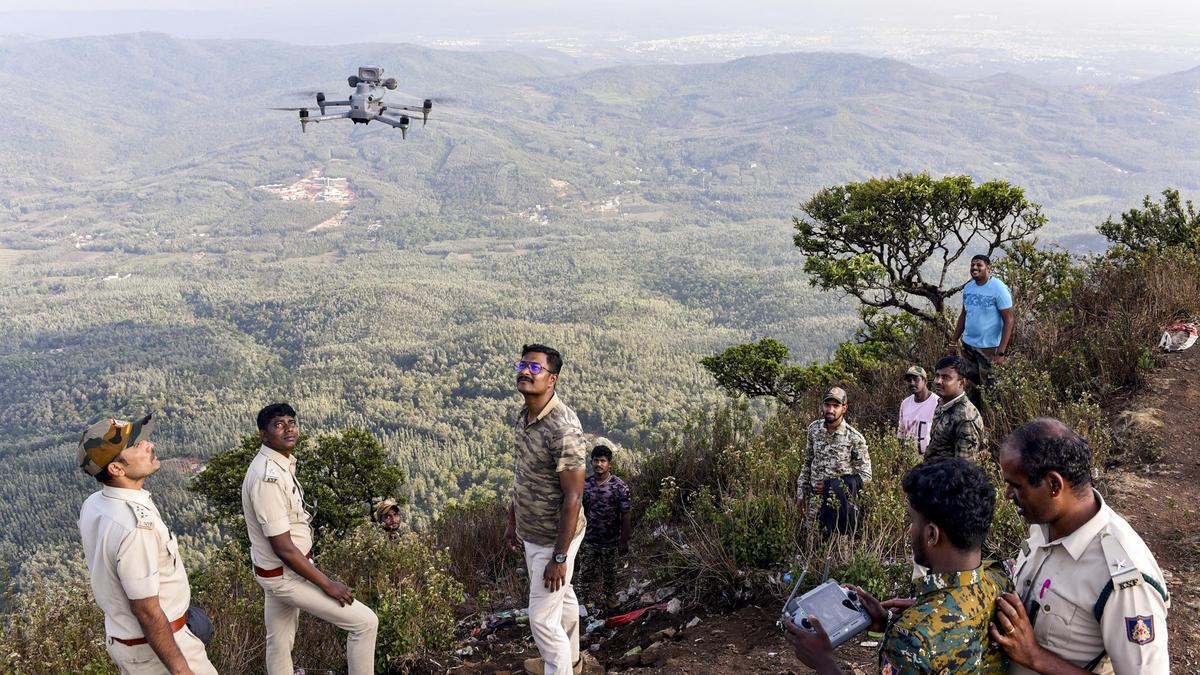
While drones have emerged as an effective tool for wildlife monitoring and mitigating human-wildlife conflicts, experts caution that their growing use could inadvertently stress wildlife and infringe on people’s privacy.
Although unmanned aerial vehicles, or drones, in some cases fitted with payloads such as loudspeakers, are used in several Indian States to monitor wild animals and drive those that stray into human settlements back into forests, the Kerala Forest department currently uses them only for “monitoring purposes”.
Annoyance to wildlife
Experts and scientists note that drone deployment over civilian areas can infringe on people’s privacy, and in forests, it can be an annoyance to wildlife, especially bees, wasps, and birds. Therefore, deployment of conservation surveillance technologies (CSTs), including drones, camera traps and thermal imaging for conservation and wildlife surveillance warrants a second thought.
“Relatively few studies have examined how drones affect wildlife behaviour. Available research indicates that the high-pitched sound of drones, which mimics that of bees and wasps, causes annoyance and disrupts these insects’ regular movements. There are instances of them attacking drones,” says Priyadarsanan Dharma Rajan, conservation researcher and practitioner and an adjunct fellow at ATREE, Bengaluru.
Should follow norms
Noting that drones have become a necessary tool for studying wildlife, a Kerala Forest Research Institute (KFRI) scientist, who did not wish to be named because he was not authorised to speak on government policy, says flying them too low, too fast, or too loudly could stress animals and affect their behaviour. “Drone operators should always follow safe flying rules. This includes keeping the drone at a safe altitude, flying slowly at a side angle instead of directly overhead, keeping flights short, and staying away from animals when they are nesting or breeding,” the scientist adds.
Acknowledging that CSTs have significantly improved wildlife monitoring and anti-poaching efforts, experts warn that their rapid expansion has also resulted in social, ethical and political implications that remain inadequately addressed. One of the key concerns is privacy, as drones and hidden camera traps can capture images and videos of people without their consent, particularly in and around forest areas. They caution that such recordings could be misused if accessed by unauthorised persons.
“Research studies have revealed rampant misuse of CSTs and severe human rights violations in Kaziranga National Park and Corbett Tiger Reserve. The Kerala government’s recent decisions to expand the deployment of drones and camera traps, therefore, require immediate and critical revision. Kerala has the opportunity to set a model for forest conservation by introducing a comprehensive Code of Practice for the use of CSTs,” adds Mr. Rajan.
Meanwhile, P. Pugazhendi, principal chief conservator of forests (Wildlife) and chief wildlife warden, Kerala, says the State does not use drones for driving animals back into forests. “Broadly, drones can serve two purposes in wildlife management. One is surveillance and monitoring, while the other is actively driving wild animals back into forests. For the latter, drones can be fitted with payloads such as loudspeakers that play sounds to herd animals away from human habitations. This practice is followed in several countries and in some Indian States as well. However, in Kerala, at present, drones are deployed only for monitoring, and only in areas reporting the severe human-wildlife conflict,” says Mr. Pugazhendi..
Published – June 29, 2026 05:38 pm IST