

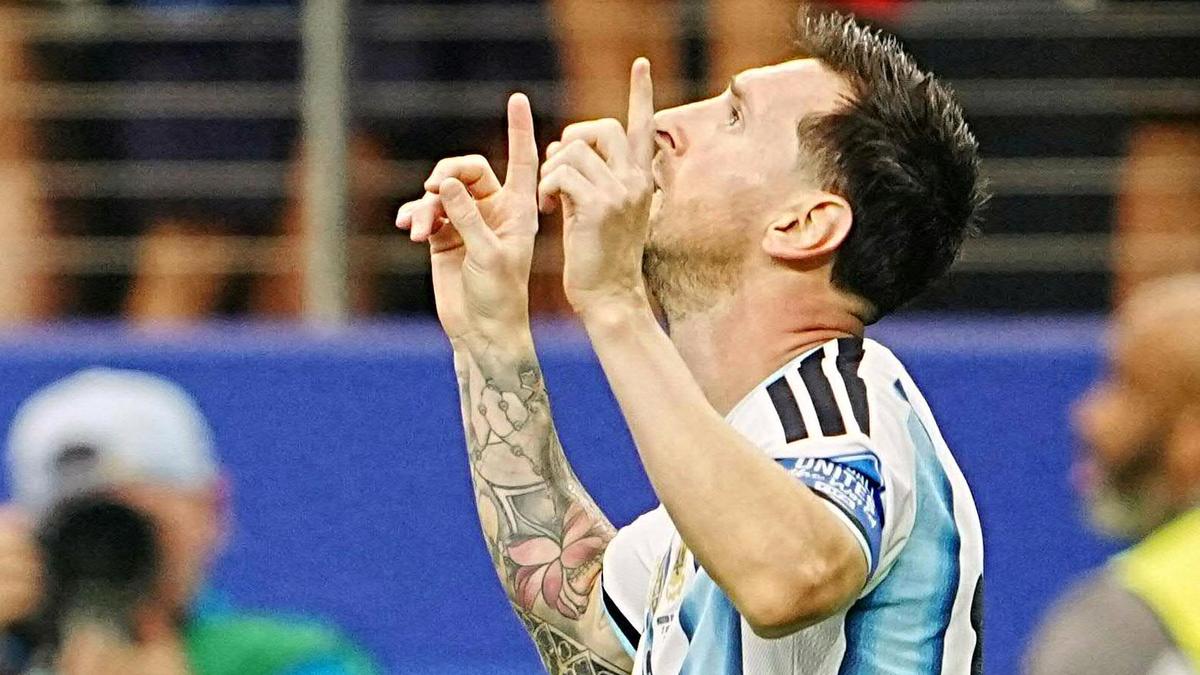
It is the fifth minute of stoppage time. There is a 1-0 lead to protect. There is qualification for the knockout stages of the FIFA World Cup to seal.
With barely a minute left for the final whistle, the practical thing for mere mortals to do would be to take the ball to a distant corner and waste as much of the remaining time as possible.
But when has Lionel Messi, long immortalised in Argentina’s iconic sky blue and white, ever been constrained by the parameters applicable to the rest of the universe? Never, not even at 38 years old, is the answer.
He hares down the right flank with the bounding enthusiasm of a restless teenager, looks up and finds Julian Alvarez sprinting down the middle with an inch-perfect pass.
Alvarez, 13 years younger, takes a couple of touches before shooting straight at goalkeeper Alexander Schlager. By this stage, Messi has positioned himself unmarked in the 18-yard box. He attracts the ball again, and navigates his way around the goalkeeper and another Austrian player before taking aim at goal. The shot is blocked, but he hammers the rebound past a row of bodies and into the back of the net.
In these few frames, the drive and desire of the irrepressible genius from Rosario are perfectly encapsulated. Of course, Messi, who turned 39 on Wednesday, was born to do things with a football that few can envision, let alone execute. But more compellingly, the little wizard, having won the World Cup in Qatar four years ago and conquered everything there is to conquer in the beautiful game, retains the fire within him to light up the global stage at this phase of his extraordinary career.
Perhaps, we shouldn’t be surprised. For, the determination to not let standards drop is a timeless trait that binds otherworldly champions across the sporting landscape — Novak Djokovic, who also turned 39 last month, is another contemporary example from the world of tennis. Xavi drew a parallel with basketball icon Michael Jordan in his column for The Athletic, for there is no footballing equivalent to his former Barcelona teammate in his view.
Another record
Messi’s aforementioned goal in a Group-J encounter against Austria at the Dallas Stadium in Arlington was his second of Monday afternoon in a 2-0 win. It was also his 18th strike across six World Cups. The 17th, which came earlier in the day in the air-conditioned venue, steered him clear of Mirosav Klose as the singular owner of the record for most goals in the history of the quadrennial show-piece. He could have eclipsed the former Germany striker even earlier in the game if not for sending his penalty wide in the ninth minute, strangely his third miss from the spot in three consecutive World Cups. It is reassuring to know that he can err too.
Otherwise, his tally of World Cup goals is another stratospheric feat in Messi’s long list of individual and collective accolades. During this very tournament, he has become only the third player, after Frenchman Just Fontaine and Brazilian Jairzinho way back, to score in six consecutive World Cup matches — the last time he failed to score was in Argentina’s final group-stage match of the euphoric 2022 campaign against Poland. With his hat-trick against Algeria last week, he also became Argentina’s youngest and oldest scorer in the tournament, a glowing stamp of his longevity.
The game against the Algerians, notably, marked 20 years to the day that he had come off the bench against Serbia and Montenegro for his World Cup debut and scored in the German city of Gelsenkirchen. His was the final goal in a 6-0 win, the only time ever that he has played supporting cast in the marquee event.
Heartbeat
That he is the main man for the Albiceleste — he has scored all five of his team’s goals at this tournament so far — even two decades later appears to blur the lines between fact and fiction. Never mind the welcome U-turn after announcing his international retirement in 2016, it is nearly four years since his greatest night in an Argentine shirt in Qatar. And still here he is, raising hopes of an encore in North America as the heartbeat of the three-time champion. “When Leo gets activated, everyone gets activated,” Argentina’s head coach Lionel Scaloni told the media after the victory over Austria.
Messi’s record-breaking opening goal on Monday was a fitting example of how the rest of the Argentine players are geared towards facilitating the legend in their midst. Among Messi’s teammates are Enzo Fernandez and Alexis Mac Allister, mainstays in the midfield for elite Premier League clubs. Lautaro Martinez, Inter Milan skipper, finished on top of the goal-scoring charts in the 2025-26 Serie A season. Atletico Madrid’s Alvarez, used as a substitute by Scaloni so far, is keenly sought by Real Madrid. Rodrigo De Paul served Atletico with distinction before joining up with Messi at Inter Miami in Major League Soccer (MLS). Yet, if all of them want to intuitively look for one man as often as possible on the pitch, it is telling of Messi’s unabated greatness.
They did exactly that in the 38th minute. Messi, with his back towards the Austrian goal, started the move by finding Thiago Almada in the middle of the park. The 25-year-old Atletico Madrid winger charged with the ball towards the edge of the 18-yard box, and then fed it out wide to Facundo Medina on the left. The left-back could have offered a cross past the last line of defence for Lautaro to latch onto, but instead passed the ball back in the direction that it came from. In anticipation of the great man running in behind him, Almada let the ball go between his legs, aptly for Messi to pass the ball past Schlager’s outstretched right arm and pump his right fist in celebration.
In a career as long as his, Messi has scored every category of goal imaginable. There have been unstoppable long-range thunderbolts and free-kicks, mesmerising solo runs, delectable chips and quintessential fox-in-the-box finishes. But if there is a type of goal that is synonymous with him, it has to be his unfailing propensity to pick his spot in the corner, open up his body and caress the ball into the net with his majestic left foot from the edge of the box.
Complementing his sublime skill and avid affection for the game is a razor-sharp brain too. It lends to his innate understanding of where he needs to be at any given juncture. He can no longer press the opposition with the intensity that a younger version of himself could, nor make gut-busting runs beyond the defence in the hope that a teammate finds him. Against Austria, as he often did in the previous World Cup, he covered a distance of nearly five kilometres merely by walking. It appears antithetical to the very essence of the sport, but it is simply his way of conserving energy in his twilight for the key moments that require him to inject his magic.
For Messi to be in the necessary physical shape for the rigours of a World Cup, the move to the MLS in 2023 has also helped. Even though the profile of the American league has grown in recent years, there isn’t as much strain on Messi’s wearing body from playing for Inter Miami as there would have been if he was still plying his trade in Europe. Without needing to operate at full throttle all the time, he has still become the fastest to 50 goals in MLS history.
Looking ahead, will Messi’s goal-scoring record in the World Cup be breached? Possibly in this very tournament, given that France’s talisman Kylian Mbappe, 27, is just two behind the Argentine.
But to help understand Messi’s legacy, the climax of Argentina’s duel against Austria was instructive as well as poignant. As the television cameras panned to an old lady in the audience, she held up a banner that read, ‘100-year-old Messi fan’.
Beyond all the goals and trophies won, Messi spreads unadulterated joy to millions around the world like her. There can be no greater endorsement of his legacy.
Published – June 25, 2026 12:18 am IST