
Skip to content
  • Facebook
  • X
  • Linkedin
  • WhatsApp
  • YouTube
  • Associate Journalism
  • About Us
  • Privacy Policy
  • 033-46046046
  • editor@artifex.news
Artifex.News

Artifex.News

Stay Connected. Stay Informed.

  • Breaking News
  • World
  • Nation
  • Sports
  • Business
  • Science
  • Entertainment
  • Lifestyle
  • Toggle search form
  • As Israel-Iran Conflict Escalates, India Inc Braces For Sea Trade Disruption
    As Israel-Iran Conflict Escalates, India Inc Braces For Sea Trade Disruption World
  • Access Denied
    Access Denied Nation
  • Textiles and garment exports fall 2.2% in 2025-26: Global Trade Research Initiative
    Textiles and garment exports fall 2.2% in 2025-26: Global Trade Research Initiative Business
  • “Need To Improve In Everything”: Indian Football Team Coach Manolo Marquez
    “Need To Improve In Everything”: Indian Football Team Coach Manolo Marquez Sports
  • Access Denied Sports
  • Centre hikes copra MSP by ₹250-300 hike per quintal for 2024 season
    Centre hikes copra MSP by ₹250-300 hike per quintal for 2024 season Business
  • Asian Games 2023, October 6: Updated List Of All Indian Medal Winners
    Asian Games 2023, October 6: Updated List Of All Indian Medal Winners Sports
  • Edmundo Gonzalez | The challenger who fled
    Edmundo Gonzalez | The challenger who fled World
What makes a Cricket pitch go wrong? The science behind bounce, grass, clay & deterioration

What makes a Cricket pitch go wrong? The science behind bounce, grass, clay & deterioration

Posted on June 19, 2026 By admin


In the first week of June, a men’s Test between England and New Zealand lasted just 166 overs, prompting unpleasant comments about the variable bounce of the Lord’s surface. While no curator intentionally sets up bad wickets, what does go wrong when a pitch goes wrong?

What is a pitch made of?

A cricket pitch is clay, water, and grass. The clay supplies the hardness, the grass provides the strength, and the water determines its pace.

Clay is a type of heavy soil composed mainly of aluminosilicate minerals. Clay particles are very small and flat, allowing them to slide past each other when they’re wet or harden and bond when they’re dry.

Curators generally choose between two main types of clay: black and red. Black soil mainly has smectite and montmorillonite minerals. It is common in Australia and parts of India. It is stickier and harder when dry, creating the wide cracks seen on day-5 pitches. But because the particles bind so tightly, the pitches can offer pace and bounce.

Red soil, more common in Chennai and some Caribbean islands, consists of kaolinite and illite. It doesn’t crack as dramatically but tends to break into smaller, finer particles more quickly, leading to rough surfaces that help the ball grip for spin and facilitate reverse swing sooner in a match.

How is a pitch laid?

Curators begin by selecting and laying the soil to contain clay. In the U.K., pitch loams are typically 25-35% clay; this together with higher silt levels encourage the seaming conditions famous in England. In Australia, the soil can exceed 60% clay, creating the bounce of Perth and Brisbane. According to former pitch curator P.R. Viswanathan, the clay content in India is usually 50-60%.

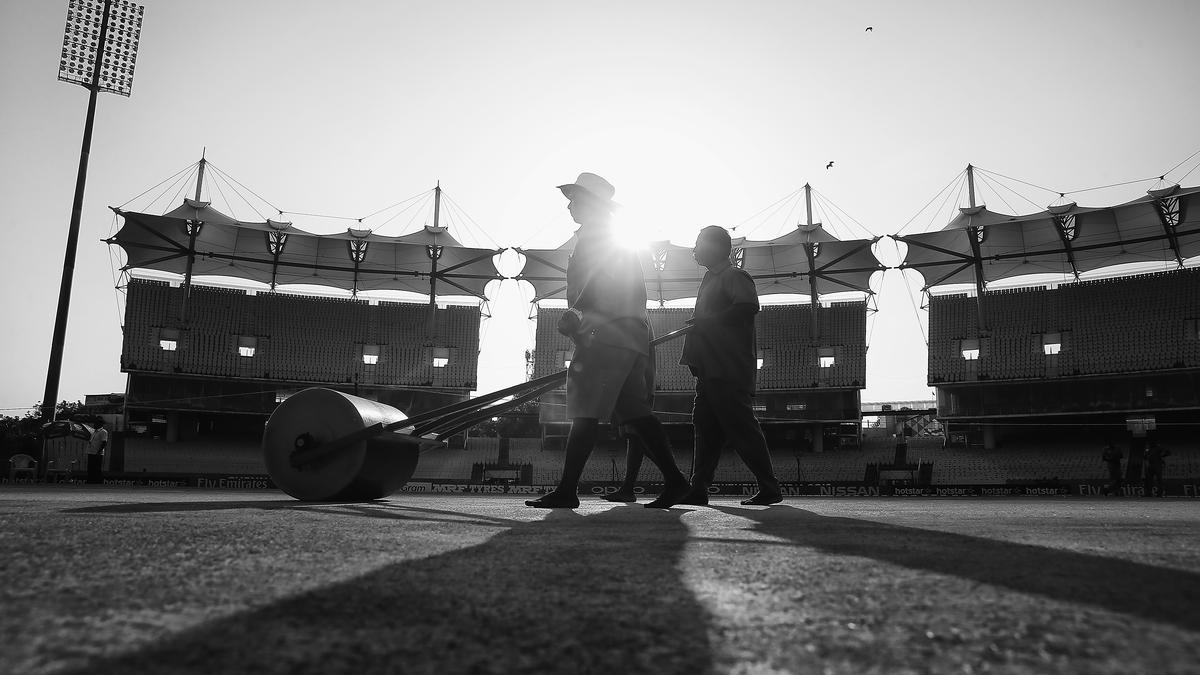
Curators also use heavy rollers, weighing a few hundred kilograms to over a tonne, to apply a large amount of pressure when the soil has just the right amount of moisture, forcing the clay particles into their most packed arrangement.

Since a heavily rolled pitch will be smooth, a ball striking the surface will suffer less friction and retain more kinetic energy. This is part of why Curtly Ambrose was able to pick up seven wickets for just one run in a spell against Australia in Perth in 1993.

Moisturising routine: Curators use a process called deep saturation to ensure moisture penetrates 75-100 mm down, allowing the clay to settle and pack.
| Photo Credit:
Getty Images

Finally, below the 100-150 mm of the wicketing layer lies the base. It usually consists of a layer of silt or sandy loam, then a layer of gravel or crushed stone. The base can’t be too soft or it will absorb the ball’s energy. If it is too hard, the pitch can heave or become uneven. Consistent bounce also requires the clay layer to be bonded to the base underneath.

In many modern multipurpose stadiums, curators develop pitches in large steel trays away from the stadium and drop them in before a season begins. Since they lack a natural soil profile, they sometimes develop more predictable bounce.

What effect does water have?

To wet a pitch, according to the U.K. Grounds Management Association, curators use a process called deep saturation several days before a match to ensure moisture penetrates about 75-100 mm down, allowing the clay to settle and pack. This could take a day or more. Then the water is allowed to evaporate, so that capillary action pulls moisture up from deeper and dries the pitch uniformly.

The bounce comes from the soil’s elasticity. A hard, bone-dry surface like Perth is highly elastic because it returns nearly all the energy to the ball, allowing it to climb. But on a damp pitch, moisture reduces friction and the ball skids through — but the water also softens the clay, reducing its elasticity and forcing the ball to stay low.

Recently, the Marylebone Cricket Club (MCC) pioneered a technique called soil-steaming to remove pests attacking the grass’s roots at Lord’s. A contractor injected superheated steam into the soil square, killing harmful microbes and weeds to several centimetres without any chemical residue. Once the roots were healthy again, the thinking went, the clay would bind better to render a more bouncy surface.

However, ESPNCricinfo reported the steaming efforts appeared “to have had minimal positive effect on the evidence of the first two days” of the England-New Zealand contest.

What role does grass play?

Aside from sinking roots into the pitch that reinforce the soil, blades of grass above the surface — which curators typically cut to be 3-5 mm high, according to pitch consultant Andy Atkinson — provide friction against the ball. In particular, the blades interact with the ball’s seam: if the pitch is lush, the seam can ‘grip’ the blades and deviate sideways.

But if curators have shaved the grass off, the seam would catch almost nothing. However, as the game wears on and one side of the ball becomes scuffed, the pitch will also increase friction on the leather and allow the ball to reverse-swing.

Grass also helps control the pitch’s wetness as its roots draw water from deeper soil layers and release it through the leaves. This can help ensure the pitch isn’t like a moist cake with a hard crust.

The Sabina Park Test match in 1998 was abandoned after only 10.1 overs because, from the same spot on the pitch, balls bowled by the West Indies quicks either reared sharply at the England batters or skidded fast and low. The inquiries that followed concluded that the pitch hadn’t fully settled before the match and may have been like the aforementioned cake.

Why does a pitch deteriorate?

For all the control curators exercise, a cricket pitch is a living, changing thing — an aspect most pronounced during a Test. After curators lay a pitch for the opening day, they anticipate the sun, the humidity, and the winds will shape its devolution over the next 450 overs.

Sticking point: The variable bounce at Lord’s often stems from the soil’s clay shortfall. For all the rolling, the clay particles don’t always bind durably.

Sticking point: The variable bounce at Lord’s often stems from the soil’s clay shortfall. For all the rolling, the clay particles don’t always bind durably.
| Photo Credit:
Getty Images

The manner of decay depends on the clay, according to the 2023 book Cricket Pitches: The Science Behind the Art of Pitch-Making. On a black-soil pitch, the clay will pull apart into islands: if a ball hits the edge of one of these cracks, it can behave dangerously. A red-soil pitch deteriorates more uniformly: the top layer turns to powder, scuffing the ball’s leather and allowing spinners to find more purchase even sans large cracks.

A good example of ‘controlled deterioration’ was the Australia v. South Africa women’s Test at Perth in 2024: curator Isaac McDonald ensured the pitch dried slowly, allowing the clay to settle into dense blocks rather than crack. Second, his team maintained a slim carpet of live grass on the pitch, preventing the top surface from breaking up into dust.

On the other hand, the bounce troubles at Lord’s often stem from the U.K. soils’ clay shortfall; the clay particles also don’t bind very durably. If the weather is also inconsistent, the pitch can develop soft spots under a hard crust, resulting in variable bounce.



Source link

Sports Tags:black soil vs red soil pitch, cricket pitch bounce, cricket pitch clay composition, cricket pitch curator, cricket pitch deterioration, cricket pitch preparation, cricket pitch science, lord, why cricket pitches fail

Post navigation

Previous Post: Hobbyists and visitors celebrate all things analogue at this three-day expo in Egmore
Next Post: Kerala Revised Budget: Infrastructure projects in Kochi receive scant allocation

Related Posts

  • Access Denied Sports
  • “Come Down To Earth”: Sachin Tendulkar’s Message To India Star Pacer Which Impacted His Performance
    “Come Down To Earth”: Sachin Tendulkar’s Message To India Star Pacer Which Impacted His Performance Sports
  • Mitchell Starc’s Blunt Take On Ashes vs Border-Gavaskar Trophy Comparison
    Mitchell Starc’s Blunt Take On Ashes vs Border-Gavaskar Trophy Comparison Sports
  • Access Denied Sports
  • Aston Villa’s Morgan Rogers Receives First England Call-Up After Mass Withdrawal
    Aston Villa’s Morgan Rogers Receives First England Call-Up After Mass Withdrawal Sports
  • India vs Ireland Live Streaming Olympics 2024 Men’s Hockey Live Telecast: When And Where To Watch
    India vs Ireland Live Streaming Olympics 2024 Men’s Hockey Live Telecast: When And Where To Watch Sports

More Related Articles

Jasprit Bumrah’s Action Questioned, Australian Broadcaster Makes Controversy-Prone Remark Jasprit Bumrah’s Action Questioned, Australian Broadcaster Makes Controversy-Prone Remark Sports
“Can Still Fight Better”: Mark Kom Blasts Nikhat Zareen And Co For Olympics Disaster “Can Still Fight Better”: Mark Kom Blasts Nikhat Zareen And Co For Olympics Disaster Sports
Access Denied Sports
Uthappa holds Kohli indirectly responsible for cutting short Yuvraj’s career Uthappa holds Kohli indirectly responsible for cutting short Yuvraj’s career Sports
Bad News For Pakistan: Star “Hospitalised” Ahead Of Crucial 5th Day Against England In Multan Test Bad News For Pakistan: Star “Hospitalised” Ahead Of Crucial 5th Day Against England In Multan Test Sports
Access Denied Sports
SiteLock

Archives

  • June 2026
  • May 2026
  • April 2026
  • March 2026
  • February 2026
  • January 2026
  • December 2025
  • November 2025
  • October 2025
  • September 2025
  • August 2025
  • July 2025
  • June 2025
  • May 2025
  • April 2025
  • March 2025
  • February 2025
  • January 2025
  • December 2024
  • November 2024
  • October 2024
  • September 2024
  • August 2024
  • July 2024
  • June 2024
  • May 2024
  • April 2024
  • March 2024
  • February 2024
  • January 2024
  • December 2023
  • November 2023
  • October 2023
  • September 2023
  • August 2023
  • July 2023
  • June 2023
  • May 2023
  • April 2023
  • March 2023
  • February 2023
  • January 2023
  • December 2022
  • November 2022
  • October 2022
  • September 2022
  • August 2022
  • July 2022
  • June 2022
  • May 2022

Categories

  • Business
  • Nation
  • Science
  • Sports
  • World

Recent Posts

  • Kerala Revised Budget: Infrastructure projects in Kochi receive scant allocation
  • What makes a Cricket pitch go wrong? The science behind bounce, grass, clay & deterioration
  • Hobbyists and visitors celebrate all things analogue at this three-day expo in Egmore
  • FIFA World Cup 2026 | United States of America vs Australia LIVE updates: Group D match gets underway
  • Congress celebrates Rahul Gandhi’s birthday with service activities at Gandhi Bhavan

Recent Comments

  1. Russelglome on UP Teacher Who Asked Students To Slap Muslim Classmate
  2. JamesNet on UP Teacher Who Asked Students To Slap Muslim Classmate
  3. DavidFuram on UP Teacher Who Asked Students To Slap Muslim Classmate
  4. Michaelskalp on UP Teacher Who Asked Students To Slap Muslim Classmate
  5. BrianArors on UP Teacher Who Asked Students To Slap Muslim Classmate
  • The Hindu Quiz on Space Shuttle disaster
    The Hindu Quiz on Space Shuttle disaster Science
  • A tale of two think-tanks
    A tale of two think-tanks Sports
  • Nirmala Sitharaman’s first Interim Budget | Puffed-up and poll-ready
    Nirmala Sitharaman’s first Interim Budget | Puffed-up and poll-ready Business
  • “Decision To Name Rohit Sharma Captain Hampered Team India”: Ex-KKR Team Director
    “Decision To Name Rohit Sharma Captain Hampered Team India”: Ex-KKR Team Director Sports
  • In videos | Budget 2024
    In videos | Budget 2024 Business
  • IPL 2026 | I can’t take too much credit for Sunrisers being on top: Cummins
    IPL 2026 | I can’t take too much credit for Sunrisers being on top: Cummins Sports
  • Access Denied Business
  • Amid Ambedkar Row, Arvind Kejriwal’s Big Move For Dalits. BJP Hits Back
    Amid Ambedkar Row, Arvind Kejriwal’s Big Move For Dalits. BJP Hits Back Nation

Editor-in-Chief:
Mohammad Ariff,
MSW, MAJMC, BSW, DTL, CTS, CNM, CCR, CAL, RSL, ASOC.
editor@artifex.news

Associate Editors:
1. Zenellis R. Tuba,
zenelis@artifex.news
2. Haris Daniyel
daniyel@artifex.news

Photograher:
Rohan Das
rohan@artifex.news

Artifex.News offers Online Paid Internships to college students from India and Abroad. Interns will get a PRESS CARD and other online offers.
Send your CV (Subjectline: Paid Internship) to internship@artifex.news

Links:
Associate Journalism
About Us
Privacy Policy

News Links:
Breaking News
World
Nation
Sports
Business
Entertainment
Lifestyle

Registered Office:
72/A, Elliot Road, Kolkata - 700016
Tel: 033-22277777, 033-22172217
Email: office@artifex.news

Editorial Office / News Desk:
No. 13, Mezzanine Floor, Esplanade Metro Rail Station,
12 J. L. Nehru Road, Kolkata - 700069.
(Entry from Gate No. 5)
Tel: 033-46011099, 033-46046046
Email: editor@artifex.news

Copyright © 2023 Artifex.News Newsportal designed by Artifex Infotech.