

Ahead of the 2026 FIFA World Cup, climate scientists warned that this edition of the tournament could be among the hottest on record, given the heat and humidity of summer in the United States and Mexico. A group of scientists wrote to FIFA demanding longer breaks for players and “aggressive” locker-room cooling, predicting that more than a quarter of the 104 matches would be played in conditions risking heat stress.
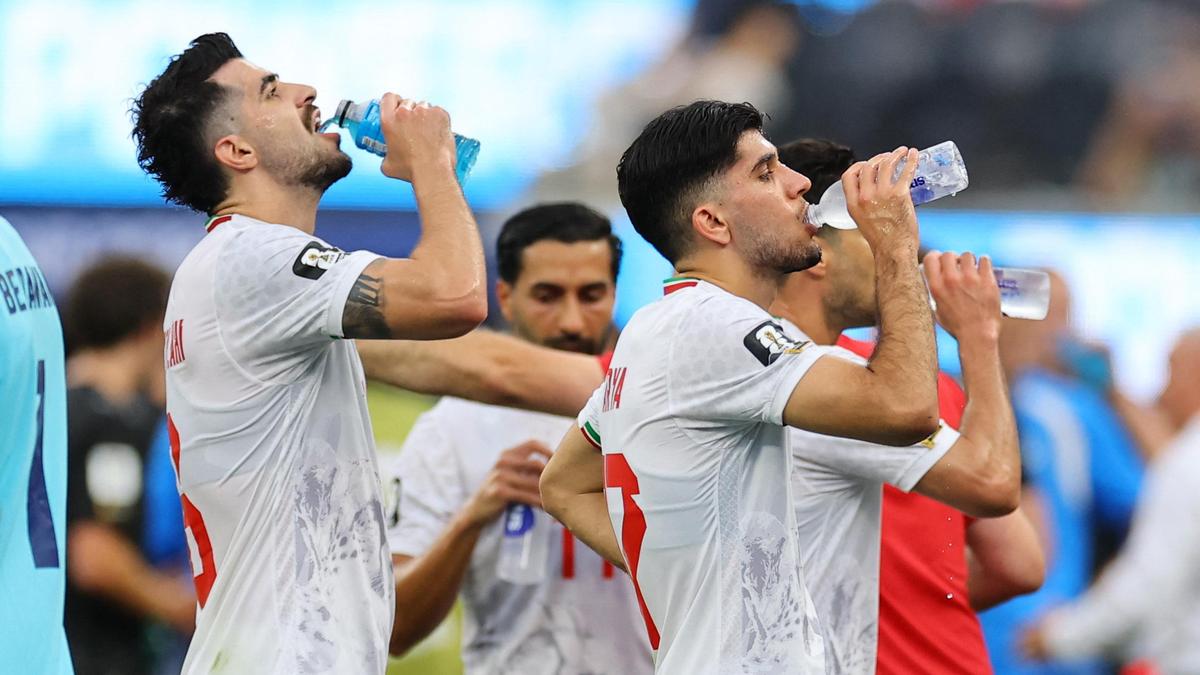
Among the measures FIFA introduced in response was a mandatory three-minute ‘hydration break’ midway through each half of every game. “In a streamlined and simplified version of the breaks used at some previous tournaments, the referee will stop the game 22 minutes into each half to allow players to rehydrate,” the governing body said. “There will be no weather or temperature condition in place, with the breaks being called by the referee in all games, to ensure equal conditions for all teams, in all matches.”
It seemed a sensible precaution. What FIFA did not anticipate was the backlash.
Drinks breaks are not, in themselves, alien to football. Major competitions played in summer have long allowed referees to call for them depending on conditions. What has rankled this time is their mandatory nature applied uniformly regardless of temperature, stadium or circumstance.

A big screen inside the stadium during the second half hydration break in the game between Saudi Arabia and Uruguay in Florida
| Photo Credit:
Reuters
Players complain that the interruptions kill the flow of the game. Broadcasters, meanwhile, have seized on the pauses as an opportunity for commercial breaks, drawing the ire of viewers watching both on linear television and live streams. “Every time, going to commercial is not something I really like,” said Virgil van Dijk, the Netherlands captain. “For neutral viewers on TV, it’s also not great. If it’s really hot, they will obviously serve a purpose. But I think you have to look at it on a game-by-game basis.”
Mauricio Pochettino, head coach of co-hosts the United States, was more blunt. “I don’t like it. I only like it when the conditions are extreme. When the conditions are good, it is unnecessary.”

Under FIFA’s rules, broadcasters may cut to commercials 20 seconds after the referee signals a break, but must return to live action 30 seconds before play resumes. Not all have complied in spirit: in India, the official broadcaster has cut away immediately on several occasions. Britain’s ITV and Spanish-language broadcaster Telemundo, by contrast, opted to stay with the live feed, allowing viewers to watch players and coaches interact during the pause.
Two halves, four quarters?
Football has been a game of two halves for more than 150 years. The imposition of fixed intervals that effectively divide each 45 minutes in two has not been warmly received. “Americans have always wanted the English game to have four quarters,” said the former England striker Ian Wright.
Critics go further, arguing that the breaks do not merely disrupt the match, they alter its fundamental character. “We love football because of the pace of the game,” said Roy Keane, the former Manchester United captain. “Some teams lose momentum with the break, some gain it. Sometimes it comes straight after a player has been receiving treatment for two or three minutes, the game kicks off, and a minute later you’ve got a hydration break.”
Lars Sivertsen, a Norwegian football journalist, put it more pointedly on X. “Football is a sport that is all about rhythm, tempo, momentum,” he wrote. “A lot of games end up being attacking teams trying patiently to break down stubborn defensive sides, putting pressure on them until someone loses focus or makes a mistake. That’s why players waste time or feign injury, to interrupt the rhythm of the opponent. But guess what: FIFA are now doing it for you, twice every game.”

Suspicions that commercial interests have come to drive the schedule hardened when Polymarket Sports shared footage of a fourth official on the sideline of the USA–Paraguay match waiting for a signal from a FIFA broadcast liaison before restarting play, while players took their positions, raring to go. During several matches, journalists inside stadiums noted that players were not even drinking during the breaks. In the Group A fixture between Czechia and South Korea in Guadalajara, where the temperature was a mild 21°C, the hydration break appeared to serve no hygienic purpose whatsoever.
Tactical timeout
Not everyone is displeased. Several coaches have made good use of the interruptions, gathering their players to issue fresh instructions, particularly when trailing or struggling to impose themselves on a match. During the Netherlands–Japan group game, Japan’s manager produced a tactical board with his side plotting to contain the Dutch attack. The stadium was air-conditioned; the players had barely broken a sweat.

Iraq coach Graham Arnold gives instructions to Amir Al-Ammari, Merchas Doski, Ali Jasim and Ali Al Hamadi during the first half hydration break
| Photo Credit:
Reuters
Brazil’s Carlo Ancelotti has been similarly untroubled. “You can explain a problem to the players,” he was quoted by the BBC after his side turned the game around against Morocco having been behind at the break. “[You can] make a tactical adjustment that can be very good.” Canada, too, equalised shortly after a second-half hydration break in their match against Bosnia-Herzegovina, when substitute Cyle Larin cancelled out the deficit.
Purists are unconvinced by such happy accidents. The suspicion is that FIFA has dressed up an advertising vehicle in the language of player welfare. “It’s a stealth advertising break,” declared Gary Neville.
What the hydration break has really exposed is a tension that has long simmered beneath the surface of the modern game: between football as a sport and football as a commercial product.
Published – June 17, 2026 10:17 am IST