





For decades, military power has been defined by the scale and sophistication of conventional arsenals — combat aircraft, tanks, artillery, warships, air-defence systems, precision-guided missiles, and other high-end assets.
End of superiority
In this environment, battlefield superiority belonged to armies with technologically advanced platforms and equipment, sophisticated intelligence networks, and large budgets. Smaller militaries and non-state actors, by contrast, were largely confined to asymmetric tactics that relied on guerrilla warfare, ambushes, and other unconventional methods to offset their opponents’ superior firepower and operational dominance.
But the ongoing wars in Ukraine and Lebanon, together with the wider U.S.–Israel–Iran theatre of conflict, have irrevocably shattered this paradigm, demonstrating that commercially derived drones — mass-produced at scale, rapidly reconfigured for multiple operational roles, and widely deployed — have become a defining feature of contemporary warfare. Performing functions ranging from intelligence, surveillance, and reconnaissance (ISR) and target acquisition to precision strikes, artillery spotting, electronic warfare, and logistics support, they have evolved from auxiliary assets into central instruments of military operations.
In doing so, they have transformed the 21st-century battlespace into an environment of persistent visibility and rapid engagement, where front lines remain continuously exposed, and rear areas can no longer be assumed secure, as multiple types of Unmanned Aerial Systems (UAS) can locate, track, and strike targets with unprecedented speed and precision.
Across these concurrent theatres of conflict, the widespread — and in some cases decisive — employment of drones has challenged established assumptions about how military power is generated and applied, reshaping doctrine, force structures, and future warfighting concepts. The consequence has been the emergence of a continuous and interconnected battlespace in which no position is truly beyond reach, and no movement can safely assume it will remain concealed for long, as detection is increasingly followed by rapid engagement and destruction.
Ukraine drone war
Nowhere has this transformation been more visible than in Ukraine, where Russia’s ‘Special Military Operation’ launched in February 2022, as a conventional war involving combat aircraft, tanks and artillery, evolved within two years into the world’s first industrial-scale, drone-intensive conflict.
From the earliest stages of the Russian invasion, Ukraine rapidly adapted commercially available drones — originally designed for civilian purposes such as aerial photography, mapping, and basic surveillance — alongside a limited number of pre-existing military Unmanned Aerial Vehicle (UAV) assets into improvised reconnaissance and strike systems.
What had initially functioned as a support tool for intelligence gathering and guiding artillery fire quickly evolved into a decisive combat capability, as small quadcopters and First-Person View (FPV) drones were progressively weaponised and deployed as low-cost, precision-guided munitions. This shift marked a fundamental transformation in how unmanned systems were used on the battlefield: from passive information-gathering platforms to active instruments of destruction. By around 2024, drones had become fully integrated into almost every layer of Ukrainian combat, ranging from tactical battlefield surveillance to frontline targeting and deep-strike missions against logistics hubs, supply routes, and rear-area infrastructure.
The operational template that emerged from this experience in Ukraine was subsequently replicated, albeit to varying degrees and in different forms, across the continuing West Asian conflicts, underscoring the growing centrality of drones to contemporary warfare.
FPV revolution
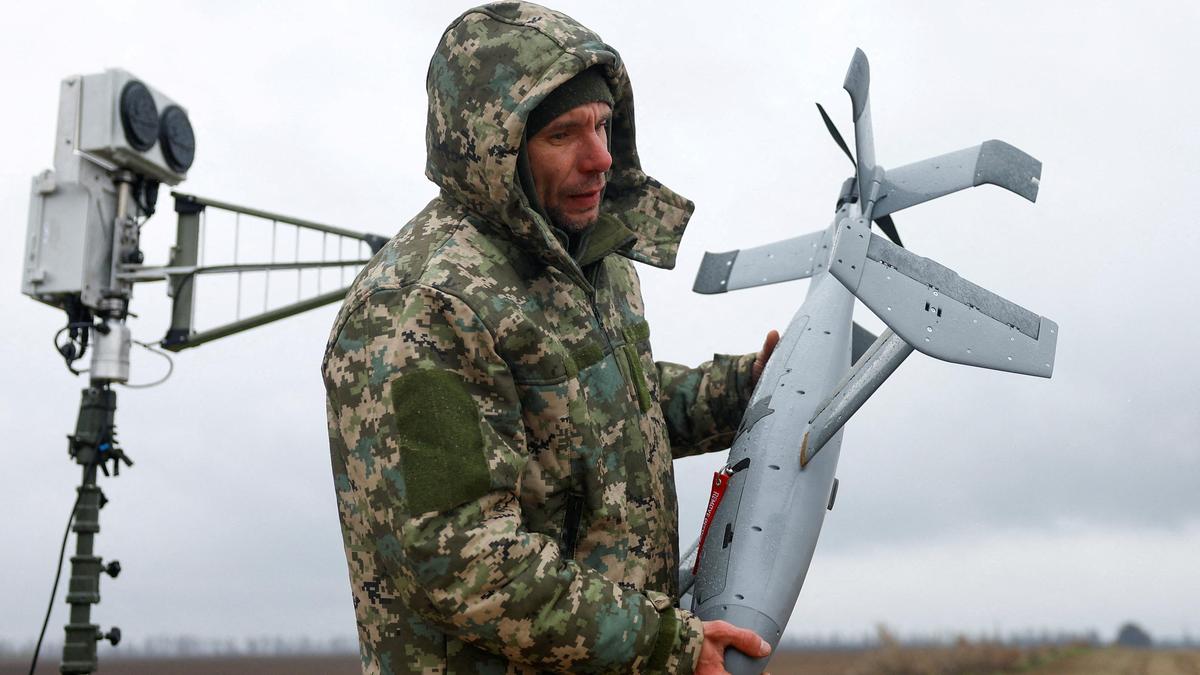
At the heart of Ukraine’s drone revolution is the FPV system — an inexpensive, commercially available platform originally designed for recreational racing and aerial photography. Controlled through a live video feed transmitted from an onboard camera to virtual-reality-style goggles worn by their operators, FPV systems offer exceptional precision, manoeuvrability, and responsiveness.
These were then rapidly transformed into a broad spectrum of combat systems, including FPV strike drones, bombers, interceptors, and long-range attack variants. Among the most prominent are heavy-lift hexacopter Vampire drones — nicknamed “Baba Yaga” by Russian forces after the fearsome figure from Slavic folklore — alongside a vast number of improvised modular platforms, assembled in multiple workshops across Ukraine.
The most common are FPV kamikaze or strike drones, inexpensive quadcopters carrying explosive payloads such as modified rocket-propelled grenade warheads or purpose-built munitions, flown directly into targets as disposable precision-guided missiles. Their extremely low cost has radically reshaped battlefield economics which enable systems worth only a few hundred dollars to destroy armoured vehicles and equipment valued in the millions.
These systems operate within a broader Ukrainian deep-strike drone architecture that includes loitering munitions such as RAM II and UJ-31 Zozulya. The latter functions as an aerially deployed “parasite drone,” carried by the Ukrainian-designed multi-purpose UJ-22 Airborne long-range UAV’s, enabling penetration of contested airspace under intensive electronic warfare conditions and extending operational reach. RAM II, by contrast, is a short-range precision loitering munition employed in coordination with reconnaissance drones like the locally developed Shark and PD-2, with improved variants offering greater range and endurance to expand their engagement envelope against air defence systems and rear-area targets.
Also included within Ukraine’s expanding drone inventory are bomber drones — largely adapted from commercial DJI Mavic 3 and DJI Matrice 300 RTK quadcopter platforms originally designed for aerial photography, surveying and industrial applications — which carry and release grenades, anti-tank mines and improvised munitions. Unlike kamikaze systems, they survive missions and can conduct multiple sorties, making them particularly effective against trenches, bunkers and other static positions.
Alongside these, Ukraine fields FPV-based strike systems like Pegasus and long-range, one-way attack drones designed to strike deep inside Russian territory against logistics hubs, airbases and critical infrastructure, far beyond the frontline. In practice, however, the distinction between FPV strike drones and loitering munitions has become increasingly blurred, with many FPV-based thermal and night-vision-equipped variants for round-the-clock operations.
But, Ukraine’s most significant innovation has been the emergence of fibre-optic FPV drones, an electronic warfare (EW)-resistant class of systems. Unlike conventional drones, which rely on radio-frequency links vulnerable to jamming, these platforms transmit commands and video through ultra-thin fibre-optic cables that spool out during flight, rendering electronic interference largely ineffective. In heavily contested electromagnetic environments, this capability restores a significant operational advantage to drone operators by enabling missions to be conducted largely free from electronic disruption.
Regional drone networks
Meanwhile, unlike Ukraine, Hezbollah’s offensive UAS capability is primarily built around Iranian-supplied platforms with limited local modification, relying heavily on systems like Ababil, Mohajer, and Shahed series. These platforms provide a layered operational architecture spanning ISR and strike functions. Within this framework, the Mohajer-4 and Shahed-129 provide tiered-ISR coverage across medium- to long-ranges, while the Shahed-136 loitering munition fulfils a ‘dedicated’ one-way strike role across a wider regional theatre.
More recently, Hezbollah has also adopted jamming-resistant fibre-optic FPV drones, enabling operations in heavily contested electromagnetic environments and enhancing close-range reconnaissance and precision strike effectiveness despite extensive Israeli EW measures.
In response, the Israel Defence Forces (IDF) in Lebanon have developed a layered counter-drone architecture, integrating EW systems, specialised radar arrays, and experimental platforms like the AI-enabled Iron Drone Raider, designed to neutralise low-altitude UAVs through kinetic, non-explosive interception methods such as net capture — by which a physical net is deployed to entangle and disable an incoming drone mid-air — or direct collision, rather than costly missile engagements. Alongside this, the IDF operates a multi-tiered UAV force structure combining long-endurance Heron systems for persistent ISR with armed drones and loitering munitions integrated into reconnaissance-strike complexes for rapid engagement.
Iran, for its part, constitutes a third and structurally distinct model of drone warfare.
Rather than employing drones solely as tactical assets, the Islamic Revolutionary Guard Corps (IRGC) integrates them into a broader strategy of deterrence, coercion, and power projection against the U.S.-Israel combine and their regional partners across West Asia.
Through indigenous systems such as Shahed drone variants, alongside platforms supplied to proxy forces across Iraq, Syria, Lebanon, and Yemen, the IRGC has demonstrated an ability to threaten military bases, critical infrastructure, and naval assets across West Asia at relatively low cost.
Economy shift
Thus, across ongoing wars and conflicts, the drone revolution is defined as much by economics as technology. Cheap, mass-produced unmanned systems are swiftly and irreversibly replacing reliance on expensive platforms, complex logistics, and specialised military structures, shifting the advantage toward the scale, speed, and production capacity of UAS ecosystems.
Warfare, therefore, is increasingly becoming a test of industrial endurance and relentless technological adaptation, where success depends on the ability to build, deploy, and counter fast-evolving, continuously reconfigured drone systems. And, in this rapidly evolving battlespace, drones are no longer just weapons, but the very infrastructure of modern-day war — shaping how conflicts are surveilled, fought, sustained, and ultimately decided.
(Rahul Bedi is a journalist based in New Delhi and Chandigarh specialising in military, defence and security matters)