



With more than 7,500 km of coastline and millions of people living in low-lying coastal areas, India faces a dilemma that it has often been told is really a trap: use engineering solutions to hold the line, so to speak, or to beat a retreat inland. While many adaptation experts and institutions in high-income countries have favoured a ‘managed retreat’ in high-risk coastal areas, governments in South Asia have favoured concrete walls instead. But really, Indians’ best bet is an oft-unarticulated third way.
At the COP climate summits and elsewhere, India’s representatives, including its Union Environment Minister, have argued that economically developing and under-developed countries deserve an extended off-ramp regarding the use of fossil fuels because these countries cannot abruptly abandon the cheapest source of energy known without also plunging millions of people back into poverty.
There is a strong normative case to apply the same argument to coastal engineering: that using engineering to buy time is India’s developmental right.
Maladaptation trap
But is it? The question arises because of social equity. That is, if a government uses its engineering off-ramp to build luxury coastal roads and high-end reclaimed cities, it is less buying time for its people and more walking into the trap of maladaptation. Put differently, engineering must not divert more investments in high-risk zones; if it does, it will only compound the catastrophe that will inevitably result as global warming continues its upward march.
For example, Nigeria has already backed a large land reclamation project dubbed the “Great Wall of Lagos”. It will protect valuable real estate and a new financial district from the Atlantic Ocean even as it diverts tidal energy to neighbouring lower-income coastal areas like Alpha Beach. The irony: it will accelerate erosion at Alpha Beach in order to diminish erosion at the financial district. Similarly, to maintain its rice-producing areas, Vietnam built a vast system of high dikes — but they also prevent natural sediments from being deposited by the river, contributing to the Mekong delta sinking faster than the sea is rising.
Closer home, the Kosi river floods almost every year thanks to its massive sediment load and steep descent down the Himalaya. So as it enters the flatter plains of North India, it naturally shifts course. To control this, the Governments of India and Nepal built large embankments under the 1954 Kosi Agreement, from Bhimnagar into North Bihar. Today, because the river is so confined, silt that would normally spread across the floodplain settles on the riverbed itself, raising the water level several metres over the surrounding land. When heavy monsoon rains cause the embankments to breach or overtop, a catastrophic flood ensues.
Managed retreat
Many parts of the Global North are increasingly experimenting with ‘managed retreat’. This is one of the four primary strategies for coastal adaptation that the UN Intergovernmental Panel on Climate Change (IPCC) articulated in its Sixth Assessment Report. Managed retreat refers to the purposeful, coordinated movement of people, assets, and/or infrastructure away from areas at risk of environmental hazards. The U.N. and the International Organisation for Migration have also used the term to discuss “planned relocation” as a tool for disaster risk reduction.
As part of managed retreat, the U.S. has used programmes like the Hazard Mitigation Grants to purchase flood-prone homes at market rates prevailing before a disaster, and converting the land into permanent open space. The U.K. has used a “managed realignment”, where authorities intentionally breach ageing seawalls to create salt marshes that then serve as natural buffers. New Zealand has been using “red-zoning” to keep developers from rebuilding in high-risk areas.
Overall, managed retreat has primarily taken the form of state-funded buyouts and regulatory zoning. However, it has also benefited from higher capital where it has been implemented and remains politically fraught, often sparking legal battles over property rights and sustaining a class gap whereby wealthy enclaves are fortified while marginalised communities are ‘managed’ away.
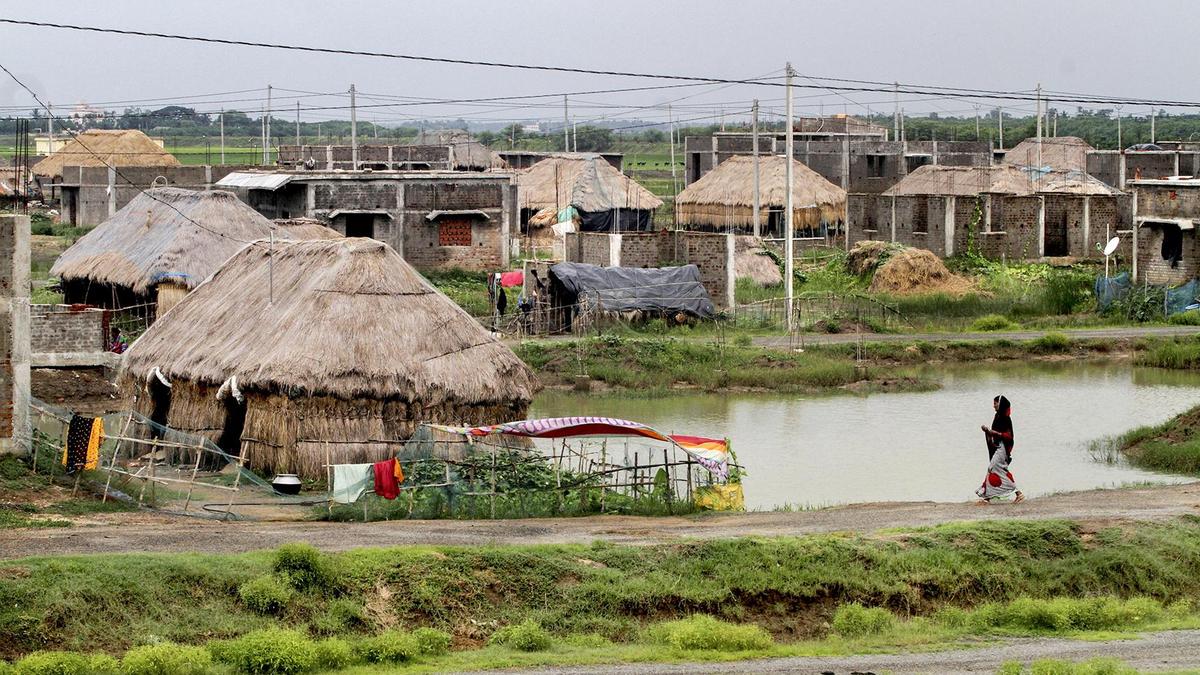
In India, the stakes are obviously different — and arguably higher. For one, its managed retreat has rarely been managed and often plainly chaotic: people are displaced, their social safety nets destroyed, and the poor further pauperised. For example, in 2018, the Odisha government moved more than 500 families in a cluster of seven villages called Satabhaya, which the Bay of Bengal had almost entirely devoured, to a rehabilitation colony in Bagapatia. But while the State provided housing, the families suddenly found themselves transitioning from being the owners of ancestral land to daily-wage labourers in a market for which they had no skills. There are many similar stories in the Sundarbans delta.
In 2024, the Panamanian government began to officially relocate the Guna Indigenous community from a sinking island to the mainland. While the move was ‘managed’ in the economic sense, the Guna people’s entire identity is tied to the sea, and their new homes on the mainland lacked the ancestral connection and traditional fishing access that sustained them for centuries. Thus they faced a cultural crisis.
‘Pioneers’, not ‘refugees’
There is a third choice hidden between concrete walls and panicked flight — a hybrid strategy that marries law, policy, and engineering. Let us start with an example this time: instead of leaving people to ‘retreat’ to its overcrowded capital, the Bangladesh government is currently transforming its port of Mongla into, in its words, a “climate-resilient town”, with investments in new schools and factories and in creating raised infrastructure. It is a solution that attempts to preserve social equity.
In the same vein, India needs to identify ‘receiver cities’ in its hinterland and invest in their infrastructure now. More broadly, migration should be a choice — a voluntary plan to relocate to an economically attractive area rather than because the alternative is to drown — and India should facilitate that.

Second, a great barrier to managed retreat in India is a lack of legal land titles for its coastal residents. The country must reform its coastal land laws to formally recognise informal settlements. In turn, the state must treat people displaced by the vagaries of climate change as ‘pioneers’ of a new national geography who are entitled to state-supported relocation rather than as ‘refugees’ or even ‘encroachers’.
Moving to higher ground
Third, India needs to systematically focus research on and investments into nature-based or hybrid solutions and away from seawalls and reclamation projects. Mangroves, bioswales, and artificial reefs provide a ‘soft’ defence while also learning to adapt to the ocean’s rhythms. Concrete does not do this. Even if a government deems ‘hard’ engineering to be necessary to protect a critical hub like Mumbai, it must include failsafe mechanisms like buffer zones around seawalls and sacrificial floodplains.
In a tacit acknowledgment that keeping the water out is not sustainable, China has been engineering its coastal cities, including Ningbo and Shanghai, to absorb water by installing permeable pavements and rain gardens and by restoring wetlands.
Most of all, the Indian government and its leaders must not be allowed to argue at the COPs and beyond that India must be allowed to engineer its way out of climate adaptation challenges — certainly not at the expense of social equity. India stands at a crossroads: it cannot afford to surrender its coast to the sea but that is no excuse to lie to itself about the permanence of concrete. Instead, it should lay the legal and economic foundations for a dignified and equitable move to higher ground.
Published – June 05, 2026 08:30 am IST