
Skip to content
  • Facebook
  • X
  • Linkedin
  • WhatsApp
  • YouTube
  • Associate Journalism
  • About Us
  • Privacy Policy
  • 033-46046046
  • editor@artifex.news
Artifex.News

Artifex.News

Stay Connected. Stay Informed.

  • Breaking News
  • World
  • Nation
  • Sports
  • Business
  • Science
  • Entertainment
  • Lifestyle
  • Toggle search form
  • R Ashwin’s Father’s Shocking Revelation On Son’s Retirement: “Humiliation…”
    R Ashwin’s Father’s Shocking Revelation On Son’s Retirement: “Humiliation…” Sports
  • 2 Fresh Summons For Arvind Kejriwal, AAP Says Backup Plan To Arrest Him
    2 Fresh Summons For Arvind Kejriwal, AAP Says Backup Plan To Arrest Him Nation
  • Access Denied
    Access Denied Nation
  • Maharashtra MLA Sparks Outrage With “Inferior Bride” Remark
    Maharashtra MLA Sparks Outrage With “Inferior Bride” Remark Nation
  • Access Denied
    Access Denied Nation
  • Access Denied Business
  • Access Denied Business
  • Mumbai Indians’ Epic Rohit Sharma-MS Dhoni Post After Sudden CSK Captaincy Change
    Mumbai Indians’ Epic Rohit Sharma-MS Dhoni Post After Sudden CSK Captaincy Change Sports
How caste, religion and history shape traditional Bengali sweets

How caste, religion and history shape traditional Bengali sweets

Posted on May 29, 2026 By admin


Book cover of Sweet Excess: Crafting Mishti in Bengal

Bengali mishti, or sweets, are innately tied to the region’s cultural identity, celebration, and daily life. A new book, Sweet Excess: Crafting Mishti in Bengal by Ishita Dey, examines the industry and its history through the lens of caste, religion, science, and law. “This geography that has witnessed famine and food movements, yet has never lost its passion for mishti,” she says. The book was written after her travels and research in West Bengal and Bangladesh. Ahead of her talk at Bengaluru’s Champaca Bookstore on May 30, we catch up with her for an interview.

Author Ishita Dey

Author Ishita Dey

Ishita is an assistant professor at South Asian University in New Delhi, and the scope of her research and interests include food, labour and senses. Hailing from Bengal, she grew up in different cities in the State before living in Kolkata, and remembers how sweets were an important part of family life. “I grew up in Bandel Thermal Power Township in Triveni in Hooghly District till I turned 15. One of my favourite sweets was piping hot rosogolla from a local sweetshop in Tribeni. It has a melt-in-the-mouth effect. Our ancestral house is in Kolkata and during our weekly visits, we would stopover at Putiram, Bhimmnag, and Deshbondhu (well-known sweetshops) and pick up signature mishti on our way home.”

Published byRoutledge, Sweet Excess is an academic undertaking into the culture, complete with data, figures and maps. “The work is based on a decade-long journey (2010 – 2018) of observing sweet-making in shops in select district towns of West Bengal (Chandannagore, Hooghly and Krishnanagar, Nadia district) and Rajshahi Division of Bangladesh. I studied the histories of sweetness and labour in the archives of caste association newsletters, recipe books, and newspapers to offer a post-colonial reading of sweetness.”

It begins with her visit to Dhaka in December 2017, where she learns about folk beliefs and superstitions around confectionery. She goes into detail about how sweets cannot be put into the categories of luxury or necessity, essential or non-essential, as they are so ubiquitous. Milk production, climate and bovine species have all shaped the sweets we eat. For example, in the summers of east India, is hard to store fresh milk as it splits. So, you will see a lot of sweets made from chhana or coagulated milk; most famously the sandesh and the rosogulla.
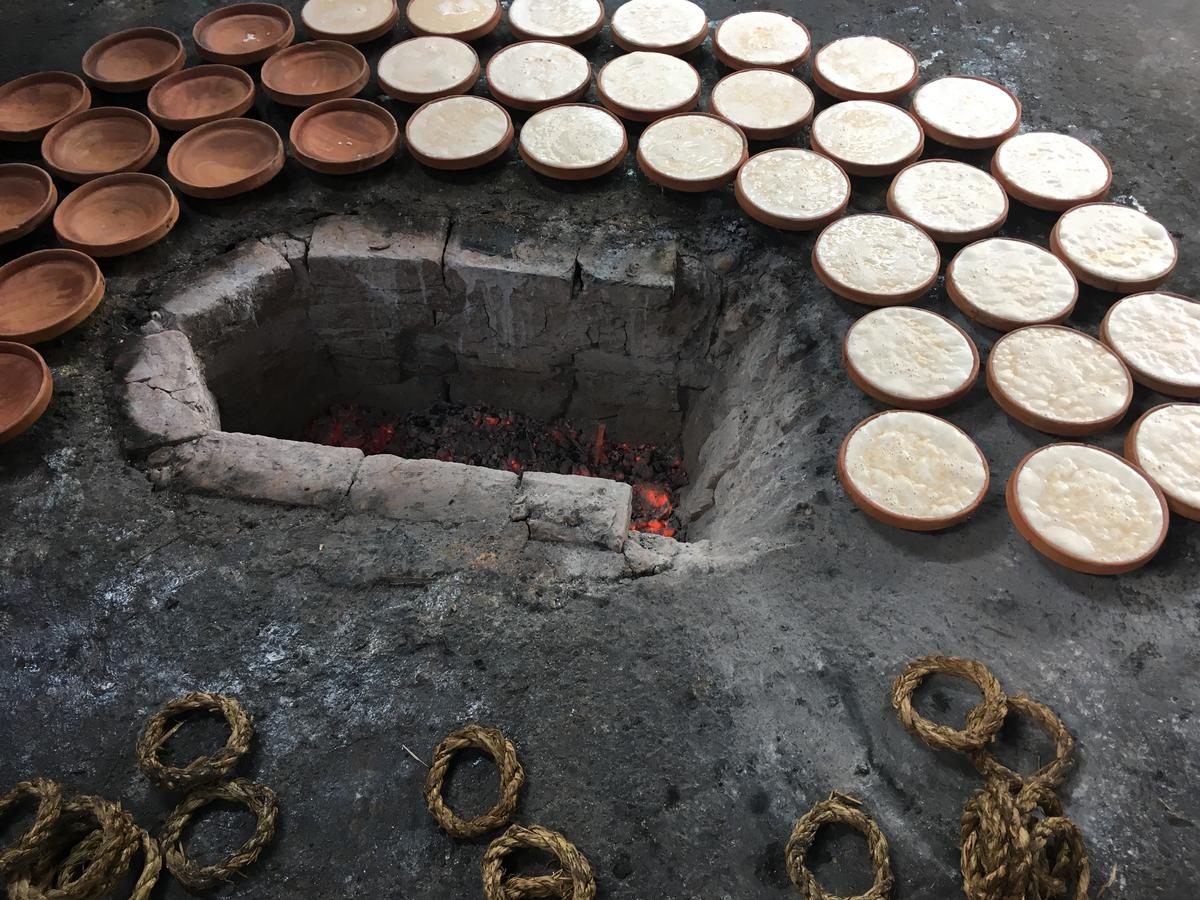
Bogurar Doi being made in Bangladesh

Bogurar Doi being made in Bangladesh
| Photo Credit:
Ishita Dey

Caste and religion

In North India, it is the halwai caste who make the sweets. “In Bengal, historically mayaras (also spelt as mayra, maira, or moira) are associated with sweet making. Take any famous sweet such as jalbhara sandesh (sandesh with a scented liquid filling) or the monohora, all legends revolve around mayaras.” The book touches on historical events, such as how the introduction of refined sugar resulted in closure of indigenous sugar mills, and it affected the community. “In Chapter 3 I discuss in these caste associations in great detail, their close ties with the legends of origin and despite the populism of the craft, the social disdain that the mayaras faced,” Ishita explains. Apart from mayaras, there are many Muslim families who were traditionally associated with sweet making. “I write about one such family who ran a successful sweetshop in Natore. In Bangladesh, Ghosh’s (is this the name of a sweet shop?) enjoy mythic status similar to mayaras.”

At the event in Champaca, the author will be in conversation with Elizabeth Yorke, a chef and food systems researcher.

The book discussion is on May 30, 6.30 PM. At Champaca Bookstore, Indiranagar, Bengaluru. To register, head to champaca.in

Published – May 29, 2026 09:11 am IST


Source link

Nation Tags:author ishita dey, bengali sweets, caste in bengal, food books, Sweet Excess: Crafting Mishti in Bengal, sweets in bengal history

Post navigation

Previous Post: Rupee rises 5 paise to 95.53 against U.S. dollar in early trade
Next Post: India, Canada launch trade and investment forum to strengthen economic partnership

Related Posts

  • Access Denied
    Access Denied Nation
  • Access Denied
    Access Denied Nation
  • Access Denied
    Access Denied Nation
  • Access Denied
    Access Denied Nation
  • Access Denied Nation
  • Access Denied
    Access Denied Nation

More Related Articles

Chandni Chowk Was Among Least Polluted In Delhi For 2 Days. Here’s Why Chandni Chowk Was Among Least Polluted In Delhi For 2 Days. Here’s Why Nation
Access Denied Access Denied Nation
PM Modi’s Poland Visit: Retracing Historical India-Poland Ties PM Modi’s Poland Visit: Retracing Historical India-Poland Ties Nation
20 coastal panchayats in Ernakulam demand inclusion of tidal flooding in disaster list 20 coastal panchayats in Ernakulam demand inclusion of tidal flooding in disaster list Nation
What iPhone Maker Foxconn Boss Young Liu Said On Row Over Hiring “Discrimination” In India What iPhone Maker Foxconn Boss Young Liu Said On Row Over Hiring “Discrimination” In India Nation
SiteLock

Archives

  • May 2026
  • April 2026
  • March 2026
  • February 2026
  • January 2026
  • December 2025
  • November 2025
  • October 2025
  • September 2025
  • August 2025
  • July 2025
  • June 2025
  • May 2025
  • April 2025
  • March 2025
  • February 2025
  • January 2025
  • December 2024
  • November 2024
  • October 2024
  • September 2024
  • August 2024
  • July 2024
  • June 2024
  • May 2024
  • April 2024
  • March 2024
  • February 2024
  • January 2024
  • December 2023
  • November 2023
  • October 2023
  • September 2023
  • August 2023
  • July 2023
  • June 2023
  • May 2023
  • April 2023
  • March 2023
  • February 2023
  • January 2023
  • December 2022
  • November 2022
  • October 2022
  • September 2022
  • August 2022
  • July 2022
  • June 2022
  • May 2022

Categories

  • Business
  • Nation
  • Science
  • Sports
  • World

Recent Posts

  • Prime Minister Narendra Modi’s ‘extreme moral cowardice’ for standing as Israel’s strongest supporter: Congress
  • Stock markets climb in early trade amid drop in oil prices
  • Blue Origin rocket explodes on launch pad during engine-firing test
  • India, Canada launch trade and investment forum to strengthen economic partnership
  • How caste, religion and history shape traditional Bengali sweets

Recent Comments

  1. CharlesImmon on UP Teacher Who Asked Students To Slap Muslim Classmate
  2. CharlesInics on UP Teacher Who Asked Students To Slap Muslim Classmate
  3. DavidExpob on UP Teacher Who Asked Students To Slap Muslim Classmate
  4. FidelQueks on UP Teacher Who Asked Students To Slap Muslim Classmate
  5. AndrewSweam on UP Teacher Who Asked Students To Slap Muslim Classmate
  • A Look At His Past Wins
    A Look At His Past Wins Nation
  • Iran sentences Nobel peace laureate Mohammadi to six years in prison: lawyer
    Iran sentences Nobel peace laureate Mohammadi to six years in prison: lawyer World
  • After Dismissing Kohli, Rohit, Rahul And Gill, SL Star Picks No. 1 Batter
    After Dismissing Kohli, Rohit, Rahul And Gill, SL Star Picks No. 1 Batter Sports
  • Access Denied Sports
  • Access Denied
    Access Denied Nation
  • Access Denied Business
  • EU Warns Musk Before Interview With Trump
    EU Warns Musk Before Interview With Trump World
  • Access Denied Business

Editor-in-Chief:
Mohammad Ariff,
MSW, MAJMC, BSW, DTL, CTS, CNM, CCR, CAL, RSL, ASOC.
editor@artifex.news

Associate Editors:
1. Zenellis R. Tuba,
zenelis@artifex.news
2. Haris Daniyel
daniyel@artifex.news

Photograher:
Rohan Das
rohan@artifex.news

Artifex.News offers Online Paid Internships to college students from India and Abroad. Interns will get a PRESS CARD and other online offers.
Send your CV (Subjectline: Paid Internship) to internship@artifex.news

Links:
Associate Journalism
About Us
Privacy Policy

News Links:
Breaking News
World
Nation
Sports
Business
Entertainment
Lifestyle

Registered Office:
72/A, Elliot Road, Kolkata - 700016
Tel: 033-22277777, 033-22172217
Email: office@artifex.news

Editorial Office / News Desk:
No. 13, Mezzanine Floor, Esplanade Metro Rail Station,
12 J. L. Nehru Road, Kolkata - 700069.
(Entry from Gate No. 5)
Tel: 033-46011099, 033-46046046
Email: editor@artifex.news

Copyright © 2023 Artifex.News Newsportal designed by Artifex Infotech.