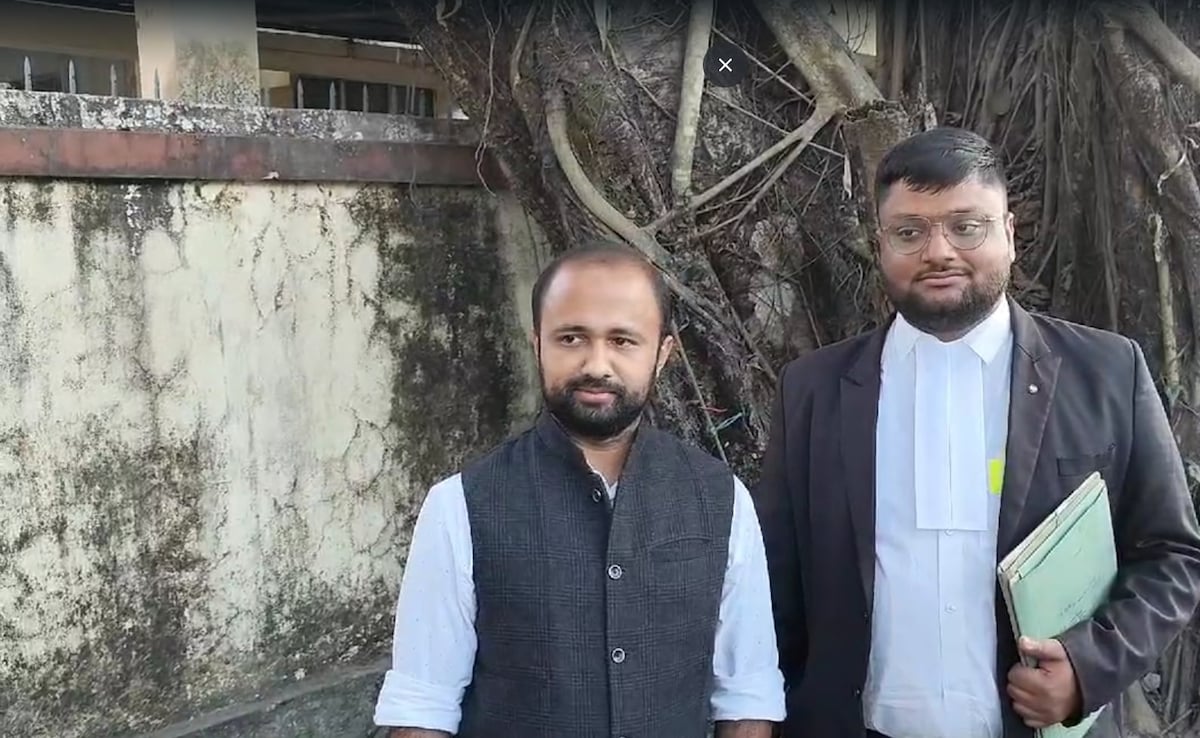





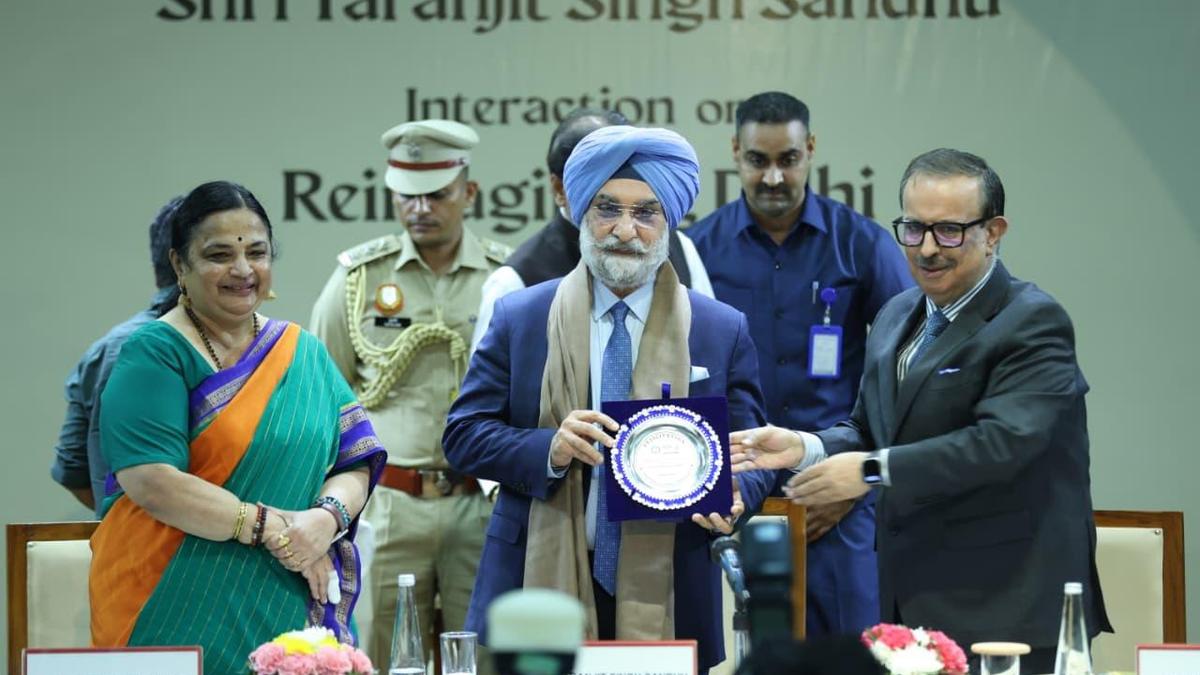
L-G Taranjit Singh Sandhu being felicitated by JNU V-C Santishree Dhulipudi Pandit and Amitabh Mattoo, Dean and Professor, School of International Studies, on Friday.
| Photo Credit: Special arrangement
Lieutenant-Governor (L-G) Taranjit Singh Sandhu on Friday said Delhi must move beyond being only the country’s political capital and become a future-ready global city built on five pillars: sustainability, inclusion, culture, innovation and economic growth, and compassion.
He was speaking at a felicitation ceremony organised for him by Jawaharlal Nehru University’s School of International Studies, of which he is an alumnus. Mr. Sandhu said Delhi has continuously evolved over centuries and is now at another important stage in its development.
“Delhi is not merely a city. It is a living civilisational narrative,” he said, tracing the city’s journey from Indraprastha to Shahjahanabad and from the Lutyens’ zone to the aspirations of a modern global capital.
Referring to Prime Minister Narendra Modi’s vision for the Capital, the L-G said, “Reimagining Delhi is not about infrastructure but the very experience of urban living.” He added that governance must remain “responsive, accessible and humane”.
On sustainability, which he described as the first pillar of Delhi’s future, Mr. Sandhu said no city could aspire for global leadership without sincerely addressing environmental challenges. Aiming for cleaner air, rejuvenated water bodies, increased green cover, better waste management, renewable energy adoption, and sustainable mobility systems should become central to Delhi’s urban vision, the L-G said.
Yamuna revival
“The Yamuna must be restored as the ecological and cultural lifeline of the city,” he said while calling for stronger public transport systems, expansion of electric mobility, pedestrian-friendly streets and better cycling infrastructure as part of the city’s future planning.
Highlighting inclusion as another key pillar, Mr. Sandhu said a truly global capital must ensure equal opportunities for all sections of society. “Reimagining Delhi means creating a city that is empathetic to the elderly, accessible to persons with disabilities, safe for women, supportive of children, respectful towards workers, and caring towards the underprivileged,” he said.
Retaining cultural soul
Emphasising Delhi’s cultural legacy, Mr. Sandhu said modernisation should not come at the cost of the city’s heritage. “As we modernise Delhi, we must ensure that we do not lose its cultural memory. Instead, we must strengthen Delhi’s position as a global cultural capital,” he said, calling for investments in museums, public art, heritage restoration, creative industries and cultural tourism.
Describing compassion as the “most important pillar”, Mr. Sandhu said the true measure of a city lay not only in its skyline or infrastructure but also in its humanity. He said the challenges like urbanisation, environmental pressures, population growth, and mobility required coordinated action and long-term planning. “If we work collectively, Delhi can emerge as one of the most admired and future-ready capitals in the world,” he said.
Published – May 09, 2026 01:08 am IST