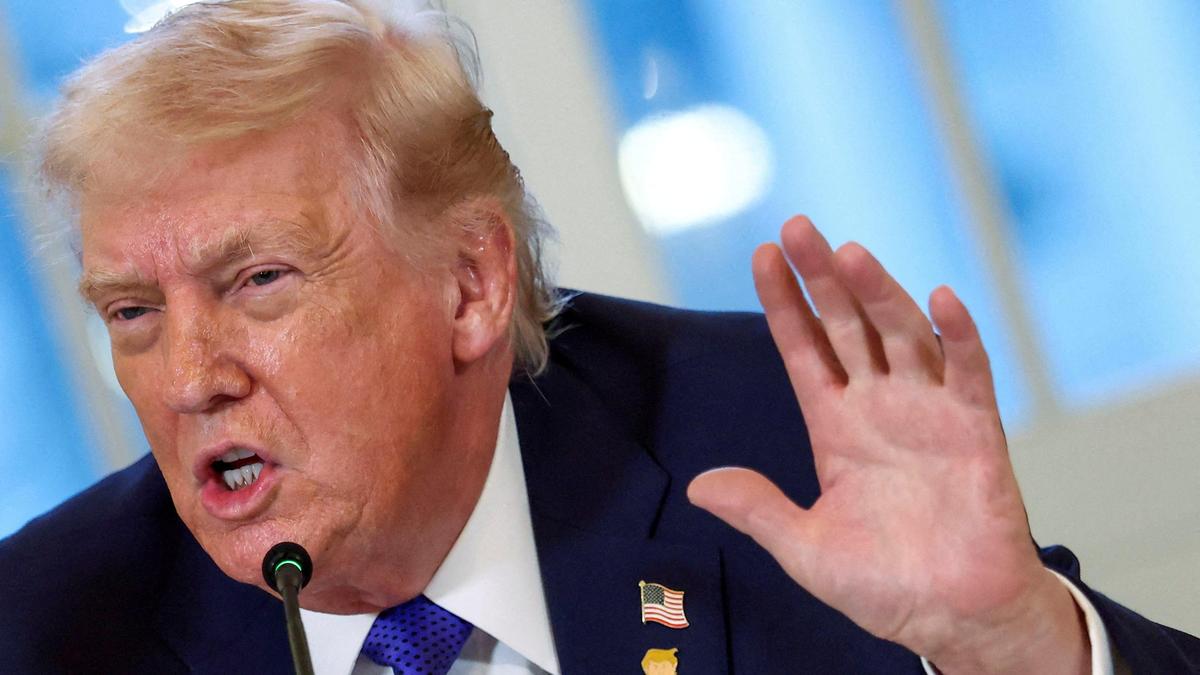



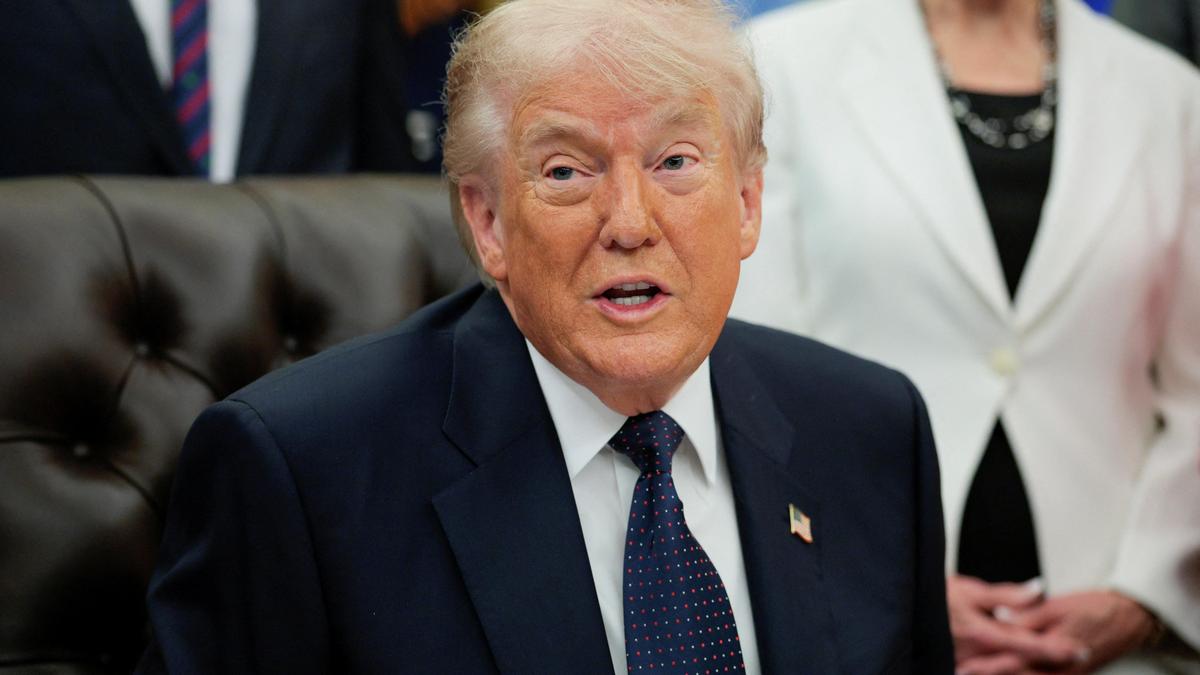
U.S. President Donald Trump speaks during an event to sign a memorandum in the Oval Office at the White House in Washington, D.C., U.S.
(This article is part of the View From India newsletter curated by The Hindu’s foreign affairs experts. To get the newsletter in your inbox every Monday, subscribe here.)
On Monday, President Donald Trump said the U.S. would “guide commercial ships” through the Strait of Hormuz, which Iran has effectively blocked after it was attacked by the U.S. and Israel on February 28. Mr. Trump said any interference with the ‘Operation Project Freedom’ would be dealt with “forcefully”. What followed was chaos, uncertainty and violence. The U.S. said it sent two destroyers through the strait to the Persian Gulf to lead the operation. Iran’s Islamic Revolutionary Guard Corps (IRGC) said it hit American ships and pushed them back. The U.S. said two merchant ships exited the strait with U.S. guidance. But that’s not the end of the story. A UAE tanker was attacked off the Omani coast and was caught fire. An oil facility in Fujairah, one of the UAE emirates, was attacked on Monday, day one of Operation Project Freedom, injuring three people. The U.S. Central Command said it sank six Iranian small boats in the waters of the Gulf of Oman. Iran said the U.S. fired on civilian boats and killed five civilians. On Tuesday, when the ceasefire appeared to be on the brink, the Pentagon said the truce with Iran was holding despite the recent tensions. Hours after, the UAE reported another missile and drone attack.
On Tuesday evening (U.S. time), Mr. Trump said he was suspending Operation Project Freedom, citing that the U.S. and Iran had made “great progress” towards a deal. Mr. Trump has been saying from the early days of the war that a deal was within reach. Yet, it proved difficult again and again for Mr. Trump to get out of the war with a satisfying agreement. He said the U.S. forces had destroyed Iran’s military capabilities. Yet, the U.S. has no meaningful military option to reopen the Strait of Hormuz. The Operation Project Freedom was an attempt to use military force to reopen the waterway. But by attacking the UAE and a vessel in the Gulf waters, Iran has sent a clear message to the U.S.–any bid to use force to reopen the choekpoint would be met with force. And then Mr. Trump took a U-turn, just hours after he rolled out the operation.
The situation remains tense. Iran has been battered economically by the war. But it has repeatedly said it would not make compromises on its core positions, including its control over the Hormuz Strait. Despite mounting economic woes, Iran’s government has projected strength and unity at home by mobilising its supporters. Saurabh Shukla and Saurabh Shahi have reported for The Hindu from Tehran about the mood in the city. They saw a city that refuses to sleep and cave in. Read here: Sleepless in Tehran as crowds rally behind the flag.
India has “strongly condemned” the attacks on the UAE, its close partner in the region, without naming Iran. Prime Minister Narendra Modi, who is expected to visit Abu Dhabi in the coming days, said: “[I] strongly condemn the attacks on the UAE that resulted in injuries to three Indian nationals. Targeting civilians and infrastructure is unacceptable.” Earlier on Tuesday (May 5, 2026), the External Affairs Ministry also issued a statement calling the attack “unacceptable” and said the “targeting of civilian infrastructure and innocent civilians” must end.
The Top Five
1. The Iran conflict and the future of Shia identity
Shia identity faces the possibility of fragmentation or radical consolidation, writes Mohammed AyoobMohammed Ayoob.
2. OPEC | Cracks in the oil crown
The cartel, already grappling with changes in the global energy landscape, geopolitical tensions, and declining influence, faces a litmus test with the exit of the UAE, one of its top oil producers with capacity to influence the market, writes Smriti Sudesh.
3. Nepal’s Army in spotlight as new government takes assertive turn
Since the new government was formed a month ago, concerns have grown about Nepal’s civic space shrinking and democratic norms being undermined, as Mr. Shah focuses on delivery and speed, writes Sanjeev Satgainya from Kathmandu.
4. Fibre-optic drones | The phantom that flies
The small first-person view attack machines have emerged as a disruptive force in the Russia-Ukraine war and parts of the West Asia conflict, writes Murali N. Krishnaswamy.
5. Between a fatwa and war: how Iran makes sense of its nuclear capability
Iran has ‘vowed’ to protect its nuclear stockpile against Trump’s threats even as its former Ayatollah Ali Khamenei disapproved of using nuclear weapons on religious grounds, writes Vasudevan Mukunth.
Published – May 06, 2026 12:42 pm IST