


Skip to content
  • Facebook
  • X
  • Linkedin
  • WhatsApp
  • YouTube
  • Associate Journalism
  • About Us
  • Privacy Policy
  • 033-46046046
  • editor@artifex.news
Artifex.News

Artifex.News

Stay Connected. Stay Informed.

  • Breaking News
  • World
  • Nation
  • Sports
  • Business
  • Science
  • Entertainment
  • Lifestyle
  • Toggle search form
  • Hardik Pandya Picked For T20 WC ‘Under Pressure’; Rohit Sharma, Ajit Agarkar Against It: Report
    Hardik Pandya Picked For T20 WC ‘Under Pressure’; Rohit Sharma, Ajit Agarkar Against It: Report Sports
  • New climate data set for India unveiled by Azim Premji University
    New climate data set for India unveiled by Azim Premji University Science
  • Nine-Man East Bengal Hold Firm To Hold Mohammedan Sporting, Secure First Point Of Season
    Nine-Man East Bengal Hold Firm To Hold Mohammedan Sporting, Secure First Point Of Season Sports
  • India ends home-leg with another loss
    India ends home-leg with another loss Sports
  • Sci-Five | The Hindu Science Quiz: On Venus
    Sci-Five | The Hindu Science Quiz: On Venus Science
  • Women biotech scientists await funds for research
    Women biotech scientists await funds for research Science
  • Congo Army Says It Stopped Attempted Coup Near Felix Tshisekedi Office In Kinshasa Involving Several Americans, British Man
    Congo Army Says It Stopped Attempted Coup Near Felix Tshisekedi Office In Kinshasa Involving Several Americans, British Man World
  • Mob Tries To Stop CRPF, Cops From Destroying Illegal Poppy Fields In Manipur’s Kangpokpi, 4 Vehicles Damaged
    Mob Tries To Stop CRPF, Cops From Destroying Illegal Poppy Fields In Manipur’s Kangpokpi, 4 Vehicles Damaged Nation
Scientists at CERN took some antiprotons out for a spin in a never-tried-before test drive

Scientists at CERN took some antiprotons out for a spin in a never-tried-before test drive

Posted on March 24, 2026 By admin


Scientists in Geneva took some antiprotons out for a spin — a very delicate one — in a truck, in a never-tried-before test drive that has been deemed a success.

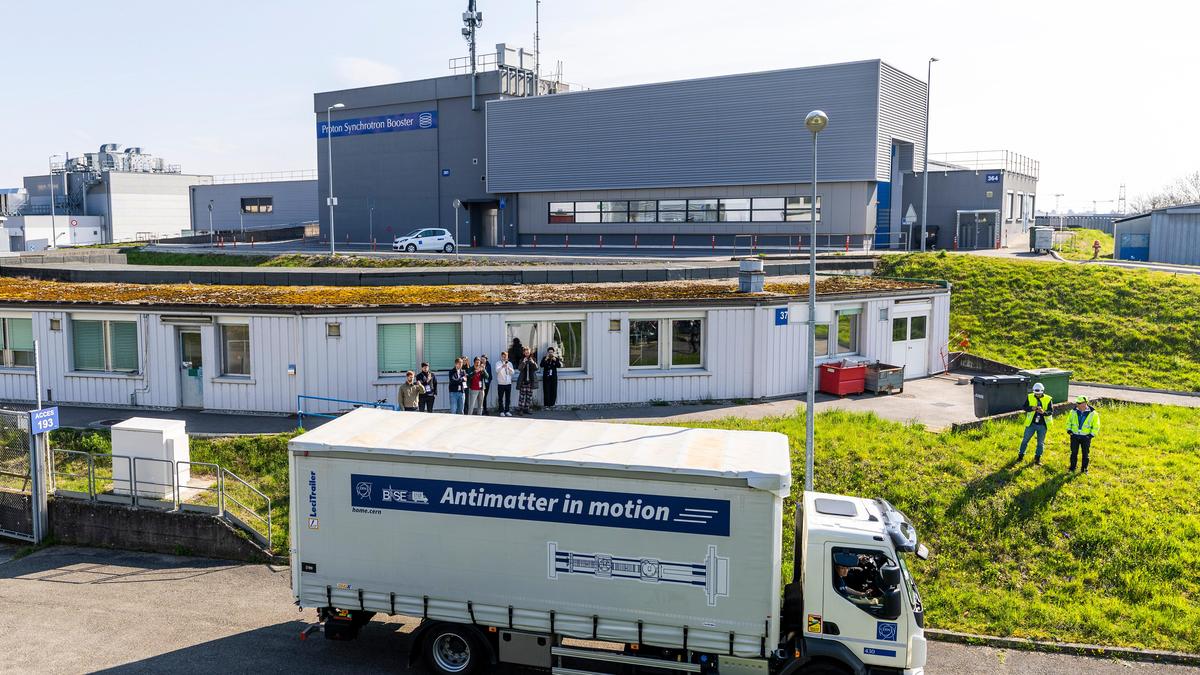
If this so-called antimatter came into contact with actual matter, even for a fraction of an instant, it would have been annihilated in a quick flash of energy. So experts at the European Organization for Nuclear Research, known as CERN, over the course of four hours on Tuesday (March 24, 2026), brought about 100 antiprotons on the road.

The antiprotons were suspended in a vacuum inside a specially designed box and held in place by supercooled magnets.

After easing them from the lab and onto the truck, the scientists transported the antimatter on a half-hour drive to test how — if at all — the infinitesimal particles could be transported by road without seeping out. The antiprotons were then taken back to the lab in Tuesday’s (March 24, 2026) final stage that concluded with applause and a bottle of Champagne.

CERN spokeswoman Sophie Tesauri called the experiment successful. It was not immediately clear how many antiprotons had survived the entire journey, but roughly 91 of 100 were still there after the truck’s trip.

The hard part: Manipulating antimatter, like antiprotons, can be tricky business. As scientists understand the universe today, for every type particle that exists, there is a corresponding antiparticle, exactly matching the particle but with an opposite charge.

If those opposites come into contact, they “annihilate” each other, setting off lots of energy, depending on the masses involved. Any bumps in the road on the test journey that aren’t compensated for by the specially-designed box could spoil the whole exercise.

“The motivation behind these experiments is to compare matter and antimatter with extremely high accuracy and watch for differences which we might have not seen yet,” said Stefan Ulmer, the leader and spokesperson for Tuesday’s (March 24, 2026) experiment.

And Tuesday’s (March 24, 2026) practice was a first step toward making good on hopes, one day, to deliver CERN antiprotons to researchers at Heinrich Heine University in Düsseldorf, Germany, which is about eight hours away in normal driving conditions.

“We are scientists. We want to understand something about the fundamental symmetries of nature, and we know that if we do these experiments outside of this accelerator facility, we can measure 100 to 1000 times better,” Dr. Ulmer said.

The antiprotons were encased in a 1,000-kg box called a “transportable antiproton trap.” It was compact enough to fit through ordinary laboratory doors and fit on a truck. It used superconducting magnets cooled to -269°C (-452°F) that allowed the antiprotons to be remain suspended in a vacuum — not touching the inner walls, which are made of… matter.

The mass in the test — slightly less than that of about 100 hydrogen atoms — is so little, experts say, that the worst possible outcome was the loss of the antiprotons. Even if they did touch matter, any release of energy would be unnoticeable, only an oscilloscope, which picks up electrical signals, was be able to detect it.

The trap, says Ms. Tesauri, “is supposed to contain these antiprotons no matter what: if the truck stops, if it starts again, if it has to slam on the brakes — all that”. Work remains: The trap can contain the antiprotons on its own for only about four hours, and the drive to Düsseldorf is twice that.

The Geneva-based centre is best known for its Large Hadron Collider, a network of magnets that accelerates particles through a 27-km (17-mile) underground tunnel and slams them together at velocities approaching the speed of light. Scientists then study the results of those collisions.

But the sprawling, buzzing complex of scientific experiment is more than just about smashing atoms together: the World Wide Web, for example, was invented here by Britain’s Tim Berners-Lee in 1989.

Heinrich Heine University is seen as a better place to study antiprotons in-depth because CERN, with all its other activities, generates a lot of magnetic interference that can skew the study of antimatter.

But to get them there, those antiprotons will have to avoid touching anything on the way.

The centre’s Antiproton Decelerator, where a proton beam gets fired into a block of metal, causes collisions that generate secondary particles, including lots of antiprotons. It’s billed as a unique machine that produces low-energy antiprotons for the study of antimatter.

CERN’s “Antimatter Factory”, lab officials say, is the only place in the world where scientists can store and study antiprotons.

The centre has been experimenting with antimatter for years, and has made breakthroughs on measurement, storage and interaction of antimatter. Two years ago, the team transported a “cloud” of about 70 protons — not antiprotons — across CERN’s campus.

It was a similar drill this time, except that with antiprotons, a much better vacuum chamber is needed, according to Christian Smorra, head of a team behind the apparatus designed to store and transport antimatter.

Published – March 24, 2026 07:43 pm IST


Source link

Science Tags:antiprotons for a delicate spin, antiprotons on road trip, CERN, CERN antiproton experiment, European Organization for Nuclear Research

Post navigation

Previous Post: Access Denied
Next Post: Access Denied

Related Posts

  • ISRO to hold more tests for Gaganyaan in coming months
    ISRO to hold more tests for Gaganyaan in coming months Science
  • The Science Quiz | How well acquainted are you with your face?
    The Science Quiz | How well acquainted are you with your face? Science
  • Putin aims to have Russian space station by 2027
    Putin aims to have Russian space station by 2027 Science
  • Climate change and how hurricane Milton became a Category 5 storm
    Climate change and how hurricane Milton became a Category 5 storm Science
  • What is mathematical realism? – The Hindu
    What is mathematical realism? – The Hindu Science
  • Solar Eclipse February 2026: Where, when and how to watch it in India?
    Solar Eclipse February 2026: Where, when and how to watch it in India? Science

More Related Articles

NASA shifts UFO debate from sensationalism to science | Data NASA shifts UFO debate from sensationalism to science | Data Science
Artemis II, the international space race, and what is at stake for the U.S. Artemis II, the international space race, and what is at stake for the U.S. Science
Why airlines cancel flights after volcanic eruptions Why airlines cancel flights after volcanic eruptions Science
What triggers the flowering of durians? What triggers the flowering of durians? Science
What is ethical hacking? – The Hindu What is ethical hacking? – The Hindu Science
SpaceX delayed Polaris Dawn launch by at least 1 day, due to weather and technical issues SpaceX delayed Polaris Dawn launch by at least 1 day, due to weather and technical issues Science
SiteLock

Archives

  • May 2026
  • April 2026
  • March 2026
  • February 2026
  • January 2026
  • December 2025
  • November 2025
  • October 2025
  • September 2025
  • August 2025
  • July 2025
  • June 2025
  • May 2025
  • April 2025
  • March 2025
  • February 2025
  • January 2025
  • December 2024
  • November 2024
  • October 2024
  • September 2024
  • August 2024
  • July 2024
  • June 2024
  • May 2024
  • April 2024
  • March 2024
  • February 2024
  • January 2024
  • December 2023
  • November 2023
  • October 2023
  • September 2023
  • August 2023
  • July 2023
  • June 2023
  • May 2023
  • April 2023
  • March 2023
  • February 2023
  • January 2023
  • December 2022
  • November 2022
  • October 2022
  • September 2022
  • August 2022
  • July 2022
  • June 2022
  • May 2022

Categories

  • Business
  • Nation
  • Science
  • Sports
  • World

Recent Posts

  • Fuel price hike amid West Asia crisis comes as a bolt from the blue
  • Thoothukudi Collector felicitates schools with 100% pass rate in class XII public examination
  • ‘Xi asked me if the U.S. will defend Taiwan’, says Trump
  • Germany’s Merz ‘wouldn’t advise’ his children to live in U.S.
  • Collector calls for new tourism circuits in Visakhapatnam district

Recent Comments

  1. Davidcag on UP Teacher Who Asked Students To Slap Muslim Classmate
  2. Hectortek on UP Teacher Who Asked Students To Slap Muslim Classmate
  3. Hectortek on UP Teacher Who Asked Students To Slap Muslim Classmate
  4. MatthewReure on UP Teacher Who Asked Students To Slap Muslim Classmate
  5. CharlesHoups on UP Teacher Who Asked Students To Slap Muslim Classmate
  • Access Denied
    Access Denied Nation
  • Access Denied Sports
  • Access Denied World
  • Lt Governor On AAP’s Objection To ‘Shivling’ Fountains
    Lt Governor On AAP’s Objection To ‘Shivling’ Fountains Nation
  • The many myths about protein deficiency in people in India
    The many myths about protein deficiency in people in India Science
  • Access Denied
    Access Denied Nation
  • Badminton: PV Sindhu, Lakshya Sen Cruise To Syed Modi International Super 300 Second Round
    Badminton: PV Sindhu, Lakshya Sen Cruise To Syed Modi International Super 300 Second Round Sports
  • Access Denied
    Access Denied Nation

Editor-in-Chief:
Mohammad Ariff,
MSW, MAJMC, BSW, DTL, CTS, CNM, CCR, CAL, RSL, ASOC.
editor@artifex.news

Associate Editors:
1. Zenellis R. Tuba,
zenelis@artifex.news
2. Haris Daniyel
daniyel@artifex.news

Photograher:
Rohan Das
rohan@artifex.news

Artifex.News offers Online Paid Internships to college students from India and Abroad. Interns will get a PRESS CARD and other online offers.
Send your CV (Subjectline: Paid Internship) to internship@artifex.news

Links:
Associate Journalism
About Us
Privacy Policy

News Links:
Breaking News
World
Nation
Sports
Business
Entertainment
Lifestyle

Registered Office:
72/A, Elliot Road, Kolkata - 700016
Tel: 033-22277777, 033-22172217
Email: office@artifex.news

Editorial Office / News Desk:
No. 13, Mezzanine Floor, Esplanade Metro Rail Station,
12 J. L. Nehru Road, Kolkata - 700069.
(Entry from Gate No. 5)
Tel: 033-46011099, 033-46046046
Email: editor@artifex.news

Copyright © 2023 Artifex.News Newsportal designed by Artifex Infotech.