

Skip to content
  • Facebook
  • X
  • Linkedin
  • WhatsApp
  • Associate Journalism
  • About Us
  • Privacy Policy
  • 033-46046046
  • editor@artifex.news
Artifex.News

Artifex.News

Stay Connected. Stay Informed.

  • Breaking News
  • World
  • Nation
  • Sports
  • Business
  • Science
  • Entertainment
  • Lifestyle
  • Toggle search form
  • ASHA Worker Allegedly Forces Daughter-In-Law To Miscarry Fearing 3rd Girl Child
    ASHA Worker Allegedly Forces Daughter-In-Law To Miscarry Fearing 3rd Girl Child Nation
  • In Ujjain Rape Case, Those Who Didn’t Help Teen May Face Charges
    In Ujjain Rape Case, Those Who Didn’t Help Teen May Face Charges Nation
  • Delhi Schools Asked To Move To “Hybrid Mode” After Supreme Court Observations
    Delhi Schools Asked To Move To “Hybrid Mode” After Supreme Court Observations Nation
  • AAP Appoints Punjab Minister Aman Arora As New President Of Its State Unit
    AAP Appoints Punjab Minister Aman Arora As New President Of Its State Unit Nation
  • New research traces how Africa’s wildcats became today’s house cats
    New research traces how Africa’s wildcats became today’s house cats Science
  • Out On Bail, AAP’s Manish Sisodia To Begin Padyatras Across Delhi Today
    Out On Bail, AAP’s Manish Sisodia To Begin Padyatras Across Delhi Today Nation
  • Access Denied Business
  • Actor Parthiban meets Deputy CM Pawan Kalyan
    Actor Parthiban meets Deputy CM Pawan Kalyan Nation
How do astronauts return from space and survive re-entry?

How do astronauts return from space and survive re-entry?

Posted on March 1, 2026 By admin


The ascent of a launch vehicle is a battle against gravity to gain the immense velocity required to stay in orbit — while re-entry is a struggle against the atmosphere to shed that same energy in a systematic way.

Initially, aerospace scientists believed that surviving atmospheric re-entry would be impossible because the massive kinetic energy of an orbiting space capsule would be converted into intense heat energy upon re-entry. The resulting temperatures would be so extreme that they would melt any known structural material. The breakthrough came with the blunt body theory, which proved that if the space capsule’s forebody is rounded with a large radius, it can deflect most of the re-entry heat into the surrounding air rather than being directed into the capsule.

More than 98% energy of a re-entering capsule is dissipated through the atmosphere and converted into heat. The capsule is shielded from this intense thermal environment by its heatshield, which has a robust thermal protection system: it dissipates the heat through either ablation — where the material sacrificially chars and erodes to carry heat away — or thermal insulation, which uses low-conductivity materials to prevent the heat from reaching the capsule’s primary structure.

What is a re-entry corridor?

To return to earth, a space capsule must break its orbit by reducing its velocity. It does this by performing a deorbit burn: turning 180 degrees and firing its engines in the opposite direction of its travel. Since forward speed is what maintains the orbit, losing that speed allows gravity to overcome the capsule’s centrifugal force. The capsule then drops out of its stable circular path and enters a shallow, downward elliptical curve, leading it into the upper atmosphere for re-entry.

The re-entry corridor is a precise atmospheric window that a spacecraft must hit to return safely, balanced between two extremes. If the entry angle is too shallow (the overshoot boundary), the capsule will act like a stone skipping across a pond, bouncing off the atmosphere back into space. Conversely, if the angle is too steep (the undershoot boundary), the capsule will hit the dense air too hard, generating lethal deceleration forces and frictional heat that exceed what the crew and capsule can survive.

What is a semi-ballistic body?

A ballistic body behaves like a falling stone: it cannot steer by itself and is slowed only by the air resistance (drag). In contrast, a semi-ballistic body flies at a specific angle, known as the angle of attack. This is achieved by intentionally offsetting its centre of gravity laterally, causing the body to fly at an angle relative to the oncoming air.

As the vehicle slams into the atmosphere at hypersonic speeds, this angle forces the air to flow asymmetrically over the body, creating an aerodynamic lift force apart from the drag force, which acts perpendicular to the direction of velocity. This lift force is strategically manipulated to allow the capsule to glide and bank through the atmosphere, providing the cross-range capability necessary to steer it precisely toward a targeted landing zone.

What is a communication blackout?

Another issue during re-entry is the communication blackout. The extreme heat generated during re-entry strips electrons from air molecules, turning it into a layer of ionised plasma. This plasma sheath acts like a metallic bubble around the capsule that reflects and blocks radio waves. Because signals cannot pass through this electrified layer, it causes a communication blackout, leaving the crew and ground control unable to speak to each other until the capsule slows down enough for the plasma to vanish.

To manage the dreaded communication blackout during re-entry, engineers utilise a combination of orbital relay networks and high-frequency signal physics. By transmitting data upward to relay satellites (such as NASA’s TDRSS) rather than downward to ground stations, the signal passes through the thinner, less dense regions of the plasma sheath in the rear of the capsule.

Why are parachutes deployed for landing?

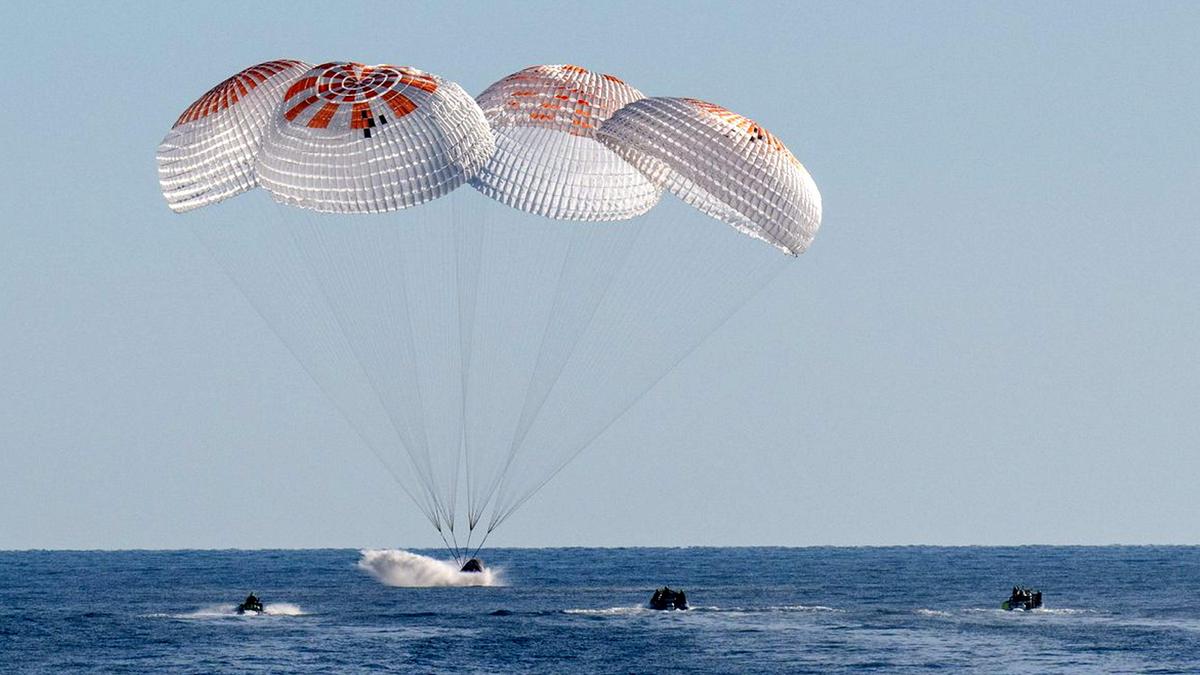
When a capsule re-enters the atmosphere, it is decelerated by aerobraking, which is the process of using atmospheric drag to slow down a capsule. As the air density increases at lower altitudes, the capsule’s speed drops until it approaches its terminal velocity — the point where the upward force of air resistance balances the downward pull of gravity. Any further reduction in velocity has to be achieved by deploying additional aerodynamic surfaces like parachutes. For a capsule returning from space, the terminal velocity in the lower atmosphere is still hundreds of kilometres per hour, far too fast for a safe landing. Practically, even before reaching the terminal velocity, the parachute has to be deployed to reduce the velocity further to make a soft landing in the sea.

How will the Gaganyaan crew module re-enter?

ISRO pioneered its re-entry capabilities with the 2007 Space Capsule Recovery Experiment (SRE), proving it could safely return an orbiting craft to earth. This was further advanced by the 2014 Crew Module Atmospheric Re-entry Experiment (CARE), which validated the full-scale thermal protection and parachute systems essential for surviving the extreme heat of a sub-orbital re-entry.

The Gaganyaan orbital module has two parts: the crew module (CM) and the service module (SM). The orbital module will be de-orbited by the thrusters in the SM and after that, the SM will separate and be destroyed by the intense heat of re-entry. Upon atmospheric re-entry, the CM maintains its trajectory within the re-entry corridor, strictly avoiding undershoot and overshoot boundaries. Operating as a semi-ballistic body, the CM executes controlled manoeuvres to reach its targeted landing site by modulating its lift vector through bi-propellant thruster firings.

Once the module reaches lower altitudes, a three-stage redundant parachute system is deployed to ensure a safe and smooth splashdown in the Bay of Bengal, which is the primary landing zone for the mission.

Unnikrishnan Nair S. is Former Director, VSSC and IIST; Founding Director, HSFC; and an expert in launch vehicle systems, orbital re-entry and human spaceflight technologies. Currently Dr Sarabhai Professor at VSSC

Published – March 02, 2026 06:00 am IST



Source link

Science

Post navigation

Previous Post: Access Denied
Next Post: Kerala Chief Minister’s moment with young landslide survivor takes political turn

Related Posts

  • Starless and forever alone: more ‘rogue’ planets discovered
    Starless and forever alone: more ‘rogue’ planets discovered Science
  • SpaceX launches its mega Starship rocket on fifth test flight
    SpaceX launches its mega Starship rocket on fifth test flight Science
  • How is India responding to crowding disasters? | Explained
    How is India responding to crowding disasters? | Explained Science
  • Smart Irrigation Plan can save 10-30% of irrigation water in drought-prone regions: IIT Bombay research
    Smart Irrigation Plan can save 10-30% of irrigation water in drought-prone regions: IIT Bombay research Science
  • Healthocide: war against healthcare – The Hindu
    Healthocide: war against healthcare – The Hindu Science
  • ISRO identifies site for Chandrayaan-4 lander
    ISRO identifies site for Chandrayaan-4 lander Science

More Related Articles

Four gurukula students from Telangana nominated for Sakura Science Programme in Japan Four gurukula students from Telangana nominated for Sakura Science Programme in Japan Science
ISRO dispatches crew module for first uncrewed mission of Gaganyaan ISRO dispatches crew module for first uncrewed mission of Gaganyaan Science
Chip that steers terahertz beams sets stage for 6G internet Chip that steers terahertz beams sets stage for 6G internet Science
Will chocolate’s future hinge on success of growing cocoa in the lab? Will chocolate’s future hinge on success of growing cocoa in the lab? Science
India could generate 11 million tonnes of solar waste by 2047: Study India could generate 11 million tonnes of solar waste by 2047: Study Science
 Extinct humans occupied the Tibetan plateau 160,000 years ago  Extinct humans occupied the Tibetan plateau 160,000 years ago Science
SiteLock

Archives

  • March 2026
  • February 2026
  • January 2026
  • December 2025
  • November 2025
  • October 2025
  • September 2025
  • August 2025
  • July 2025
  • June 2025
  • May 2025
  • April 2025
  • March 2025
  • February 2025
  • January 2025
  • December 2024
  • November 2024
  • October 2024
  • September 2024
  • August 2024
  • July 2024
  • June 2024
  • May 2024
  • April 2024
  • March 2024
  • February 2024
  • January 2024
  • December 2023
  • November 2023
  • October 2023
  • September 2023
  • August 2023
  • July 2023
  • June 2023
  • May 2023
  • April 2023
  • March 2023
  • February 2023
  • January 2023
  • December 2022
  • November 2022
  • October 2022
  • September 2022
  • August 2022
  • July 2022
  • June 2022
  • May 2022

Categories

  • Business
  • Nation
  • Science
  • Sports
  • World

Recent Posts

  • Access Denied
  • Access Denied
  • Access Denied
  • Access Denied
  • Access Denied

Recent Comments

  1. DomingoKnize on UP Teacher Who Asked Students To Slap Muslim Classmate
  2. Matthewlaw on UP Teacher Who Asked Students To Slap Muslim Classmate
  3. AnthonySew on UP Teacher Who Asked Students To Slap Muslim Classmate
  4. DomingoKnize on UP Teacher Who Asked Students To Slap Muslim Classmate
  5. DouglasSeemn on UP Teacher Who Asked Students To Slap Muslim Classmate
  • Access Denied
    Access Denied Nation
  • After Columbia, Pro-Palestine Protests At Other Top US Universities
    After Columbia, Pro-Palestine Protests At Other Top US Universities World
  • Delhi Records Winter Season’s Coldest Morning At 7.1 Degrees Celsius
    Delhi Records Winter Season’s Coldest Morning At 7.1 Degrees Celsius Nation
  • Access Denied World
  • Jurgen Klopp’s Red Bull Decision ‘Ruined Life’s Work’ Say Dortmund Fans
    Jurgen Klopp’s Red Bull Decision ‘Ruined Life’s Work’ Say Dortmund Fans Sports
  • Multiple People Shot Along Highway In US’ Kentucky, Suspect On The Run
    Multiple People Shot Along Highway In US’ Kentucky, Suspect On The Run World
  • German economy to shrink further in 2024, think-tanks issue statement
    German economy to shrink further in 2024, think-tanks issue statement Business
  • Chirag Paswan Re-Elected Lok Janshakti Party (Ram Vilas) Chief For 5 Years
    Chirag Paswan Re-Elected Lok Janshakti Party (Ram Vilas) Chief For 5 Years Nation

Editor-in-Chief:
Mohammad Ariff,
MSW, MAJMC, BSW, DTL, CTS, CNM, CCR, CAL, RSL, ASOC.
editor@artifex.news

Associate Editors:
1. Zenellis R. Tuba,
zenelis@artifex.news
2. Haris Daniyel
daniyel@artifex.news

Photograher:
Rohan Das
rohan@artifex.news

Artifex.News offers Online Paid Internships to college students from India and Abroad. Interns will get a PRESS CARD and other online offers.
Send your CV (Subjectline: Paid Internship) to internship@artifex.news

Links:
Associate Journalism
About Us
Privacy Policy

News Links:
Breaking News
World
Nation
Sports
Business
Entertainment
Lifestyle

Registered Office:
72/A, Elliot Road, Kolkata - 700016
Tel: 033-22277777, 033-22172217
Email: office@artifex.news

Editorial Office / News Desk:
No. 13, Mezzanine Floor, Esplanade Metro Rail Station,
12 J. L. Nehru Road, Kolkata - 700069.
(Entry from Gate No. 5)
Tel: 033-46011099, 033-46046046
Email: editor@artifex.news

Copyright © 2023 Artifex.News Newsportal designed by Artifex Infotech.