



Skip to content
  • Facebook
  • X
  • Linkedin
  • WhatsApp
  • Associate Journalism
  • About Us
  • Privacy Policy
  • 033-46046046
  • editor@artifex.news
Artifex.News

Artifex.News

Stay Connected. Stay Informed.

  • Breaking News
  • World
  • Nation
  • Sports
  • Business
  • Science
  • Entertainment
  • Lifestyle
  • Toggle search form
  • Wrong To Say It Has No Data
    Wrong To Say It Has No Data Nation
  • Palestinian killed in clashes with Israelis in West Bank
    Palestinian killed in clashes with Israelis in West Bank World
  • Bizarre’ bird-like dinosaur has scientists enthralled 
    Bizarre’ bird-like dinosaur has scientists enthralled  Science
  • Dominant India Storm Into T20 World Cup Final With 68-Run Drubbing Of England
    Dominant India Storm Into T20 World Cup Final With 68-Run Drubbing Of England Sports
  • Indian passengers stranded at Kuwait airport depart for Manchester
    Indian passengers stranded at Kuwait airport depart for Manchester World
  • High Drama In Tamil Nadu Assembly Amid Opposition Protests On Anna University Rape Case
    High Drama In Tamil Nadu Assembly Amid Opposition Protests On Anna University Rape Case Nation
  • In Israel’s Ashkelon, The Iron Dome At Work
    In Israel’s Ashkelon, The Iron Dome At Work World
  • Union Minister Piyush Goyal After US Visit
    Union Minister Piyush Goyal After US Visit Nation
How proteins are being tweaked to be quantum sensors inside the body

How proteins are being tweaked to be quantum sensors inside the body

Posted on February 22, 2026 By admin


For decades, fluorescent proteins have been among the most powerful tools in biology. They glow when illuminated, allowing scientists to see where molecules are inside cells and how they move. From tracking cancer cells to mapping neural circuits, these luminous markers transformed the life sciences, work recognised with a Nobel Prize in 2008.

Now, two major studies published in Nature suggest that fluorescent proteins can do more than glow. Certain fluorescent proteins can be modified to detect magnetic fields and radio waves from inside living cells. In effect they behave as quantum sensors, devices whose operation depends on the behaviour of electrons at the smallest scales.

Until recently, quantum technologies were confined to ultra-cold laboratories filled with specialised equipment. Biology by contrast has been viewed as an unlikely home for quantum effects. Living cells are warm, crowded, and constantly in motion — conditions thought to destroy fragile quantum states.

The new results challenge that assumption, opening a path towards genetically encoded quantum sensors and a new class of hybrid quantum-biological technologies.

Hidden sensitivity

When a fluorescent protein absorbs light, one of its electrons is pushed into a higher-energy state. Usually, the electron quickly returns to its original state and releases energy as light. That simple process is what makes the protein glow.

In some proteins, however, this journey is more complicated. The excited electron can briefly interact with a nearby molecule inside the protein, forming what scientists call a radical pair, two molecules that each carry an unpaired electron.

For a short time, the spins of these electrons are linked. The outcome of their interaction depends on weak magnetic influences around them. Even weak magnetic fields can change how the pair behaves, which in turn alters how much light the protein emits.

Chemists have known about this effect for decades, and it has been proposed as a possible explanation for how some animals sense Earth’s magnetic field. What had been missing was a way to reliably harness this phenomenon inside living cells.

Protein sensors

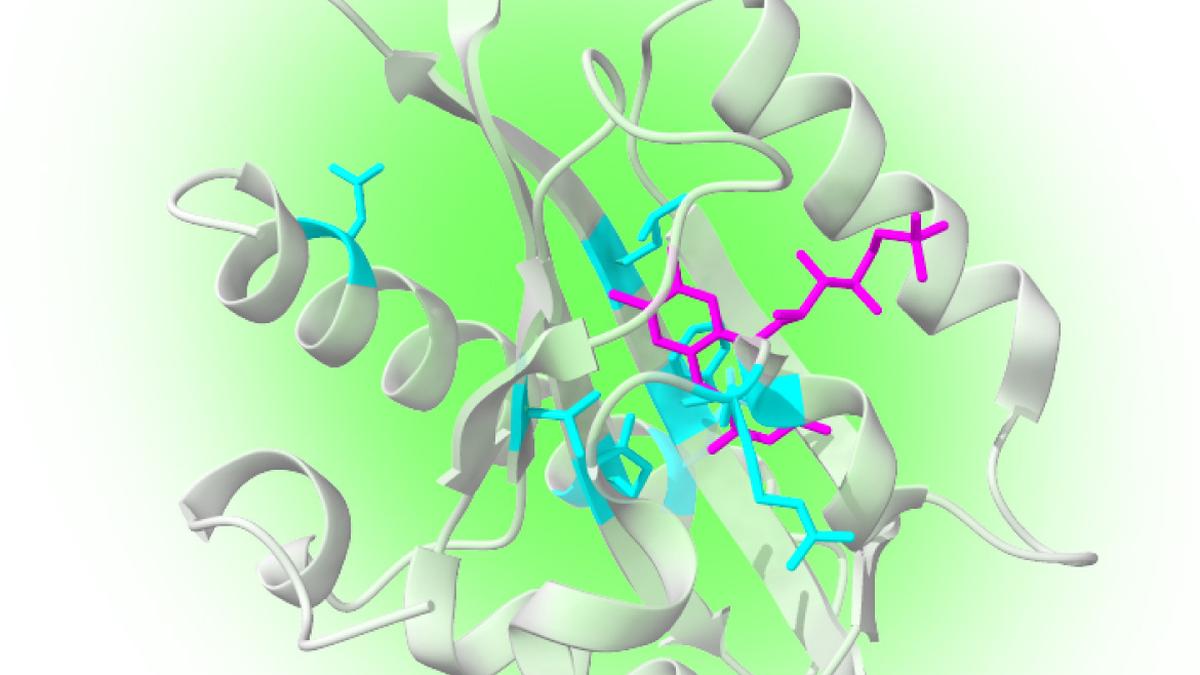
Researchers at the University of Chicago’s Pritzker School of Molecular Engineering focused on a variant of enhanced yellow fluorescent protein (EYFP), a close relative of green fluorescent protein. They discovered that EYFP possesses a metastable triplet state — a temporary electronic configuration in which an electron’s magnetic spin can be isolated and controlled.

Using carefully timed laser pulses, the team initialised the spin state of EYFP, manipulated it with microwave fields, and read it out optically, completing the full sequence required of a qubit.

They also detected optically driven magnetic resonance signals from EYFP inside living cells. These effects appeared in human kidney cells at low temperature and in Escherichia coli bacteria even at room temperature, showing that the protein’s quantum behaviour survives in biology’s noisy environment.

A second research group at the University of Oxford took a different approach. Working with a plant light-sensing protein, they used genetic engineering to create a family of magneto-sensitive fluorescent proteins called MagLOV. Through repeated rounds of mutation and selection, they produced versions with stronger and more stable magnetic responses.

The researchers showed that MagLOV proteins exhibit optically detected magnetic resonance in living bacterial cells at room temperature. In other words, radio waves at specific frequencies can predictably change fluorescence, directly revealing electron-spin behaviour.

Historically, biological candidates for quantum sensors were limited to purified, in-vitro systems, showed weak responses, or degraded quickly under light exposure. The engineered MagLOV proteins overcome many of these obstacles by combining stability, sensitivity, and genetic compatibility.

Together, the studies demonstrate that proteins can be programmed through DNA to act as quantum sensors.

Why inside cells matters

Most existing quantum sensors are made from solid materials such as diamond. These devices can be extraordinarily sensitive, but they are difficult to place inside cells or attach to specific biological targets.

Protein sensors are fundamentally different. Cells can produce them naturally once given the correct genetic instructions. The sensors can also be fused to other proteins, allowing researchers to position them at precise locations inside the cell.

This matters because many crucial biological processes involve subtle magnetic or electronic effects, including enzyme reactions with metal atoms, formation of short-lived free radicals, and electron transfer during respiration and photosynthesis.

Until now, studying these phenomena inside living cells has been nearly impossible. Protein-based quantum sensors offer a potential solution.

More than detection

The MagLOV researchers also showed that magnetic modulation can improve conventional fluorescence imaging. By switching a magnetic field on and off, they separated the MagLOV signal from background fluorescence and cellular autofluorescence. This technique, known as lock-in detection, enhances weak signals in noisy environments.

They further demonstrated a form of spatial localization based on magnetic resonance. Using magnetic-field gradients, they could determine the position of MagLOV-expressing cells within a three-dimensional sample, even when light scattering would normally blur the image.

The approach resembles some principles of magnetic resonance imaging (MRI), but uses genetically encoded fluorescent proteins as the signal source.

New ways of seeing

These studies point to a future in which genetically encodable quantum sensors reshape how scientists probe living systems. As sensitivities improve, protein-based qubits and magnetic-resonance probes could enable nanoscale measurements of magnetic fields, electric fields, temperature, and chemical environments directly inside cells.

Such sensors might track protein shape changes, monitor biochemical reactions in real time, or reveal how drugs bind to their targets with unprecedented precision.

Important challenges remain, though. Protein-based quantum sensors are currently less sensitive than solid-state devices, coherence times are shorter, and photobleaching remains a concern. Yet fluorescent proteins themselves took decades to become routine tools, and similar improvement could steadily close the gap.

Manjeera Gowravaram has a PhD in RNA biochemistry and works as a freelance science writer.

Published – February 23, 2026 05:30 am IST



Source link

Science

Post navigation

Previous Post: Access Denied
Next Post: Access Denied

Related Posts

  • World Ocean Day 2024: Understand the Indian Ocean and you’ll understand much about earth
    World Ocean Day 2024: Understand the Indian Ocean and you’ll understand much about earth Science
  • PixxelSpace India-led consortium to establish India’s first commercial earth observation satellite constellation
    PixxelSpace India-led consortium to establish India’s first commercial earth observation satellite constellation Science
  • Like bronze idols, India’s dino egg fossils risk being sold abroad
    Like bronze idols, India’s dino egg fossils risk being sold abroad Science
  • Octopuses, fish hunt together using surprisingly complex decision-making
    Octopuses, fish hunt together using surprisingly complex decision-making Science
  • Before and after satellite images of Wayanad landslip
    Before and after satellite images of Wayanad landslip Science
  • Fighting mosquito menace with repellents, vaccines
    Fighting mosquito menace with repellents, vaccines Science

More Related Articles

Scientists search for a female partner for world’s ‘loneliest’ plant Scientists search for a female partner for world’s ‘loneliest’ plant Science
Ahead of Gaganyaan, ISRO CE-20 engine already has a notable legacy Ahead of Gaganyaan, ISRO CE-20 engine already has a notable legacy Science
Vikram lander makes soft-landing on Moon again, successfully undergoes hop test: ISRO Vikram lander makes soft-landing on Moon again, successfully undergoes hop test: ISRO Science
Andean glacier retreat unprecedented in human civilisation, study finds Andean glacier retreat unprecedented in human civilisation, study finds Science
What is the technology behind manufacturing a semiconductor chip? | Explained What is the technology behind manufacturing a semiconductor chip? | Explained Science
Could ‘marine cloud brightening’ reduce coral bleaching on the Great Barrier Reef? Could ‘marine cloud brightening’ reduce coral bleaching on the Great Barrier Reef? Science
SiteLock

Archives

  • February 2026
  • January 2026
  • December 2025
  • November 2025
  • October 2025
  • September 2025
  • August 2025
  • July 2025
  • June 2025
  • May 2025
  • April 2025
  • March 2025
  • February 2025
  • January 2025
  • December 2024
  • November 2024
  • October 2024
  • September 2024
  • August 2024
  • July 2024
  • June 2024
  • May 2024
  • April 2024
  • March 2024
  • February 2024
  • January 2024
  • December 2023
  • November 2023
  • October 2023
  • September 2023
  • August 2023
  • July 2023
  • June 2023
  • May 2023
  • April 2023
  • March 2023
  • February 2023
  • January 2023
  • December 2022
  • November 2022
  • October 2022
  • September 2022
  • August 2022
  • July 2022
  • June 2022
  • May 2022

Categories

  • Business
  • Nation
  • Science
  • Sports
  • World

Recent Posts

  • Cuba coast guard kills 4 on Florida-registered boat
  • Trump, Zelenskyy speak before Ukraine-U.S. talks in Geneva
  • Access Denied
  • Iran negotiators arrive in Geneva for high-stakes U.S. talks
  • Access Denied

Recent Comments

  1. BrianLilia on UP Teacher Who Asked Students To Slap Muslim Classmate
  2. BrianLilia on UP Teacher Who Asked Students To Slap Muslim Classmate
  3. BrianLilia on UP Teacher Who Asked Students To Slap Muslim Classmate
  4. Richardlen on UP Teacher Who Asked Students To Slap Muslim Classmate
  5. GeorgePag on UP Teacher Who Asked Students To Slap Muslim Classmate
  • Modi Government Plans E-Office In All Subordinate Offices Within 100 Days
    Modi Government Plans E-Office In All Subordinate Offices Within 100 Days Nation
  • “Not Done Any Match Fixing”: Gautam Gambhir Drops Bombshell Remark On ‘Spirit Of Cricket’ Query
    “Not Done Any Match Fixing”: Gautam Gambhir Drops Bombshell Remark On ‘Spirit Of Cricket’ Query Sports
  • Canada PM Justin Trudeau Apologies After Nazi Veteran Honoured In Parliament
    Canada PM Justin Trudeau Apologies After Nazi Veteran Honoured In Parliament World
  • Couple Who Set Sail In Self-Built Eco-Friendly Yacht Found Dead In Lifeboat
    Couple Who Set Sail In Self-Built Eco-Friendly Yacht Found Dead In Lifeboat World
  • NDTV Election Quiz: Play Now
    NDTV Election Quiz: Play Now Nation
  • Chief Minister Gehlot criticises Budget for reducing MGNREGS allocation, says disappointing for Rajasthan
    Chief Minister Gehlot criticises Budget for reducing MGNREGS allocation, says disappointing for Rajasthan Business
  • Access Denied Sports
  • AbRam Khan’s Shocked Reaction At Shreyas Iyer’s Dismissal Viral. Internet Says, “KKR Runs In Blood”
    AbRam Khan’s Shocked Reaction At Shreyas Iyer’s Dismissal Viral. Internet Says, “KKR Runs In Blood” Sports

Editor-in-Chief:
Mohammad Ariff,
MSW, MAJMC, BSW, DTL, CTS, CNM, CCR, CAL, RSL, ASOC.
editor@artifex.news

Associate Editors:
1. Zenellis R. Tuba,
zenelis@artifex.news
2. Haris Daniyel
daniyel@artifex.news

Photograher:
Rohan Das
rohan@artifex.news

Artifex.News offers Online Paid Internships to college students from India and Abroad. Interns will get a PRESS CARD and other online offers.
Send your CV (Subjectline: Paid Internship) to internship@artifex.news

Links:
Associate Journalism
About Us
Privacy Policy

News Links:
Breaking News
World
Nation
Sports
Business
Entertainment
Lifestyle

Registered Office:
72/A, Elliot Road, Kolkata - 700016
Tel: 033-22277777, 033-22172217
Email: office@artifex.news

Editorial Office / News Desk:
No. 13, Mezzanine Floor, Esplanade Metro Rail Station,
12 J. L. Nehru Road, Kolkata - 700069.
(Entry from Gate No. 5)
Tel: 033-46011099, 033-46046046
Email: editor@artifex.news

Copyright © 2023 Artifex.News Newsportal designed by Artifex Infotech.