



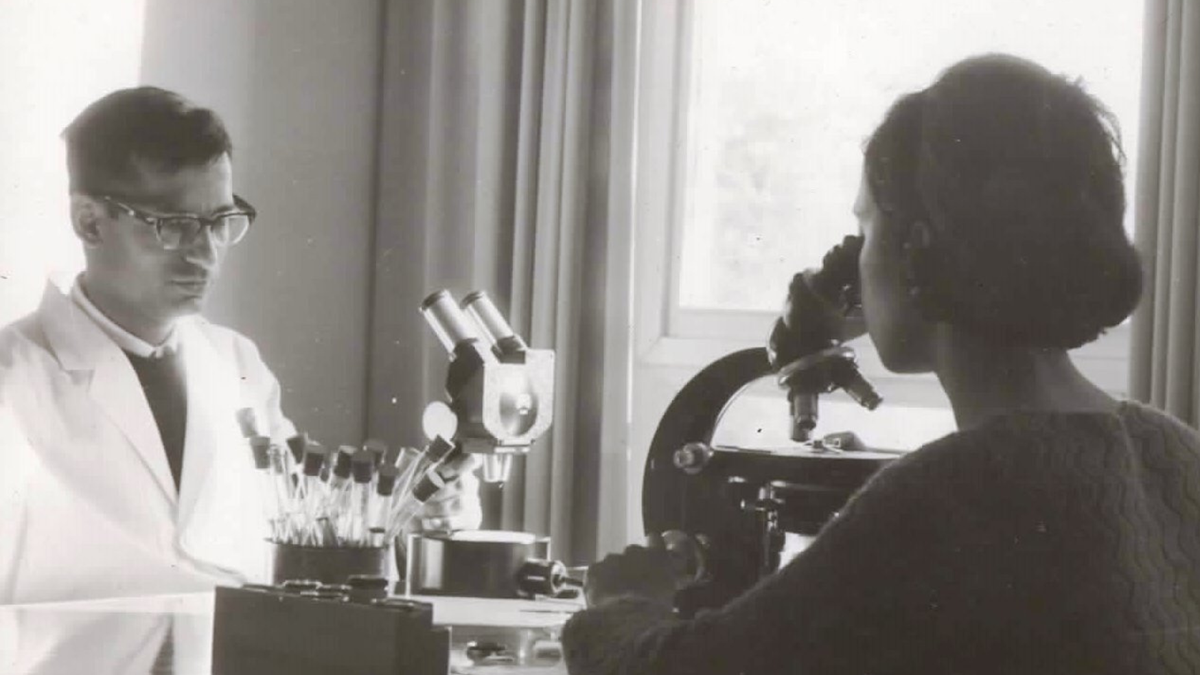
On January 20, 2026, Rev. Dr. Leo D’Souza, a Jesuit scientist based in Mangaluru, died aged 93. Dr. D’Souza, fondly known as Fr Leo, trained in the 1960s at the Max Planck Institute for Plant Breeding Research in Cologne, working alongside stalwarts in the field such as Ingo Potrykus, Joseph Straub, and Sudhir Kumar Sopory.
He set up one of India’s earliest tissue culture laboratories in 1975, where his women-led team of doctoral students slowly and steadily made a series of breakthroughs — including the world’s first ever test-tube cashew tree that was transferred to soil.
“Fr. D’Souza was among the early pioneers of plant tissue culture research in India, making significant contributions at a time when the discipline was still in its formative stage,” said Pramod Tandon, a leading plant biotechnologist and Padma Shri awardee.
In 1970, when Leo D’Souza was called back to India after his scientific studies, his PhD advisor Joseph Straub suggested he meet a friend of his to guide him on a suitable research topic. The friend turned out to be M.S. Swaminathan, who was at the time in New Delhi. When Dr. Swaminathan found out that the young priest’s hometown was Mangalore, he recommended Anacardium occidentale, the cashew plant, as a topic of research.
Tissue culture
The cashew tree is not native to India. It was brought into the coastal region by the Portuguese from Brazil in the 16th century to keep the lateritic soil found there from being eroded. Once people recognised the commercial value of its nuts and fruits, it emerged as an important cash crop. By the 1980s, cashew was being cultivated on nearly 5 lakh ha of land in the country, although the net production remained far below what was optimal for the processing industry.
An article in the 1982 issue of the journal Manushi noted that women accounted for more than 80% of the labourers employed in the cashew industry. They were usually illiterate and routinely underpaid. Fr Leo personally visited many cashew processing plants in and around Mangalore, and the situation of the labourers and small farmers of cashew plantations made an impression on him. He recognised that relying on seed propagation, grafting, and cutting was not sufficient, and that tissue culture — a relatively new technology that he was an expert on — could be the answer. He embarked on a mission to develop high yielding varieties of cashew in order to benefit these sections of society.
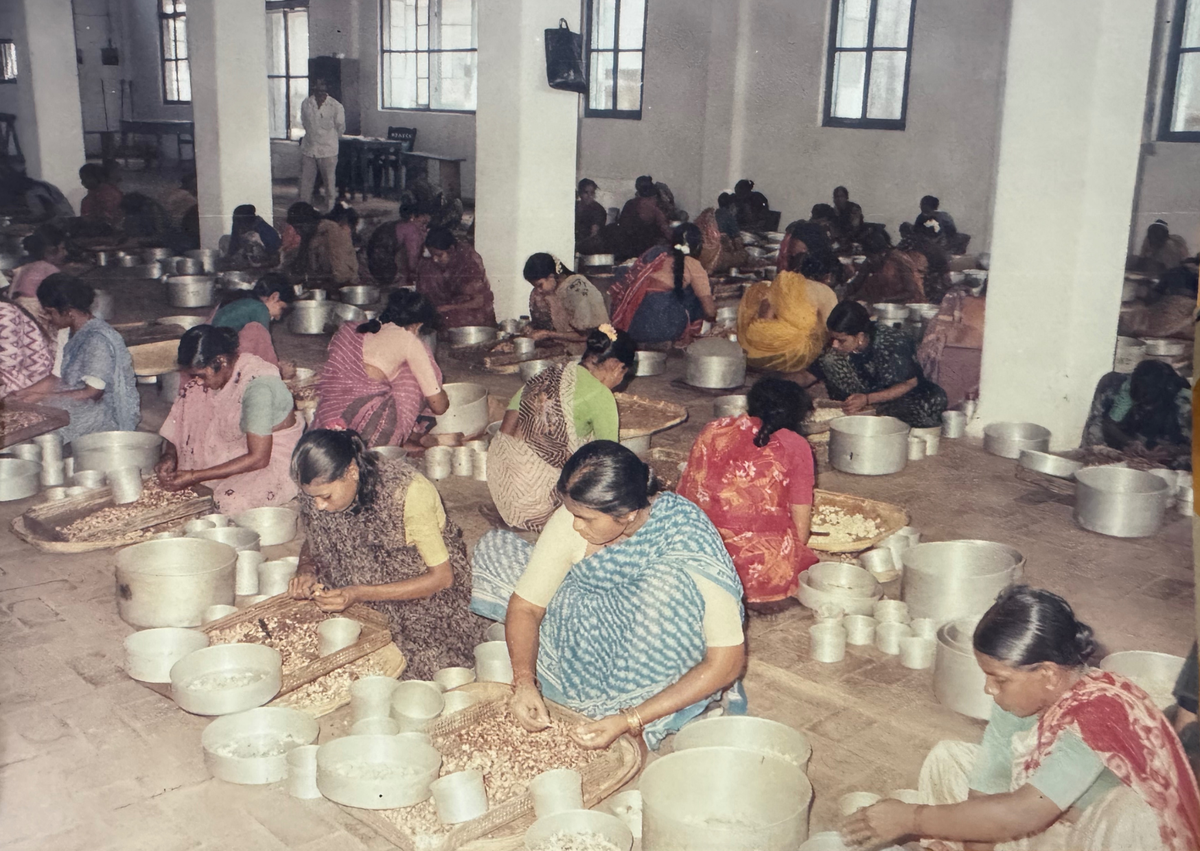
A photograph from Fr Leo’s collection showing women working at a cashew processing plant.
| Photo Credit:
Special arrangement
At the time, there was already a cashew research station in Ullal, near Mangalore, but Fr Leo was told that the scientists deputed there were desperate to be transferred because they were unused to the intense rains and severe humidity of the seaside town. Dr. Swaminathan also believed that as a Jesuit priest untethered by aspirations for promotions and transfers, Fr Leo was uniquely placed to do justice to this overlooked area of research.
Convinced, Fr Leo established his Laboratory of Applied Biology at the Jesuit-run St. Joseph’s College in Bangalore in 1975. This was nearly a decade before the Department of Biotechnology (DBT) came to be. However, five years later, he was appointed principal at another Jesuit college, St. Aloysius in Mangalore. While Mangalore was his hometown and St Aloysius was where he had done all of his schooling, he dreaded the thought of sidelining research for administration. Fortunately, there was a room available for him to move his laboratory to.
His laboratory has operated there ever since, and is today headed by his former PhD student Shashikiran Nivas.

Top of his mind
Despite being a reluctant principal, Fr Leo administered the college efficiently. Right from the start, he advocated for the inclusion of women in the college, which had been boys-only since it was founded in 1880. Not only did he have to convince a sceptical management and staff, he also had to ensure that the college infrastructure would adequately serve the needs of this new demographic. In 1986, the college finally started admitting women; today they constitute more than 50% of the staff and the students there.
Of the many responsibilities he assumed over the course of his career, one was particularly close to his heart: the establishment and running of the Aloysians’ Boys’ Home, a rehabilitation centre and home for abandoned, traumatised, and orphaned children, many of whose parents were in prison. He was proud of the lives the boys who grew up there built for themselves.
In one of his essays, he wrote about how driving a bus was a dream for many of the boys, and of being heartened that so many of them fulfilled it by becoming bus drivers in Mangalore. He recalled another example of a former resident of the home named Nelson, who completed a course in vocational training and had secured a job as training officer in air-conditioning and refrigeration at a technical institute.
Even as he navigated administrative challenges and was involved in many other activities, his laboratory was always on top of Fr Leo’s mind. He received approval from Mangalore University to start a PhD programme, which was (and remains) an unconventional and notable achievement for an undergraduate college. His first PhD student was a young woman from a village in Kundapura in Udupi district, named Icy D’Silva.
Together, the duo began attempts to grow tissue culture cashew plants, which would enable large scale rapid multiplication of trees.
From lab to soil
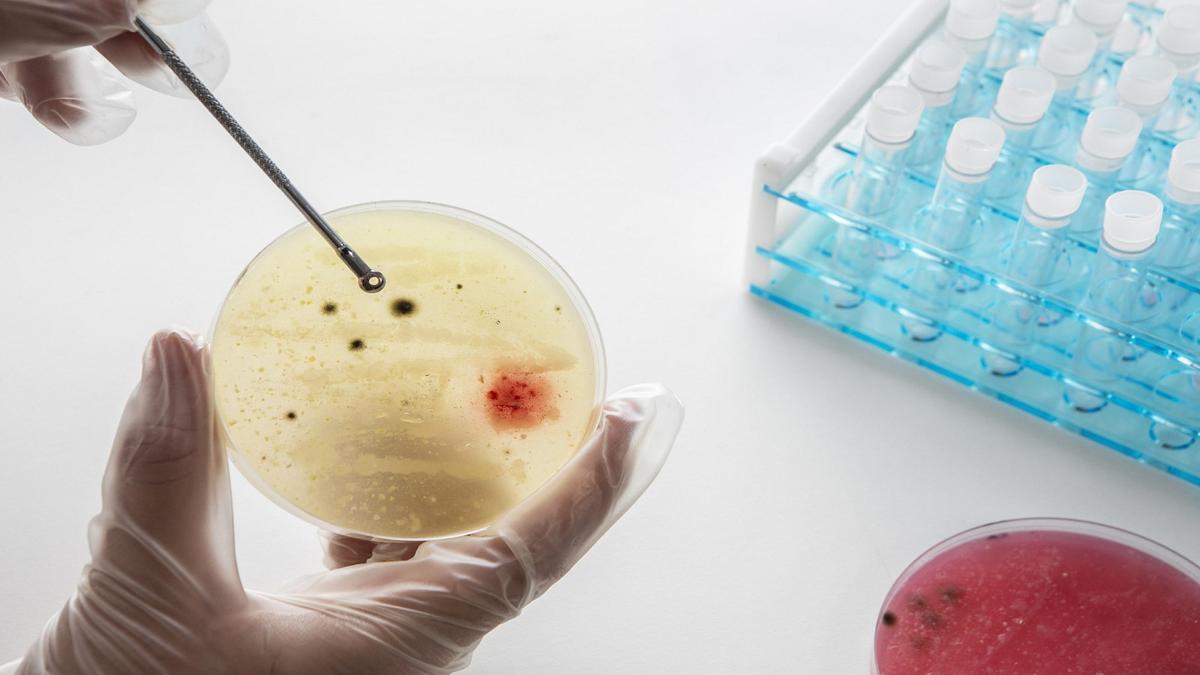
Conventional breeding techniques such as seed propagation and cross-breeding can help improve plant varieties and their yield, but they’re time consuming and the quality is difficult to maintain. On the other hand, tissue culture, a.k.a. micropropagation, allows for the development of a whole cashew plant from a small tissue sample. The controlled conditions in a laboratory allow for the technique to be used en masse, with the guarantee that the resulting plantlets will be genetically identical to the original plant.
Several scientists in tropical countries, including India, were trying to revolutionise the cashew industry with a reliable tissue culture protocol but this proved exceedingly difficult. Compared to related species such as mango and pistachio trees, cashew is recalcitrant to tissue culture, presumably because it releases phenolic compounds into the culture medium, eventually killing the developing cells. In the few cases that researchers were successful in generating plantlets in the lab, the plantlets would die soon after being transferred into the soil.
It took close to 10 years, but in 1990, D’Silva, under the guidance of Fr Leo, accomplished her goal. In a paper published in the journal Plant Cell, Tissue and Organ Culture in 1992, the pair described how they had generated cashew plantlets, successfully transferred them to soil, and established them in the field.
One of Fr Leo’s regrets was that he couldn’t secure the cooperation of scientists at the cashew research station in Ullal in taking the work forward. He believed this came in the way of science fulfilling its potential with respect to improving cashew as well as the livelihoods of people who cultivated and processed it.
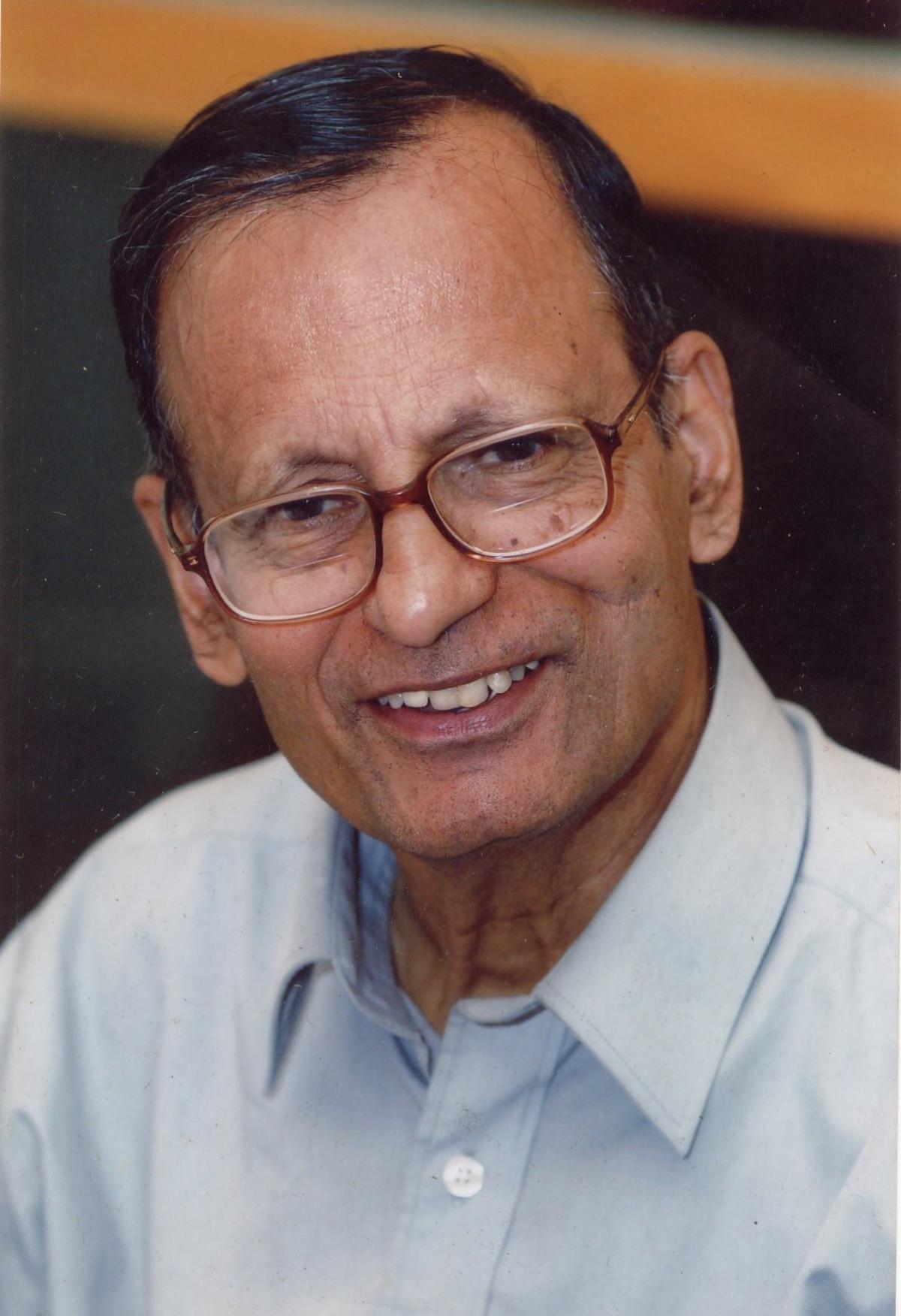
Though Fr Leo taught at St. Joseph’s College in Bengaluru for a relatively short period of time, his students still remember him.
| Photo Credit:
Special arrangement

‘International quality’
Over the years, Fr Leo’s lab also conducted important work with coconuts, ferns, algae, ragi, and ornamental and medicinal plants. Besides cashew, the team managed to micropropagate a range of other trees. Part of Fr Leo’s legacy is the avenue of tissue cultured trees growing in the St. Aloysius (now a deemed-to-be university) campus today.
Many of his students went on to pursue research in academia as well as in industry, in India and abroad. One is Smitha Hegde, a leading pteridologist (pteridology is the science of ferns) and currently the research director at the Centre for Advanced Learning, Mangaluru. Dr. Hegde pointed out that Fr Leo made sure to give his students every opportunity to present and share their work in conferences abroad. She herself got the chance to present her work on ferns in the Royal Botanic Gardens at Kew in 1995.
“These experiences helped us realise that our work was of international quality.” She fondly remembered their small group of researchers strutting around campus feeling like “little Einsteins”.
Dr. Hegde also recalled Fr Leo being a champion of women’s empowerment.
“If he saw only men on stage, even for a simple function, he would ask ‘where is the woman representation?’ Not only did he want women to get the chance to work, he was also very keen that our work got visibility,” she said.
Used to explaining himself
Though he taught at St. Joseph’s College in Bengaluru for a relatively short period of time, his students still remember him. Notable among them is Jyotsna Dhawan, a leading cell biologist and Emeritus Scientist at the CSIR-Centre for Cellular and Molecular Biology in Hyderabad.
“What strikes me now is that there was no dichotomy in his teaching of a scientific discipline rooted in the tenets of evolutionary theory and his identity as a man of the cloth,” she wrote to this reporter upon hearing of Fr Leo’s death. “Along with Fr Cecil Saldanha, these Jesuit botanists gave us a firm grounding in plant science for which I am forever grateful.”
Reconciling these two identities came effortlessly to Fr Leo, but he constantly encountered raised eyebrows along the way.
“People stared at me the first time I entered the Max Planck Institute in Cologne,” he said in an interview with this reporter a few months before he passed away. “I thought they were staring at my brown skin, but it was my clerical collar.”
So Fr Leo was used to explaining himself.
“A priest is not only to work in the church. His work must have a value for other people, especially poor people,” he affirmed in the same interview.
When one of his colleagues in Germany asked him why he didn’t stick to the altar and pulpit, Fr Leo replied: “Had Gregor Mendel [the Austrian monk who is often known as the father of genetics] followed this principle, then the scientific world would have lost an important scientist who discovered the basics of genetics and plant breeding.”
Nandita Jayaraj is an independent science journalist and co-founder of the feminist science media project Labhopping.