



Silk, the queen of fibres, is drawn or reeled from cocoons of the silk moth (Bombyx mori). Humans domesticated it more than 5,000 years ago in China, from the wild moth (Bombyx mandarina). The ancestral moth is today found in China, the Korean Peninsula, Japan, and far eastern Russia, whereas the domesticated moth is reared all over the world, including in India. In fact, India is the world’s second largest producer of raw silk after China.
Caterpillars, also known as silkworms, of both these species feed exclusively on leaves of mulberry plants (genus Morus). The domesticated moth is much larger than its wild progenitor, and thus extrudes a longer silk fibre to build its larger cocoon, up to 900 metres long. But it depends wholly on human care for its survival and reproduction. Since having been domesticated, it has lost the ability to fly, and since its need for camouflage no longer exists, it has also lost its caterpillar and adult-stage pigmentation.
Carotenoids and flavonoids
‘Wild’ silks – which include the muga, tasar, and eri silks – are obtained from other moth species: namely, Antheraea assama, Antheraea mylitta, and Samia cynthia ricini. These moths survive relatively independently of human care, and their caterpillars forage on a wider variety of trees. Non-mulberry silks comprise about 30% of all silk produced in India. These silks have shorter, coarser, and harder threads compared to the long, fine, and smooth threads of the mulberry silks.
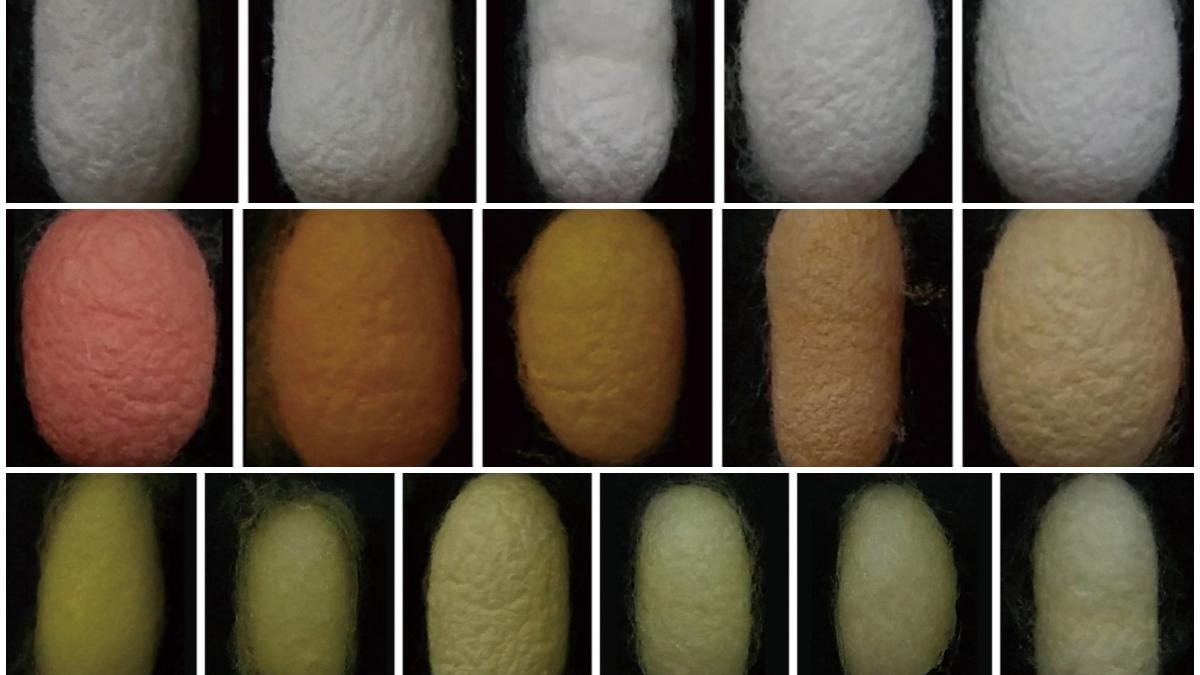
The ancestral mulberry moth makes (boringly uniform) brown-yellow cocoons. In contrast, domesticated silk moth cocoons come in an eye-catching palette of yellow-red, gold, flesh, pink, pale green, deep green or white. Human handlers selected the differently coloured cocoons whenever they emerged, possibly in the hope of breeding for coloured silks. But they were disappointed: the pigments that coloured the cocoons are water-soluble, so they gradually fade away. The coloured silks we see in the market are instead produced by using acid dyes.
We know today that the cocoon’s pigments are derived from chemical compounds called carotenoids and flavonoids, which are made by the mulberry leaves. Silkworms feed voraciously on the leaves, absorb the chemicals in their midgut, transport them via the hemolymph – arthropods’ analogue of blood – to the silk glands, where they are taken up and bound to the silk protein. Mature caterpillars then spin out the silk proteins and associated pigment into a single fibre. The caterpillar wraps the fibre around itself to build the cocoon.
Mutant strains a valuable resource
The adult moth hatches (or ecloses) from the cocoon. In this process, the fibre is broken in many places. Superior quality silk however comes from an unbroken fibre, so unhatched cocoons are used for reeling. There is a contentious ‘economics versus ethics’ debate here about creating a species that depends wholly on humans (and whose unhatched cocoons we drown in hot water for better quality silk), but that is for another article.
The differently coloured cocoons arise from mutations in genes responsible for the uptake, transport, and modification of carotenoids and flavonoids. The mutant strains have become a valuable resource for scientists to study the molecular basis of how, in a relatively short span of 5,000 years, artificial selection generated such spectacular diversity.
Research on silk domestication has largely been conducted in China and Japan, although scientists from India (including from the Centre for DNA Fingerprinting and Diagnostics in Hyderabad, where this author worked), have also made some important contributions.
Combinations behind the colours
This said, earlier this year, researchers in Southwest University in Chongqing, China, proposed a model to explain how different combinations of mutations give rise to the different colours of the cocoons.
They found that the formation of a yellow-red cocoon requires the Y gene, which encodes a protein that transports the carotenoids from midgut to the silk glands. Other genes (C, F, Rc, and Pk) encode proteins that selectively absorb specific carotenoids. Mutations in one or more of these genes produce the yellow, flesh-coloured, rusty, and pink cocoons. If the Y gene is mutated, the flavonoids are absorbed but the carotenoids are not, resulting in green cocoons.
Further, whether the green is dark or light depends on whether genes for other proteins that enhance flavonoid uptake are normal or mutated. If both carotenoids and flavonoids are not taken up, the cocoons remain white. The researchers showed that a cluster of five closely related genes was responsible for the uptake of flavonoids.
The gene called apontic-like
Domesticated and ancestral mulberry silk moths can be interbred to produce hybrid offspring. Last year, researchers in the University of Tokyo and Columbia University in New York created such hybrid moths and then specifically mutated either their B. mori– or B. mandarina-derived copy of a gene called apontic-like.
The hybrid caterpillars, like their wild parent, made the pigment called melanin. But when the B. mandarina-derived copy of apontic-like was mutated, the hybrid failed to make melanin. (This didn’t happen when the B. mori-derived copy was mutated, however.) The implication was that the domesticated silkworm’s apontic-like gene had lost the ability to support melanin production.
Both versions of the apontic-like gene make the same protein. Therefore, the difference between them was attributable to differences in sequences that regulate when and where the gene was turned ‘on’ or ‘off’.
Gene by gene
Silk is an acme of domestication, comparable in its success to basmati rice, alphonso mangoes, and the golden retriever. Today, the tools are at hand for scientists to make and compare genetically identical hybrid silk moths that differ only in which of a gene’s two parental versions is inactivated: domesticated or ancestral.
This paves the way for scientists to work out – gene by gene – all the key steps that led to silk moth domestication. Hopefully, someday soon, similar techniques will become available for us to analyse domestication in rice, mangoes, and dogs.
D.P. Kasbekar is a retired scientist.