



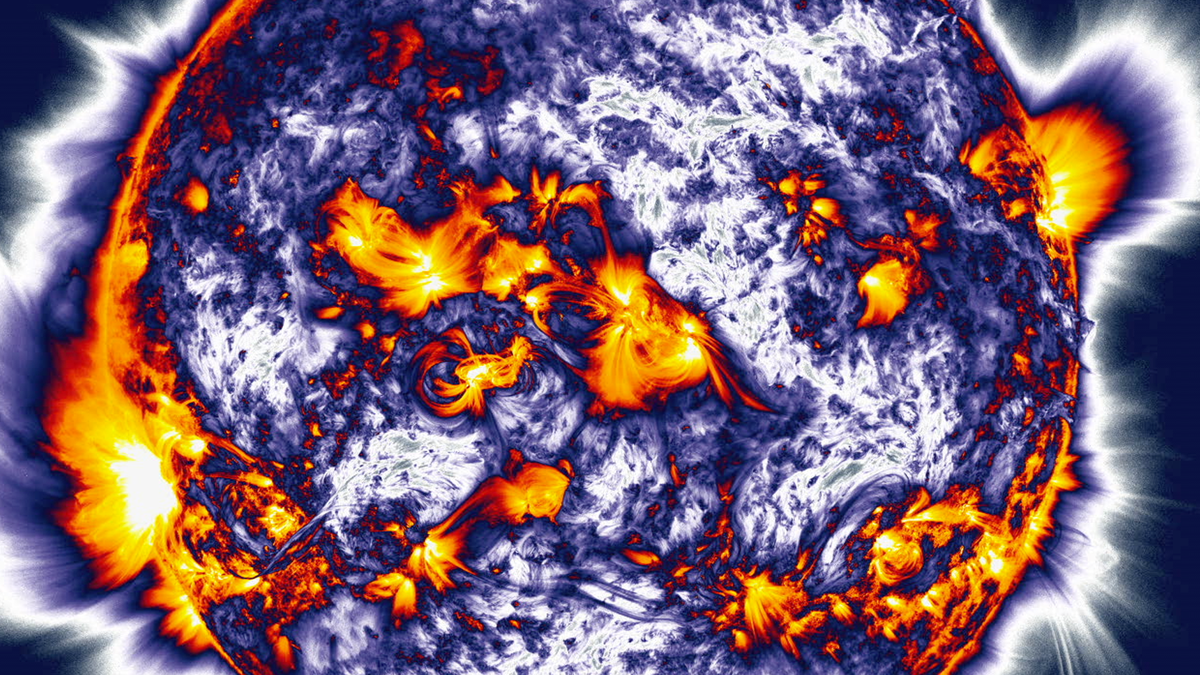
The sun has a profound influence on life on the earth. It’s the source of life as well as motivates the technological infrastructure that sustains modern society. Solar flares, coronal mass ejections, and energetic storms create space weather that affect satellites and astronauts in space, disrupting communications, navigation, and power grids on the earth. Understanding how solar activity originates, evolves, and affects our space environment is thus vital for effective space weather forecasting.
Astronomers in India recently provided an overview of the current state of solar and space physics. They focused on key challenges that are expected to shape the field over the next decade and highlighted how the Indian scientific community will tackle them with help from existing expertise as well as upcoming facilities.
Their ideas were detailed in a paper published in the Journal of Astrophysics and Astronomy.
Solar tantrums
“The key scientific question is understanding solar eruptions, such as solar flares and coronal mass ejections (CMEs), and their potential impact on space assets like satellites orbiting earth,” Vaibhav Pant, scientist at the Aryabhata Research Institute of Observational Sciences (ARIES) and second author of the paper, said. “Given our increasing reliance on space technologies, addressing this issue is of utmost urgency.”
CMEs are sudden discharges of a large amount of plasma from the outermost part of the sun’s atmosphere, known as the corona (Latin for ‘crown’). Solar wind on the other hand is a continuous outflow of charged particles from the corona. A solar flare is a massive explosion on the sun, triggered by the rapid release of energy from twisted magnetic fields above sunspots, generating a burst of radiation across the electromagnetic spectrum, including radio waves, X-rays, and gamma rays.
Dr. Pant said several significant challenges complicate the study and prediction of CMEs and related solar phenomena. Key issues include the incomplete understanding of the connection between CMEs and the solar wind, the poorly defined magnetic structures of CMEs (which affect their motion), and the complex interactions with ambient solar magnetic fields that alter their orientation and affect the earth and other planets. Predicting solar flares is still challenging due to limited knowledge about how magnetic fields emerge from under the sun’s surface.
Sun-watching strategies
In September 2023, the Indian Space Research Organisation (ISRO) launched Aditya-L1, India’s first space observatory focused on the sun. Aditya-L1 is currently stationed 1.5 million km from the earth at Lagrange point 1 (L1). Lagrange points are positions in space where the gravitational forces between two large bodies, like the sun and the earth, balance out the orbital motion of a smaller object, creating areas of relative stability that allow spacecraft to “hover” with minimal fuel use. There are five Lagrange points in the sun-earth system.
“Aditya-L1 is positioned at the L1 location, where it takes high-resolution images and spectra of the solar atmosphere. A number of exciting results have already been published from this mission,” Dr. Pant said. “We should also consider deploying more [instruments] at other strategic locations, such as L4 and L5” — a suggestion articulated in the overview.
L1 is located on the line connecting the sun and the earth, so any eruption from the sun moving towards the earth will pass through it, and Aditya-L1 can detect it. The L4 point is 60º ahead of the earth’s orbit and L5 is 60º behind. So a spacecraft at L5can observe solar regions before they rotate towards the earth, allowing them to detect solar activity and CMEs potentially before they occur.
Two spacecraft, one at L1 and another at L5, will function like “two eyes” observing the same solar events, allowing researchers to accurately compute the 3D trajectories of these phenomena, Dr. Pant said. Another spacecraft at L4 point will create a triangular observation network with the earth at the centre. Using its data, physicists can better track eruptions and produce better estimates of when they arrive at the earth.
On the flip side, L4 and L5 are 30 million km from the earth, complicating data transmission. “Sending data will be slower compared to the L1 position, but if this challenge is mitigated, it would be a great technological demonstration by Indians,” Dr. Pant said.
The Indian solar community is also working on enhancing ground-based facilities to observe the Sun.
“The Indian Institute of Astrophysics has proposed a two-metre-class ground-based telescope that will be instrumental in studying the sun’s lower atmosphere with high resolution,” Dr. Pant said.
This upcoming project is called the National Large Solar Telescope. Its planned size makes it unsuitable for deployment in space.
Onward, sunward
The long-term vision of solar physics in India also includes plans to educate early-career researchers and young students on solar physics and to analyse Aditya-L1 data. To this end, ISRO and ARIES have been conducting workshops across India. Ten have been completed thus far and an 11th one is scheduled for October at Pondicherry University.
“It was an amazing experience, and the workshop exposed me to a world of cutting-edge research and the top-level researchers leading these studies,” Hardik Medhi, a doctoral student at the National Centre for Radio Astronomy in Pune, who attended the third Aditya-L1 workshop, said.
Savitha M.S., an integrated MTech PhD student at the Indian Institute of Astrophysics, Bengaluru, attended the third and fifth Aditya-L1 workshops. She said: “This exposure not only broadened my knowledge but also strengthened my passion and determination to pursue research in solar physics.”
The paper reported the involvement of 229 early-career Indian researchers in solar physics, both in India and abroad, plus 65 faculty members and scientists working in India. The authors stressed the need to expand the community by hiring new faculty members, developing academic programmes, engaging with the public, and fostering industry partnerships.
The authors also highlighted the need for a national network of advanced supercomputing facilities for computational astrophysics. As telescopes and space missions improve, analysing and interpreting the data they collect will demand heavy physics-based simulations, rendering supercomputers very useful, if not essential.
Looking ahead, Dr. Pant expressed optimism that “in the next 10 to 15 years, we should be able to develop our own state-of-the-art prediction models for solar flares and the arrival times of coronal mass ejections (CMEs) on earth.”
India recently opened its space sector up to private companies. Aside from building satellites and launching rockets, their involvement also portends private-sector innovation in modelling solar storms and predicting space weather.
“These developments will make India self-reliant in understanding space weather and the solar-terrestrial relationship,” Dr. Pant added.
With a community of experts, young researchers, and students; new facilities and numerous initiatives (many in the works); and now a long-term guiding vision, solar physics and space weather are expected to grow significantly in the coming years.
Shreejaya Karantha is a freelance science writer.