



Skip to content
  • Facebook
  • X
  • Linkedin
  • WhatsApp
  • Associate Journalism
  • About Us
  • Privacy Policy
  • 033-46046046
  • editor@artifex.news
Artifex.News

Artifex.News

Stay Connected. Stay Informed.

  • Breaking News
  • World
  • Nation
  • Sports
  • Business
  • Science
  • Entertainment
  • Lifestyle
  • Toggle search form
  • India successfully test-fires long range hypersonic missile
    India successfully test-fires long range hypersonic missile Science
  • 32 Dead In Bangladesh Unrest, Protesters Set Fire To State TV Headquarters
    32 Dead In Bangladesh Unrest, Protesters Set Fire To State TV Headquarters World
  • India’s forex reserves decline by .88 billionn to 3.983 billion
    India’s forex reserves decline by $1.88 billionn to $623.983 billion Business
  • Uddhav Thackeray As Cousin Raj Thackeray Meets Amit Shah
    Uddhav Thackeray As Cousin Raj Thackeray Meets Amit Shah Nation
  • U.S. House passes bill that would lead to a TikTok ban if Chinese owner doesn’t sell
    U.S. House passes bill that would lead to a TikTok ban if Chinese owner doesn’t sell World
  • 2024 Interim Budget | Allocation for Minority Ministry remains same
    2024 Interim Budget | Allocation for Minority Ministry remains same Business
  • Iran-Backed Houthis Say Exposed “Spy” Network Aiding US, Israel: Report
    Iran-Backed Houthis Say Exposed “Spy” Network Aiding US, Israel: Report World
  • ISRO’s SpaDex mission advances lunar exploration, sample return missions and other objectives: ATL
    ISRO’s SpaDex mission advances lunar exploration, sample return missions and other objectives: ATL Science
Why did macroscopic quantum tunnelling win the 2025 physics Nobel?

Why did macroscopic quantum tunnelling win the 2025 physics Nobel?

Posted on October 7, 2025 By admin


The story so far: Quantum mechanics says that particles can sometimes cross barriers they don’t have the energy to climb, like boring through a mountain instead of scaling it first. This process, called tunnelling, is common in nuclear and atomic physics. The 2025 physics Nobel Prize laureates John Clarke, Michel Devoret, and John Martinis showed that such behaviour can occur not only in subatomic particles but also in an electrical circuit made of superconductors. The finding opens the door to new technologies set to transform the way we collect, study, understand, and use information from our surroundings.

What is a Josephson junction?

The fundamental unit of the award-winning experiments the trio conducted is a device called a Josephson junction. Here, two superconductors are separated by a very thin insulator. The trio wanted to know if a parameter of the circuit as a whole, in this case the junction’s phase difference, could behave like a single quantum particle. They came away from their experiments with a resounding ‘yes’, by observing both macroscopic quantum mechanical tunnelling and discrete energy levels in the circuit.

A schematic illustration of a single Josephson junction. A and B are two superconductors; C is an ultrathin insulator.
| Photo Credit:
Miraceti (CC BY-SA)

In a superconductor, many electrons pair up and move without resistance. In a Josephson junction, the relevant variable is the phase difference of the superconducting order parameter. Put differently, the superconducting order parameter is a macroscopic variable that trillions of electron pairs in the material share and which describes the state the system is in. Theory predicts that the current through the junction depends on the value of the parameter, and that the phase difference evolves in time according to the voltage across the junction.

When the scientists sent a current through the Josephson junction, they found that if it was small enough, the flow of paired electrons was stalled and the circuit produced no voltage. In classical physics, this state would never change: the electrons’ flow would remain blocked. But in the quantum world, the current has a small chance of suddenly tunnelling out of the trap and flowing freely on the other side, creating a measurable voltage.

Why was the circuit fragile?

In the early 1980s, several groups searched for this tunnelling by varying the current and recording the value at which the junction produced a voltage. If the electron pairs were simply escaping to the other side due to thermal fluctuations — akin to being heated enough to jump across the mountain — cooling the device ought to steadily increase the amount of current required to produce a voltage. On the other hand, if the electron pairs were tunnelling through, the rate of crossing over would eventually stop changing with temperature.

Simple though the setup was, the challenge was in keeping stray microwave radiation from affecting the circuit and producing data consistent with the temperature-independent behaviour. So the experimenters needed to reduce and characterise environmental noise with great care.

The Berkeley team led by Clarke, working with Devoret and Martinis, solved this problem by redesigning their setup so stray signals couldn’t interfere. They used special filters and shielding to block unwanted microwaves and kept every part of the experiment extremely cold and stable. Then they sent in faint yet precisely tuned microwave pulses to gently test how the circuit responded, allowing them to measure its electrical properties accurately. When they finally cooled the system to very low temperatures, they saw that its behaviour matched the exact patterns predicted by quantum tunnelling theory.

How did the circuit show quantum effects?

The researchers also wanted to find out if the circuit’s trapped state behaved like a quantum system with distinct energy steps — a hallmark of a quantum state — instead of a smooth range. They shone microwaves of different frequencies onto the junction while adjusting the current. When the frequency exactly matched the gap between two allowed energy levels, the circuit suddenly escaped more easily from its trapped state. The higher the level, the faster this escape happened. These patterns showed that the circuit’s overall state could only receive or emit fixed packets of energy, which is also how a single particle following the rules of quantum mechanics would behave. In short, the circuit as a whole behaved like an atom.

Put together, the results revealed two facts. First, a macroscopic electrical circuit — one that you could see with the naked eye — could display quantum behaviour when sufficiently isolated from its environment. Second, the relevant macroscopic coordinate in that circuit could be understood using the standard tools of quantum mechanics.
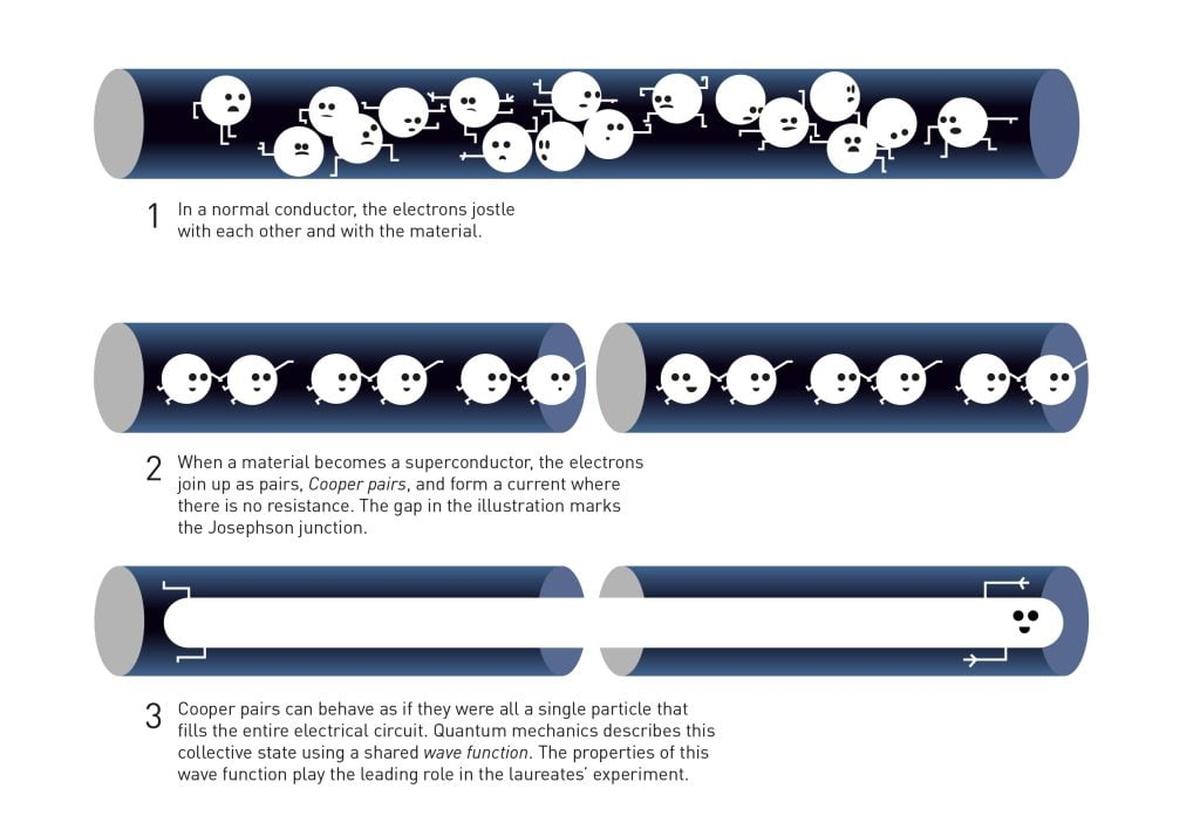
What happens inside a superconductor?

What happens inside a superconductor?
| Photo Credit:
Johan Jarnestad/The Royal Swedish Academy of Sciences

These experiments also pointed to a practical path for controlling and ‘reading’ macroscopic quantum states — in this case using a bias current, weak microwaves, and sufficient protections to shield the circuit from external radiation — one that gave the field a template to make reliable quantum measurements in solid-state devices. Subsequent work in the 1990s and 2000s extended these ideas, developing superconducting qubits, embedding them in microwave resonators, and improving their coherence (i.e. their ability to maintain their quantum states without them being destroyed by noise).

What are the applications of this work?

The technological applications flow from the same physics. A circuit with a Josephson junction can be made to mimic the quantised energy levels of an atom; microwaves could drive the circuit to jump between these energy levels; and carefully coupling the circuit to a resonator could allow an operator to measure changes in the circuit without disturbing it. This architecture, known as circuit quantum electrodynamics, is the foundation of many of today’s superconducting quantum processors.

(The resonator is like an echo chamber for microwaves. When the circuit is coupled to a resonator, the two can exchange energy in a controlled way, allowing scientists to measure the circuit’s state indirectly by observing changes in the resonator’s behaviour.)

Superconducting circuits that exploit macroscopic quantum effects are now central to several emerging technologies. They are quantum amplifiers that boost extremely weak signals without adding noise — a useful ability in diagnostics as much as searches for dark matter. They are used to measure current and voltage with extraordinary precision. They can be microwave-to-optical converters that link quantum processors to fibre-optic networks. They are components in quantum simulators used to model complex materials or even chemical reactions atom by atom.

Ultimately, these devices are useful because the circuits’ phase difference and the supercurrent respond to even small external influences with large, measurable changes. The laureates’ work turned this bug into a feature.

Published – October 07, 2025 07:24 pm IST


Source link

Science Tags:2025 physics Nobel Prize, 2025 physics nobel prize winners, macroscopic quantum tunnelling, quantum mechanics 2025 physics Nobel Prize

Post navigation

Previous Post: Access Denied
Next Post: Access Denied

Related Posts

  • Why were the Spain floods so deadly?
    Why were the Spain floods so deadly? Science
  • IMD: India’s weather tracker turns 150 years old
    IMD: India’s weather tracker turns 150 years old Science
  • From refugee to Nobel: Yaghi hails science’s ‘equalising force’
    From refugee to Nobel: Yaghi hails science’s ‘equalising force’ Science
  • ‘To become an astronaut, love science, do science, and become science’
    ‘To become an astronaut, love science, do science, and become science’ Science
  • ISRO dispatches crew module for first uncrewed mission of Gaganyaan
    ISRO dispatches crew module for first uncrewed mission of Gaganyaan Science
  • Russia’s Luna-25 spacecraft enters lunar orbit
    Russia’s Luna-25 spacecraft enters lunar orbit Science

More Related Articles

Data gaps beyond India are holding monsoon forecasts back | Analysis Data gaps beyond India are holding monsoon forecasts back | Analysis Science
Understanding ovarian cancer: its causes, symptoms, and screening methods Understanding ovarian cancer: its causes, symptoms, and screening methods Science
Watch | Chandrayaan-3’s journey from the Moon’s orbit to its surface Watch | Chandrayaan-3’s journey from the Moon’s orbit to its surface Science
Climate footprint of space exploration is passing below the radar Climate footprint of space exploration is passing below the radar Science
India needs youth mental health focus to strike demographic gold India needs youth mental health focus to strike demographic gold Science
Bird flu reaches mainland Antarctica for first time, scientists say Bird flu reaches mainland Antarctica for first time, scientists say Science
SiteLock

Archives

  • October 2025
  • September 2025
  • August 2025
  • July 2025
  • June 2025
  • May 2025
  • April 2025
  • March 2025
  • February 2025
  • January 2025
  • December 2024
  • November 2024
  • October 2024
  • September 2024
  • August 2024
  • July 2024
  • June 2024
  • May 2024
  • April 2024
  • March 2024
  • February 2024
  • January 2024
  • December 2023
  • November 2023
  • October 2023
  • September 2023
  • August 2023
  • July 2023
  • June 2023
  • May 2023
  • April 2023
  • March 2023
  • February 2023
  • January 2023
  • December 2022
  • November 2022
  • October 2022
  • September 2022
  • August 2022
  • July 2022
  • June 2022
  • May 2022

Categories

  • Business
  • Nation
  • Science
  • Sports
  • World

Recent Posts

  • Rupee falls 3 paise to 88.78 against U.S. dollar in early trade
  • Access Denied
  • Access Denied
  • EU wants key sectors to use made-in-Europe AI
  • Access Denied

Recent Comments

  1. dfb{{98991*97996}}xca on UP Teacher Who Asked Students To Slap Muslim Classmate
  2. "dfbzzzzzzzzbbbccccdddeeexca".replace("z","o") on UP Teacher Who Asked Students To Slap Muslim Classmate
  3. 1}}"}}'}}1%>"%>'%> on UP Teacher Who Asked Students To Slap Muslim Classmate
  4. bfg6520<s1﹥s2ʺs3ʹhjl6520 on UP Teacher Who Asked Students To Slap Muslim Classmate
  5. pHqghUme9356321 on UP Teacher Who Asked Students To Slap Muslim Classmate
  • Mohamed Al-Fayed, Ex-Harrods Owner Whose Son Died With Princess Diana: 5 Points
    Mohamed Al-Fayed, Ex-Harrods Owner Whose Son Died With Princess Diana: 5 Points World
  • How Australia Legend Justin Langer Is Powering The Career Of LSG Star Ayush Badoni
    How Australia Legend Justin Langer Is Powering The Career Of LSG Star Ayush Badoni Sports
  • Election Fraud Claims In US Slow Down After Donald Trump’s Win
    Election Fraud Claims In US Slow Down After Donald Trump’s Win World
  • Lionel Messi Boost For Argentina Ahead Of Copa America Semi-final Against Canada
    Lionel Messi Boost For Argentina Ahead Of Copa America Semi-final Against Canada Sports
  • Mexico Discusses Aliens After Lawmaker Presents ‘Extra-Terrestrial’ Bodies
    Mexico Discusses Aliens After Lawmaker Presents ‘Extra-Terrestrial’ Bodies World
  • ICC’s Ultimatum To Pakistan Cricket Board On Champions Trophy: “Accept Hybrid Model Or…”
    ICC’s Ultimatum To Pakistan Cricket Board On Champions Trophy: “Accept Hybrid Model Or…” Sports
  • The Hindu Morning Digest, October 28, 2024
    The Hindu Morning Digest, October 28, 2024 Nation
  • ‘Why is he being a coward?’: Gehlot on Shekhawat approaching court over Sanjivani ‘scam’
    ‘Why is he being a coward?’: Gehlot on Shekhawat approaching court over Sanjivani ‘scam’ Nation

Editor-in-Chief:
Mohammad Ariff,
MSW, MAJMC, BSW, DTL, CTS, CNM, CCR, CAL, RSL, ASOC.
editor@artifex.news

Associate Editors:
1. Zenellis R. Tuba,
zenelis@artifex.news
2. Haris Daniyel
daniyel@artifex.news

Photograher:
Rohan Das
rohan@artifex.news

Artifex.News offers Online Paid Internships to college students from India and Abroad. Interns will get a PRESS CARD and other online offers.
Send your CV (Subjectline: Paid Internship) to internship@artifex.news

Links:
Associate Journalism
About Us
Privacy Policy

News Links:
Breaking News
World
Nation
Sports
Business
Entertainment
Lifestyle

Registered Office:
72/A, Elliot Road, Kolkata - 700016
Tel: 033-22277777, 033-22172217
Email: office@artifex.news

Editorial Office / News Desk:
No. 13, Mezzanine Floor, Esplanade Metro Rail Station,
12 J. L. Nehru Road, Kolkata - 700069.
(Entry from Gate No. 5)
Tel: 033-46011099, 033-46046046
Email: editor@artifex.news

Copyright © 2023 Artifex.News Newsportal designed by Artifex Infotech.