





For more than three decades, the phrase “cold fusion” has carried a whiff of promise as well as scandal. In 1989, chemists Martin Fleischmann and Stanley Pons announced that simple tabletop experiments with palladium electrodes in heavy water seemed to produce more heat than chemistry could explain. If true, this meant nuclear fusion, an energy process normally demanding temperatures hotter than on the sun, might be coaxed out of a glass of water. The idea promised cheap and limitless clean energy.
However, attempts to replicate it quickly failed. A US Department of Energy panel later that year dismissed the claims and the case of cold fusion went cold.
Yet the scientific allure didn’t disappear entirely. As Curtis Berlinguette, a chemist at the University of British Columbia, and his collaborators contended in a 2019 article in Nature, “Continued scepticism of cold fusion is justified, but we contend that additional investigation of the relevant conditions is required before the phenomenon can be ruled out entirely.”
That group undertook a multi-institution programme to examine highly hydrided metals, calorimetry in extreme conditions, and low-energy nuclear reactions. They found no evidence for anomalous heat production — but they uncovered new insights into how metals like palladium absorb hydrogen and deuterium.
A feat of density
Fast forward to August 2025, when Berlinguette appeared again as a senior author on a new study in Nature. This time, the team reported building a “benchtop fusion reactor” that used both ion implantation and electrochemical loading to drive nuclear reactions in palladium. The study stopped well short of generating energy. Instead, the system produced neutrons equivalent to about a billionth of a watt of fusion power while consuming 15 W of input electricity. Crucially, it claimed to show that an electrochemical process at the electron-volt (eV) energy scale could measurably enhance nuclear reactions at the million-electron-volt (MeV) scale.
This link between chemistry and nuclear physics is crucial. Standard approaches to nuclear fusion — using tokamak reactors like at the ITER facility in France or high-power laser facilities like at the National Ignition Facility in the US — rely on heating plasma to more than 100 million degrees C and confining it with magnetic fields or inertia. These experiments have achieved energies needed for fusion but at enormous technical cost (several billion dollars). By contrast, metals like palladium naturally absorb hydrogen isotopes at extremely high densities.
As the 2025 paper said, “A deuterium fuel density of 1028 m-3 can be easily achieved in a solid metal lattice.”
This density lies between what magnetic and inertial confinement achieve, but with far simpler means.
The team was also motivated by history. Fleischmann and Pons had attributed their excess heat to deuterium nuclei fusing inside palladium. Their evidence was weak: they reported no clear nuclear signatures, like neutrons or tritium, at levels consistent with fusion. On the other hand, the new team asked: what if electrochemistry could alter the likelihood of nuclear events, and not through heat but by increasing the local fuel density and changing the conditions inside a metal lattice?
Loading the palladium
The new device developed by the team has been named the “Thunderbird Reactor”. It is not a power plant but a testbed designed to check whether chemistry can indeed drive nuclear physics. The team explicitly avoided measuring heat, focusing instead on unambiguous nuclear signals.
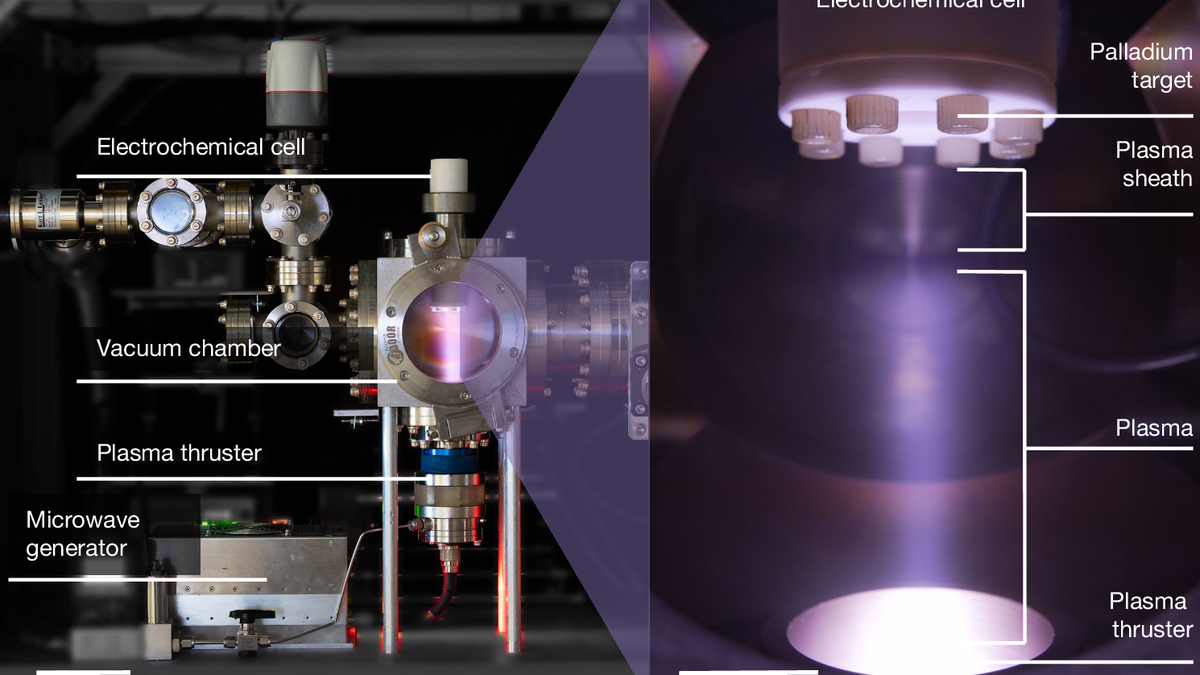
The Thunderbird Reactor is a compact particle accelerator that fits on a lab bench. In the tests, it combined three elements: a plasma thruster that generated deuterium ions (D+), a vacuum chamber where those ions were accelerated toward a target, and an electrochemical cell attached to the back of that target.

The target was a 300-micrometre thick palladium disk. On one side, a plasma sheath driven by a 30 kV voltage accelerated ions into the palladium, implanting them a fraction of a micrometre deep. On the other side, the palladium served as a cathode in heavy-water electrolysis, absorbing additional deuterium atoms from heavy water (D2O). This combination of forces ensured that an extremely high concentration of deuterium entered the palladium metal lattice, around 1028 m-3.
To detect fusion, team members used a neutron-sensitive scintillation detector outside the chamber. A sophisticated pulse-shaping technique allowed them to separate neutrons from background gamma rays with more than 99.9999% confidence.
Telltale signs
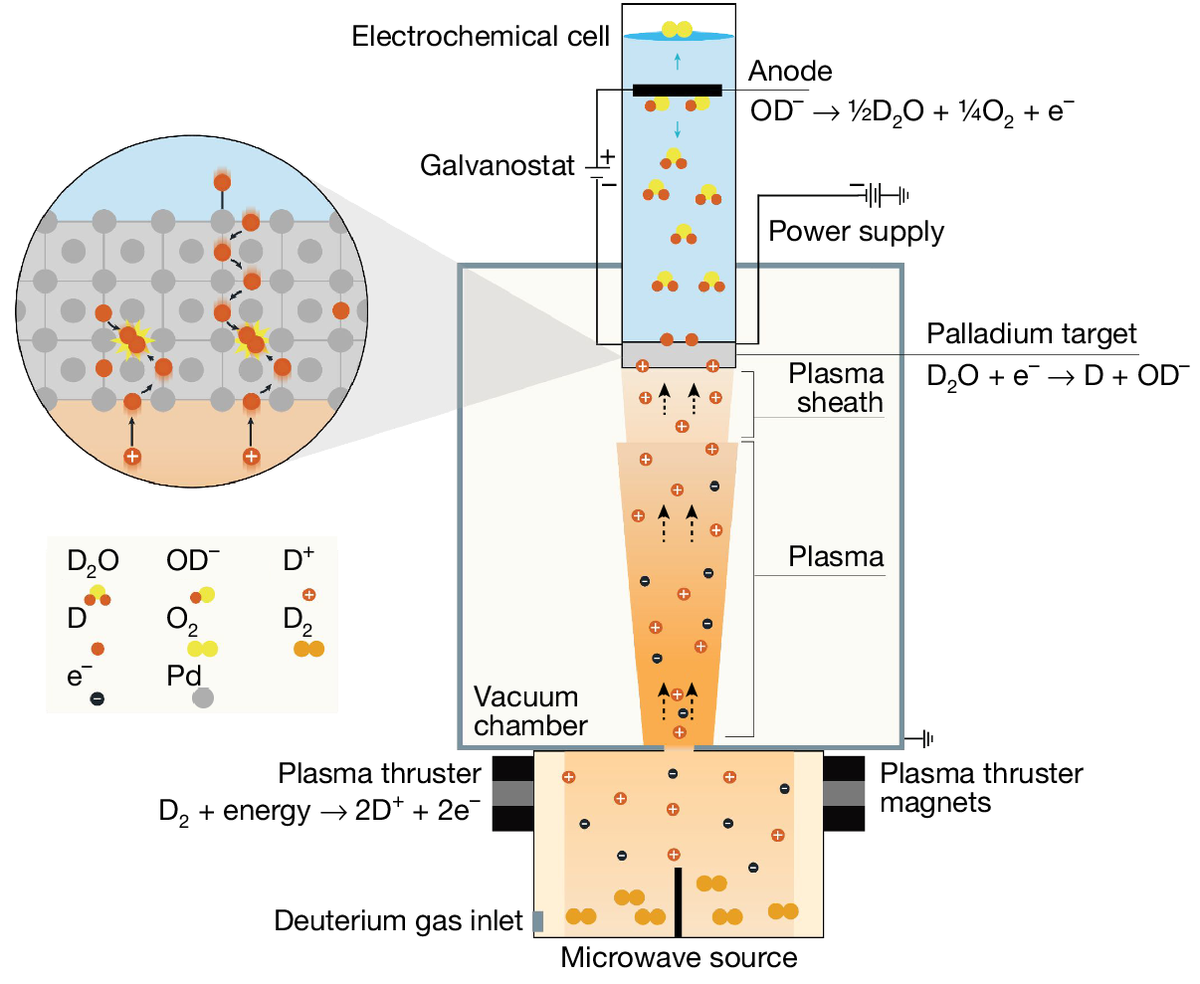
A schematic illustration showing the working principle of the Thunderbird Reactor. The deuterium gas inlet is at the bottom and the electrochemical cell is at the top. The palladium sheath is visible at the middle.
| Photo Credit:
Nature vol. 644, pages 640–645 (2025)
The team thus reported two main results.
First, simply bombarding the palladium target with deuterium ions produced neutron emission consistent with D-D fusion. After 30 minutes of operation, the production of neutrons stabilised at about 130-140 per second, far above the background rate of 0.21 counts per second. Computer simulations confirmed that the neutrons’ energy spectrum matched D-D fusion.
Second, when the electrochemical cell was switched on to load extra deuterium into the target, neutron production increased further. This effect was reproducible across multiple targets and cycles.
The overall power output, however, was minuscule. As the authors acknowledged in their paper, “The Thunderbird Reactor produces a neutron yield equivalent to only 10-9 W with 15 W of input power.”
Cultural implications
The immediate implication is scientific rather than practical: the experiment demonstrated that a chemical process (electrolysis of heavy water) could measurably influence a nuclear reaction rate. Thus, controlling how deuterium loads into a metal lattice may be a way to study nuclear processes at energies far below those in stars or reactors.

For the broader fusion community, the result is an approach that complements tokamaks and lasers. The paper emphasised that “many more advances are needed for the Thunderbird Reactor to achieve net energy gain”. The authors’ suggestions include using metals like niobium or titanium that can host higher deuterium concentrations, and using plasma sources that deliver more ions. There is even speculation about exploiting quantum coherence effects or secondary reactions involving tritium and helium-3.
But equally important is the cultural implication. By openly acknowledging the failures of the past, yet carefully defining a new path, the new team has reframed the conversation. In the 2019 paper, Berlinguette & co. noted, “Finding breakthroughs requires risk taking, and we contend that revisiting cold fusion is a risk worth taking.” The 2025 study in turn didn’t claim a miracle but showed that careful science in a controversial area could still yield new knowledge.
There are also material consequences. Palladium’s ability to absorb hydrogen isotopes is of great interest for energy storage and catalysis. The electrochemical insertion methods developed here could aid fuel cells and hydrogenation chemistry. As the 2019 perspective said, “The absorption of hydrogen into palladium is an active area for exploring how metal-solute interactions affect properties relevant to energy storage, catalysis and sensing.”
Scepticism also remains essential. The 1989 episode showed the dangers of over-claiming; the current work avoided that pitfall by reporting modest results: neutron counts rising by 15% when extra deuterium is loaded. Whether this effect can be scaled up or harnessed remains to be seen. Still, the study may reopen doors for funding and research that were closed before.
mukunth.v@thehindu.co.in
Published – September 05, 2025 06:00 am IST