





On July 30, the India-US space collaboration crossed a historic milestone with the successful launch of NISAR, or the NASA-ISRO Synthetic Aperture Radar satellite, a flagship earth observation mission jointly developed by the two nations’ space programmes. It is the first satellite to use radars of two frequencies — the L-band radar by NASA and the S-band radar by ISRO — to continuously monitor the earth’s surface. NISAR is expected to provide unprecedented data on land deformation, ice-sheet dynamics, forest biomass, and natural disasters like earthquakes and floods. With its high-resolution, all-weather, day-night imaging capabilities, NISAR aims to enhance climate resilience, agricultural monitoring, and disaster response. Beyond science, NISAR also holds commercial promise to enable new data services, geospatial analytics, and early-warning systems across sectors such as insurance, infrastructure, and agriculture.
To discuss this scientific milestone and what this means for space cooperation, Vasudevan Mukunth and Kunal Shankar spoke to Karen St. Germain. Dr. St. Germain is the director of the Earth Science Division at the Science Mission Directorate at NASA, where she oversees NASA’s full earth science portfolio, including satellite missions, technology, applied research, and data-to‑action programs.
Vasudevan Mukunth: Karen, thank you so much for joining us today. Can you give us a few examples of scientific studies that are possible with NISAR, but haven’t been possible so far with the existing crop of Earth observation satellites?
Karen St. Germain: Absolutely, and it’s great to be with you. The way to think about NISAR is that it will see anything that has structure to it that moves, that changes its position at a scale of less than a centimeter over an area about half of a tennis court. When I say anything that has structure: it could be forest, it could be buildings, it could be glaciers, mountains, land. Anything that moves, we’ll see at an unprecedented level of fidelity.
What that means is we will be able to see the slight bulging that happens before a volcano erupts. We’ll be able to see the land becoming unstable before a landslide. We’ll be able to see building shifts after an earthquake or any other sort of event. When a forest gets cut down, we’ll be able to see that. Anything that changes, we’ll be able to see, and that’s an extraordinary new capability for us.
Kunal Shankar: After the launch, NISAR will start its 90-day commissioning phase. And this is the world’s first dual band SAR satellite. In this phase, do you foresee any challenges with calibration, especially with cross-band calibration? Could you break down that process for us?
Karen St. Germain: There are a number of different aspects to the calibration. Largely the ISRO team will focus on calibrating the S-band radar and the NASA team will focus on calibrating the L-band radar. They don’t really get cross-calibrated, but each one will look at its own special targets.
Now, what do I mean by a target? It’s something we call a corner reflector and it is exactly what it sounds like. It’s a corner, just like the corner of a room. And it has a special feature, which is that when a pulse of energy hits it from any direction, it reflects back in exactly the same direction. So we use these targets to calibrate independently each of the instruments. And then the only other thing we really have to pay special attention to is the alignment, the pointing. Are they pointing in the same place on the ground? And for that, we’ll use the data itself. So the data itself will identify features and we’ll align those features from each radar.
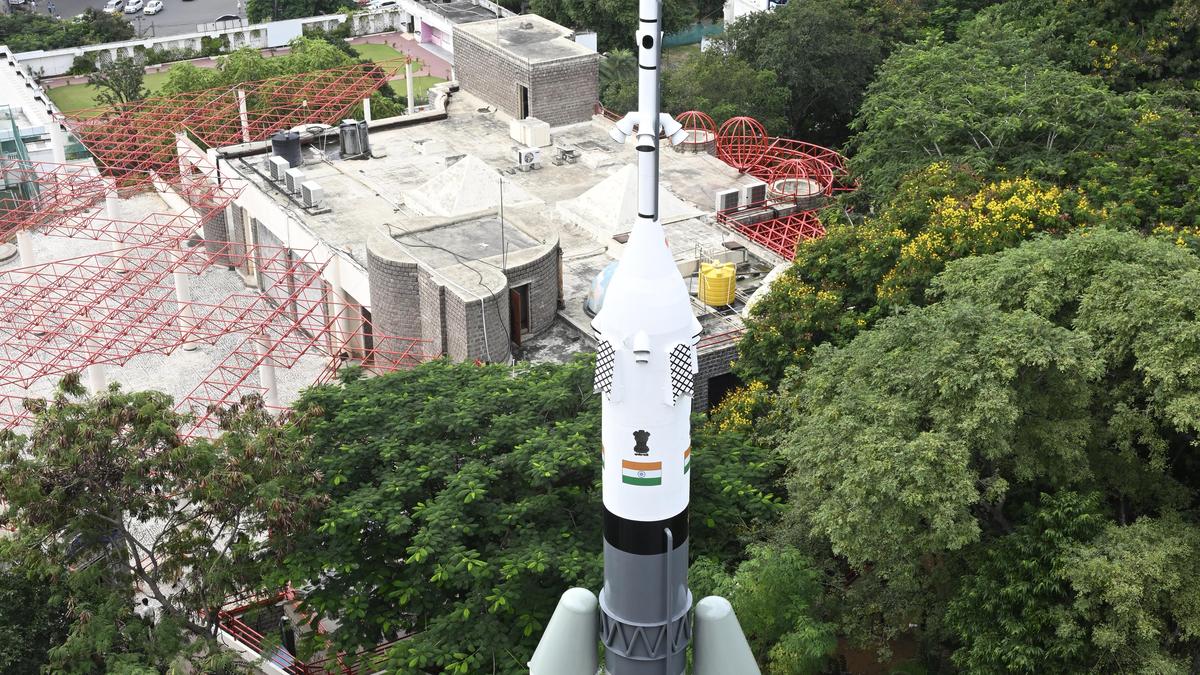
The GSLV-F16 mission lifts off carrying the NASA-ISRO NISAR satellite ISRO’s Sriharikota spaceport on July 30, 2025.
| Photo Credit:
ISRO/ANI
Vasudevan Mukunth: So NASA’s investment in NISAR is about $1.2 billion, right?
Karen St. Germain: That’s about right.
Vasudevan Mukunth: If possible, could you tell us how this cost breaks down on the US side?
Karen St. Germain: The way NASA builds missions, we establish a life cycle cost. So that life cycle starts when we start designing and it runs through the design phase, the build, the integration, the launch, and all the way through — what we call the prime mission, which for NISAR is the first three years. For NISAR, that included the deployable antenna, which is the most distinguishing feature of NISAR, and the L-band radar. And of course, the L-band and the S-band are operating through the same reflector. Then of course, there are various electronics and data handling elements as well.
And then there are the people, right? The people that put it all together and worked so closely with the team from India. So even after we were finished building our part, our team came to India to work with ISRO to integrate it onto the spacecraft and prepare for launch and even sat on the console for the launch. So it’s a total cost.
Kunal Shankar: Speaking of costs, there’s a lot of interest about the commercial aspect and the applications aspect of NISAR. Could you just tell us a bit about the kind of interest that it has generated?
Karen St. Germain: Actually, let me take a step back and talk about earth observation data in general because understanding the earth — the surface, the atmosphere, and the changes large and small that can have impacts on communities and businesses, that’s become an enormous area of interest. In fact, NASA’s been collecting data on the earth system for more than 60 years now. And we find that about three quarters of our Fortune 100 companies are drawing something out of that earth observation archive. We also find that about 75% of our users, and we have more than 5 million users, are coming from .com addresses. So we are talking about agriculture producers, the insurance industry, the finance industry, the transportation industry. And that’s before you even get to things like disaster response. So we have a tremendous interest in general.
For NISAR specifically, we know that NISAR will produce data that can directly benefit agriculture, also risk assessment — everything from natural hazards like earthquakes and volcanoes, which are both issues in the US but also things like wildfire risk because NISAR will be able to characterise how much fuel is in our wildlands. So that’s dry fuel that is burnable. There are all these application areas. One of the things that we do that we’re really excited about is any time we launch a new mission, we have an Early Adopters program. These are people out there who anticipate what NISAR might do for them in their business. We don’t require that they tell us a lot about what they intend to do. But right now for NISAR, we have at least 200 of these Early Adopters. Once the data start to roll out and the excitement builds, we expect it to take off from there.
Kunal Shankar: Which you believe is a high number.
Karen St. Germain: The Early Adopters, yeah. It’s a high number for a mission that is as sophisticated as NISAR. What I mean by that is: pictures are generally easy for people to use. Synthetic aperture radar data requires some pretty complex processing to turn it into usable information. But all the data is free and openly available from us. We will distribute the L-band data out of the Alaska SAR facility and our colleagues at ISRO will have their own distribution mechanism for the S-band data, and it will also be open and freely available.
Vasudevan Mukunth: Two-hundred is a big number. Also, can you explain why NISAR took 11 years to build? Were there any particularly difficult engineering challenges that you had to overcome first?
Karen St. Germain: Yeah, absolutely. First, it’s an enormously complex system, with many dozens of subassemblies that had to be designed. Of course, to make these two radars work together and operate through a single reflector, there’s a lot of design work that had to happen up front. So it was challenging to begin with. And then we had a couple of other particular challenges. This one happened right as I was starting my job: COVID hit. So think about an integrated engineering team already separated by time zones and distance and now having to work through a global pandemic. A lot of this work also had to happen in person. We had people who had to travel at the height of COVID, and had to leave their families. Remember that the waves of COVID hit differently in the US and India. We had people on both teams sometimes come down with COVID when they were in the opposite country, so we had to take care of one another’s teams. Then we had to develop entirely new protocols for how people could work together in a space and remain healthy. That was a big one.
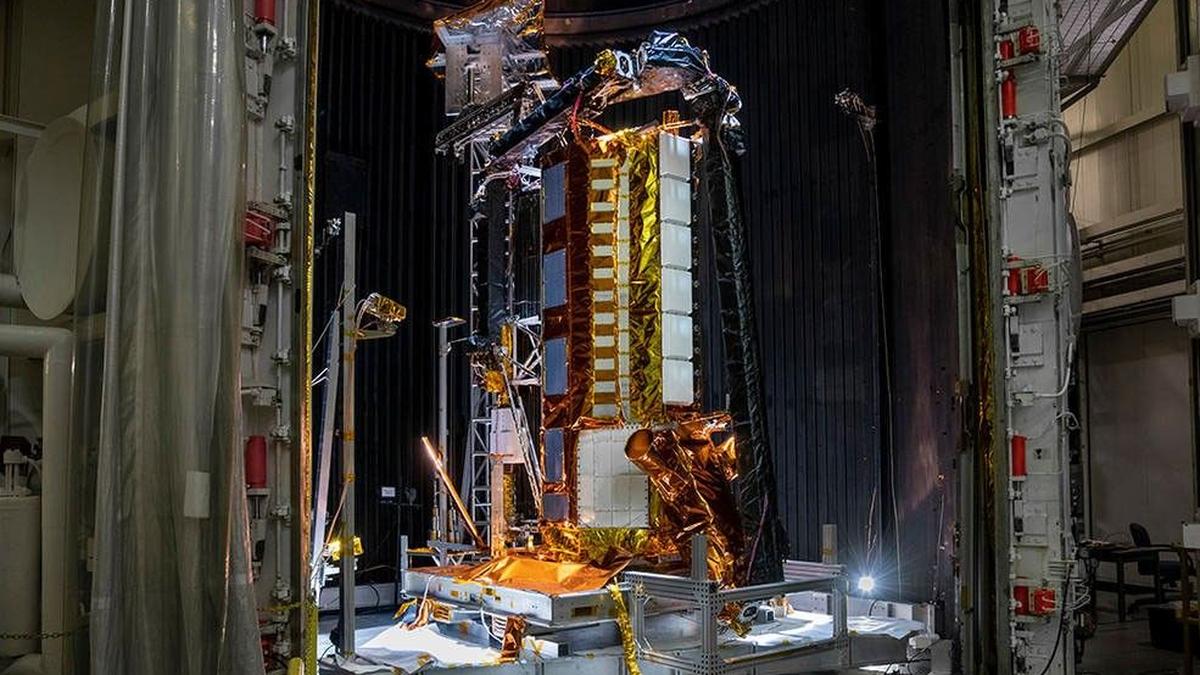
More recently, this reflector is enormous, it’s about a 40-foot deployable reflector. And when we were in India integrating and we were testing in the thermal vacuum, we saw some data that worried us. We were really afraid that there may be too much of a thermal load on that reflector before it gets deployed, and it might overheat. If it did that, it could challenge the structural integrity. Of course, when you’ve got a deployable antenna, if it doesn’t stay taut, it doesn’t reflect the way you want it to. So we ended up de-mating that reflector, bringing it back home, applying a reflective coating so the sun couldn’t cause it to overheat, on the struts (not on the reflector surface itself). Then we had to ship it back and reintegrate. So we had a couple of technical challenges, which we expect when you’re doing something as difficult as this.
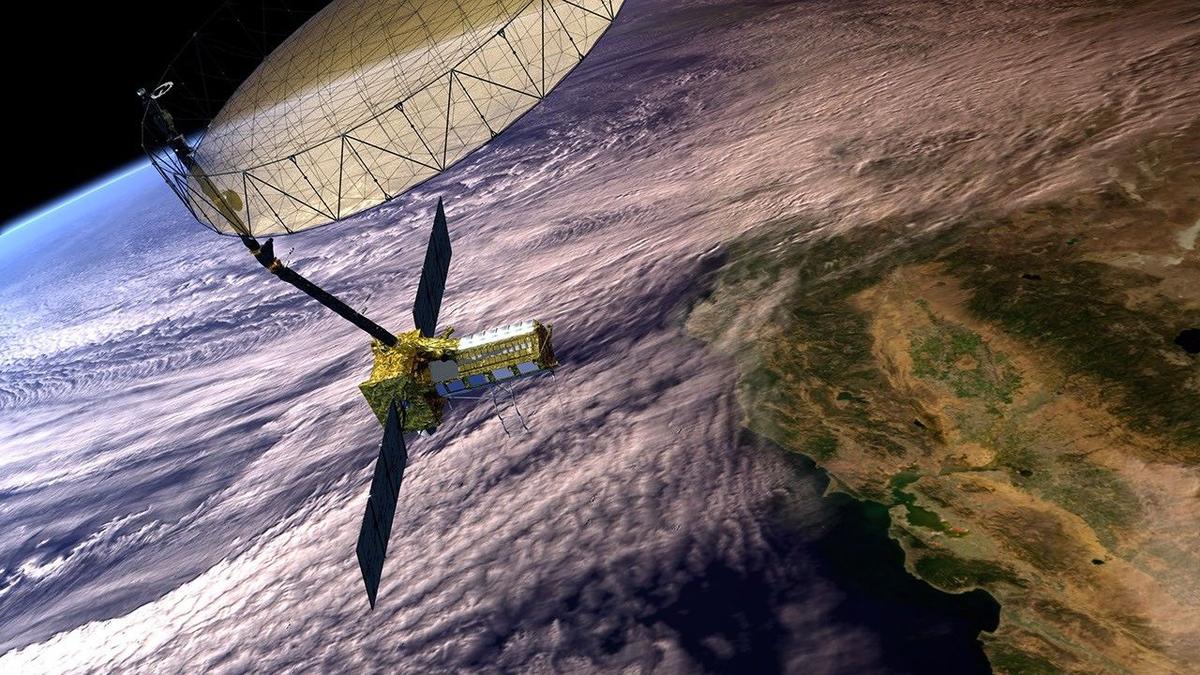
An artist’s illustration of NISAR orbiting the earth. The 12-m-wide reflector is seen deployed.
| Photo Credit:
NASA
Kunal Shankar: Speaking of challenges, what do you think are the limitations in terms of penetration depth of the L-band versus the S-band?
Karen St. Germain: I would not frame it so much in terms of limitations as I would frame it that they are both specialists and they just have different specialties. So the L-band has a longer wavelength and that means it can penetrate deeper. It can penetrate through foliage. Of course they’ll both be able to create imagery in day and night through clouds and weather. It’s just that when there is some material there like foliage, the L-band will penetrate further: it will interact with larger structures. The S-band will give you more information about that foliage because it’s more sensitive to it. That’s just one example. They will really just see different things. And their power then will be when we combine the information from them and get a more holistic holistic view, right?
Vasudevan Mukunth: This is kind of a follow up to that. Both the L-band and the S-band radars use the same reflector. Since S-band has a shorter wavelength than the L-band, does this create any trade-offs in either L-band or S-band performance?
Karen St. Germain: It doesn’t. And the reason for that is because this is a synthetic aperture radar. It creates its spatial resolution as it moves along. Each radar is taking snapshots as it moves along. You know, to get this kind of centimetre level fidelity and the kind of spatial resolution we’re achieving, if you were to use a solid antenna, it would have to be five miles long. Just like when you’re talking about a camera, if you want to be able to get high fidelity, you need a big lens. Same idea. But we can’t deploy an antenna that big. So what we do is we build up image after image after image to get that resolution. And because of this technique, it’s actually independent of wavelength. It works the same for S- and for L-bands. The only thing that’s a little different is because the antenna feeds for the L-band and the S-band can’t physically occupy the same space, they have to be next to each other and that means there’s a slight difference in the way their pulses reflect off the antenna. There’s that positioning difference, and that we can correct for.
Vasudevan Mukunth: Could you tell us a little bit more about that slight difference?
Karen St. Germain: It’s the way a reflector works. You would ideally want to put the feed at the focal point of the reflector. But when you have two feeds, you can’t do that. So they’re slightly offset. That means they illuminate the reflector just slightly differently. The alignment is just a little bit different. The team optimised the design to minimise that difference and to make it so that they could correct it in post-processing.
Kunal Shankar: How do NASA and JPL’s radar systems for planetary exploration feed into and evolve from their Earth observation systems? And even at the moon, NASA and ISRO have been collaborating specifically using radar systems on the DFSAR on Chandrayaan-2 orbiter and the Mini-RF on LRO. Can we imagine a NISAR built for missions to the moon, Mars or beyond?
Karen St. Germain: Of course, once you have expertise in a technology, you can use it in many, many ways. And this is often the case in NASA between earth science and planetary science. One of us will develop a new technology or advance a new technology and then it can be used very broadly. So absolutely! And we love that kind of interplay. I love seeing earth science technologies make it into planetary missions.
That’s one aspect. The other thing is what we learn from NISAR on earth can inform what we understand about other planets. There are lots of ways that we interact across disciplines.
Vasudevan Mukunth: Could you give us an example of a lesson that you would learn from NISAR that would help with the planetary mission?
Karen St. Germain: Let’s see. One of the things that NISAR is going to tell us about is what’s going on underneath the crust of the surface because we’ll be able to see these very small motions that you and I don’t experience daily, right? We can’t sense these. But NISAR will, and it will allow us to advance our models about how the interior of planets work. And those kinds of models are the same models we use when we try to understand how a planet like Mars works.
Vasudevan Mukunth: NISAR is a first of its kind equal partnership between NASA and ISRO. Can you tell us what kind of precedent this collaboration sets for future major collaborations or technology sharing between the two organisations?
Karen St. Germain: First, I will say I have been singularly focused on getting NISAR off the ground and not really looking beyond. Of course, you know, when I was preparing for launch, I went and bought a little figure of Ganesh. Because my understanding is that Ganesh brings good tidings for the beginning of an enterprise.
And for as long as we’ve been working on NISAR, the launch really represents the beginning of that collaboration. We will be working together closely for many years just to extract all the value out of NISAR. But as you said, NASA and ISRO are working together in many ways in human exploration and potentially in other areas. I hope, and I think that, we will have a rich collaboration for a very long time and I think it will span the areas of interest from earth science to planetary science and human exploration.