





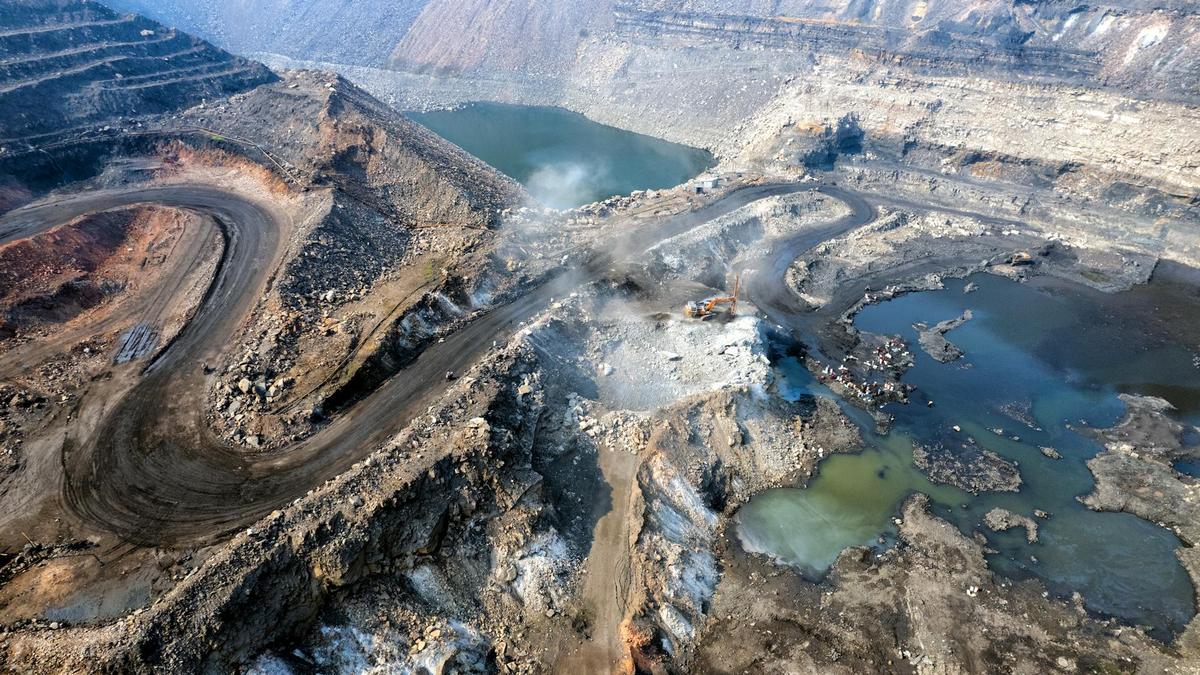
The Bengal Nagpur Railway had been tasked by the British Indian government with developing rail networks in eastern and central India. In 1900, when its workers were digging in Jharsuguda, now a district in Odisha, they stumbled upon large coal deposits. Nine years later, Jharsuguda’s first coal mine was established and a century later the region was producing more than 15 million tonnes of coal in a year.
Coal is a fossil fuel produced by the decomposition of dead plants trapped in layers of soil. Around three-fourths of India’s electricity is produced by coal-fired power plants. It’s also critical in the iron, steel, cement, and fertiliser industries. India is one of the largest producers and consumers of coal worldwide, second only to China.
A patina of dust
In Jharsuguda, most coal mines are open-cast. Miners here start at the surface of the soil, removing soil and rocks to expose the coal deposits. This is more cost-effective than underground mining, which requires digging tunnels to access the deposits.
But open-cast mining pollutes the air more. The dust from blasting rocks, drilling holes in the ground, and transporting the coal and rock waste disperses through the air and can choke lungs when inhaled. The dust also settles on the leaves of plants nearby. When this happens, stomata — the small pores on leaves through which plants exchange carbon dioxide, water vapour, and oxygen — are clogged, affecting photosynthesis and temperature regulation in the plants.
Estimating the impact of mining dust on nearby vegetation requires researchers to collect a large number of dust-laden leaves from plants spread in the area surrounding a mine. With the dust spreading as far as 30 km away from the mining site, this is a Herculean task.
In a October 2024 study published in the Journal of Geophysical Research: Biogeosciences, researchers from the University of Southampton in the UK and the National Institute of Technology (NIT), Rourkela, reported using freely available data from several satellites to investigate how plants are affected by mining dust.
“Use of satellite data provides a great opportunity to efficiently monitor larger areas,” study co-lead and University of Southampton professor of remote sensing Jadu Dash said.
The data suggest the dust has significant effects on the ability of vegetation to absorb carbon dioxide.
Amit Kumar Gorai, professor of mining engineering at NIT Rourkela and the other lead, added, “The study emphasises the importance of tackling dust pollution to protect vegetation and promote sustainable urban and industrial development.”
Eyes in the sky
The study was performed by Avinash Kumar Ranjan, who undertook the project as a part of his doctoral research at NIT Rourkela.
He began by estimating the amount of mining dust settling on leaves in areas surrounding coal mines in Jharsuguda. To do this, he used data from two satellites, Landsat-8 and -9, and two satellite clusters, Sentinel-2 and PlanetScope. The US Geological Survey and NASA launched the Landsat satellites in 2013 and 2021 while the European Space Agency launched Sentinel-2B (which supplied data for the study) in 2017 and Planet Labs launched PlanetScope in 2016-2022.

Light falling on leaves is composed of different wavelengths: we can see some (blue, green, red) but not others (e.g. infrared). The leaves absorb some of these wavelengths and reflect the rest. Like a camera snaps our photographs by capturing the visible light reflected by our bodies, satellites can capture images of an area in different wavelengths using special instruments.
When dust settles on leaves, it changes how much of a certain wavelength of light the leaves reflect. This changes the images of an area captured by a satellite for that particular wavelength. By comparing satellite images of areas farther from the coal mines with those that were closer, the researchers could estimate the amount of dust settling on leaves.
To validate their estimates, the team also visited two sites in Jharsuguda and collected 300 leaf samples with dust on their surfaces. In their laboratory, they weighed each dusty leaf, and brushed the dust off and weighed the leaf again. The difference between the two readings yielded another estimate of the amount of dust settling on plant leaves around the coal mines.
Finally, they used statistical methods to find that the actual readings were remarkably close to those calculated from satellite data, demonstrating that satellite images could be used to estimate the amount of mining dust settling on the local flora.
Narayan Kayet, a scientist at the Environmental Management and Policy Research Institute, Bengaluru, said the strength of the study lay in “the use of data from multiple satellites, which ensures comprehensive coverage and cross-validation of results.”
Kayet has previously studied the amount of mining dust settling on plants surrounding coal mines in Jharkhand. He wasn’t involved in the new study.
“Incorporating measurements from the field strengthens the credibility” of estimates derived from remote-sensing data, he added.
Dusty leaf, sick plant
The researchers also used statistical models to correlate the amount of dust on leaves with vital physiological processes. For the latter, they used readings from two other space-based instruments called ECOSTRESS and MODIS. Their data can be used to compute the temperature of plants in an area and the amount of water vapour they release, both in high resolution.
The team’s models suggested that plants with one gram of mining dust on their leaves absorbed “approximately 2-3 grams less carbon per square meter of area,” Gorai said.
While the amount might seem small for an individual plant, “when you multiply it across large areas of forests or vegetation near mining sites, the loss of carbon absorption becomes significant over time,” he added.

Apart from being important for photosynthesis in plants, carbon absorption lowers the amount of carbon dioxide in the air. But when dust clogs the stomata, the plant absorbs less carbon and leaves more carbon dioxide in the atmosphere. This could worsen global warming over time.
Another effect of clogged stomata is that plants become less able to exude water vapour in a process called transpiration. Plants that transpire well are able to maintain their temperature better; those that don’t become warmer.
“When leaves are too hot, they struggle to photosynthesise efficiently,” Gorai explained. “Over time, this can lead to stunted growth or even the death of plants.” This then leads to long-term damage to local ecosystems.
Dash and Gorai also said their study provides a quick and effective way for governments to monitor dust pollution in and around coal mines, identify hotspots, and implement timely measures to prevent long-term damage to surrounding vegetation and local ecosystems.
Such measures could include water sprays and dust barriers, Dash said.
Kayet agreed: “We need stringent measures to reduce dust emissions in mining regions to mitigate vegetation stress.”
Sayantan Datta is a science journalist and a faculty member at Krea University.
Published – January 28, 2025 05:30 am IST