


President Yoon Suk Yeol’s shock declaration of martial law revved up South Koreans from 0 to 100.
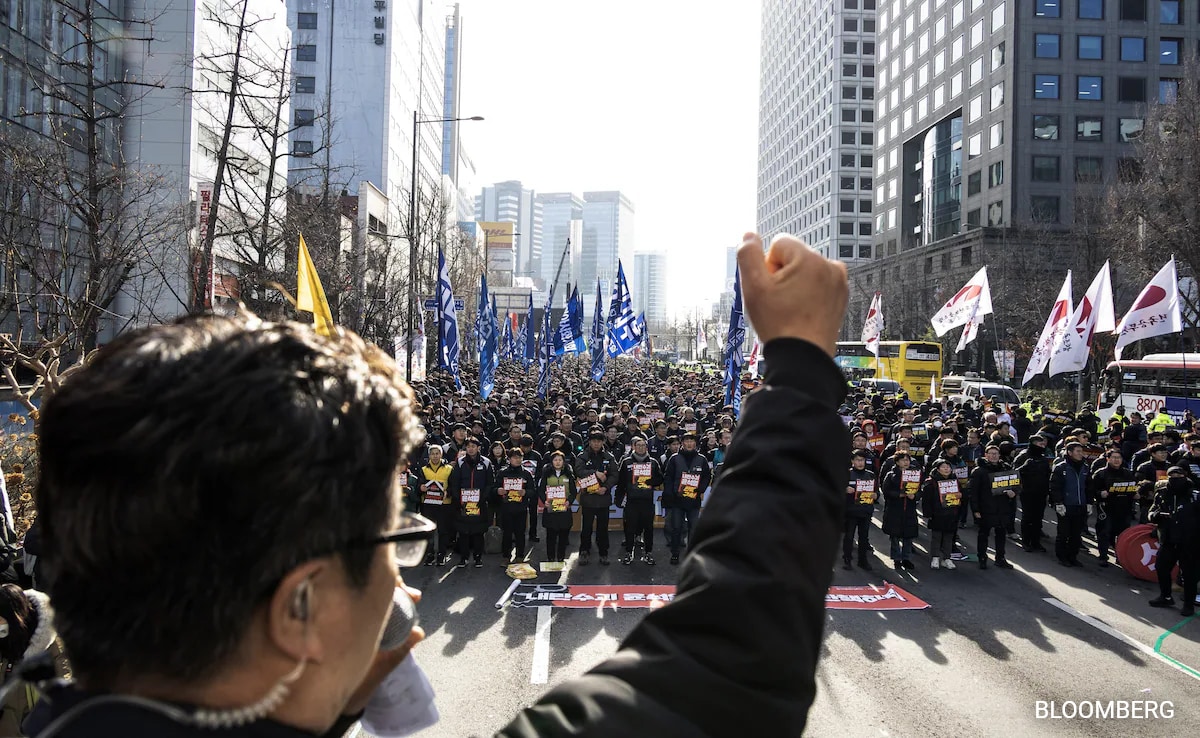
Within hours of Yoon’s late night announcement on Dec. 3, protesters massed on Seoul’s streets and lawmakers were so frantic to block the decree that they climbed over the fence of the legislature. A few days later, the president barely survived an impeachment attempt. The following weekend, officials once again gathered to oust Yoon. This time they succeeded. On the roads, thousands of demonstrators screamed with joy and released balloons into the air.
For much of the world beyond South Korea, the intensity of the past couple of weeks is a hard-to-fathom episode in a nation that’s fought hard for democratic rights and clearly refused to part with them. But beyond raw anger at a government many feel has failed them, the swiftness of Yoon’s fall also gestures at the culture of South Korea, which has rapidly industrialized in recent years partly through maximizing efficiency and a head-on approach to solving conflict, for better or worse.
This ethos — referred to in Korean as palipali, or “hurry hurry” — touches issues big and small. In its most positive form, it’s an approach to life that’s allowed the country to climb atop global supply chains and punch above its weight in business, politics and pop culture.
Over the past few decades, South Korea’s most enviable companies, among them Samsung Electronics Co. and Hyundai Motor Co., found success through embracing creative destruction and taking daring swings. Infrastructure projects have often moved at turbospeed, and the scars of poverty and past colonial and military regimes inform decision-making, motivating the populace to keep striving for a stabler future.
Unlike neighboring Japan, for instance, where corporates often struggle to innovate and the same party has mostly been in power for decades, Koreans aren’t afraid of bold pivots or voicing their displeasure. Yang Keeho, a professor of Japanese studies at Sungkonghoe University in Seoul, called the two countries “polar opposites.” In Japan, regime change is rare because resistance is broadly shunned.
Yet Koreans wasted no time in a largely unified pushback after Yoon declared martial law, one of the nation’s most consequential events in decades. Thousands of demonstrators poured onto the streets of Seoul with light sticks and danced at rallies to pop songs like Whiplash, a hit from the girl band Aespa.
“Palipali culture is an extremely powerful tool,” said Yoon Sooyeon, 41, a supporter of the protest movement who works in Seoul at an orchestra. “It’s a big part of what makes Korea do things that other countries can’t. This characteristic of how we can all gang up together very quickly and get excited.”
She said the past month also illustrates an anger that’s embedded in another popular term: naembi geunseung, or the boiling pot syndrome. Koreans heat up fast, she said, and cool down just as swiftly. “I’m not exactly a huge fan of this easy-to-heat-up nature,” she said. “But when the momentum is there, it really translates into a huge amount of energy.”
South Korea’s history helps explain its culture. In less than 100 years, the East Asian nation broke free from Japanese occupation, survived conflict with North Korea, and transformed its impoverished, agrarian economy into one of the world’s most formidable, with a gross domestic product that’s 85 times larger today than it was five decades ago. Some link the development of palipali to the Chollima Movement, when North Korea urged labor to work harder and faster to boost production after the Korean War ended in 1953.
This mentality influenced South Korea, which was the poorer of the two economies after the fighting ended. Business and political leaders pulled the country up through encouraging a uniquely abrasive — and often theatrical — approach to achieving speedy results.
Strongmen feature prominently in South Korea’s chaebols, massive, family-run conglomerates that dominate the economy. Former Samsung chairman Lee Kun-hee is famous for telling his employees that they must sacrifice everything for the good of the company except for their wives and children. In 1995, he set fire to 150,000 phones and faxes, some of them defective, to make a statement about quality control, an event known as the “Anycall execution.”
To construct one of South Korea’s first highways, the Gyeongbu Expressway, developers hired 9 million people and members of the military, finishing the job a year ahead of schedule. And Park Tae-Joon, the founder of Posco Holdings, one of the world’s largest steel manufacturers, was so committed to expediting the building of a plant in the city of Pohang that he lived on the construction site.
This approach to development has its downsides. In the political context, South Korea’s leaders are often criticized for dramatic excesses and a level of public strife unheard of in other parts of East Asia. Many of the nation’s premiers have been impeached or imprisoned. Even Yoon’s decision to declare martial law has hints of palipali: After meeting with advisors for just five minutes, the president went ahead with the decree — in his telling to thwart “anti-state forces” among his political opponents.
Koo Jeong-woo, a sociology professor at Sungkyunkwan University in Seoul, said the word carries some negative connotations, though it’s also “what drives a highly-sophisticated level of cooperation.” Others see it as a simplistic depiction of Korean culture, noting that palipali is expressed differently from the past. Many argue that living standards are high enough today that extreme measures broadly aren’t needed anymore.
Even so, palipali is an emotion that suggests perseverance and survival. After Yoon’s announcement, Koreans knew what to do.
“We get a glimpse into a culture’s nature when things like this happen,” Koo said. “Koreans are not shy about expressing ourselves. We’re very passionate and we have a strong obsession toward achieving goals, something we earned and developed in response to our geopolitical status, the Japan occupation and the Korean War.”
For many, the goal this month was ousting Yoon, whose approval rating plunged to 11% before the impeachment vote. During his tenure, young Koreans, in particular, have held his administration responsible for widening income disparities and lack of job opportunities.
On Saturday, more than a quarter million Koreans braved the cold to bring the president’s chapter to an end. A rival group of pro-Yoon protesters, largely older and more conservative, also gathered in Seoul’s Gwanghwamun Square, a central landmark for Korean history.
Ahead of the voting, Kim Yebin joined protesters outside the National Assembly with her parents and sister. The crowd sang along to Saturday Night, a popular K-pop song, changing the lyrics to meet the moment. “On Saturday night, impeach Yoon Suk Yeol!”
Many spoke emotionally about the last time South Korea was under martial law. In 1980, students led an uprising for democracy in the city of Gwangju. The military met demonstrators with force, firing indiscriminately into the crowds and killing hundreds.
Soon after the votes were counted, phones lit up with news alerts: 204 ballots in favor of removing Yoon and 85 against. The crowd erupted. Demonstrators cried and embraced their neighbors. “We did it!” Kim shouted.
“Everything has happened at lightning speed from beginning to end,” said Kim, whose throat was sore from singing. “The truth is we are a crowd of 200,000 different individuals. But we were here together united with a single goal.”
The days ahead could still be rocky. After Yoon declared martial law, South Korea’s markets shed billions of dollars and the won fell against the dollar to its lowest level since the global financial crisis. The Bank of Korea has vowed to stabilize the economy after Saturday’s vote, but volatility remains a possibility.
Within a few months, South Korea’s Constitutional Court will also rule on the validity of the impeachment motion. If the measure moves forward, and Yoon is formally removed, the government has 60 days to hold fresh presidential elections.
Yet even with the uncertainty, many Koreans say this month has brought much of the country together, illustrating the unique resilience of a populace unwilling to turn back the clock to darker chapters of history.
“There is a hundred-year-long tradition of resistance,” said Ben Forney, a researcher at Seoul National University who writes about economic security. “I think now the Korean people have this confidence that they can make a change.”
(This story has not been edited by NDTV staff and is auto-generated from a syndicated feed.)