


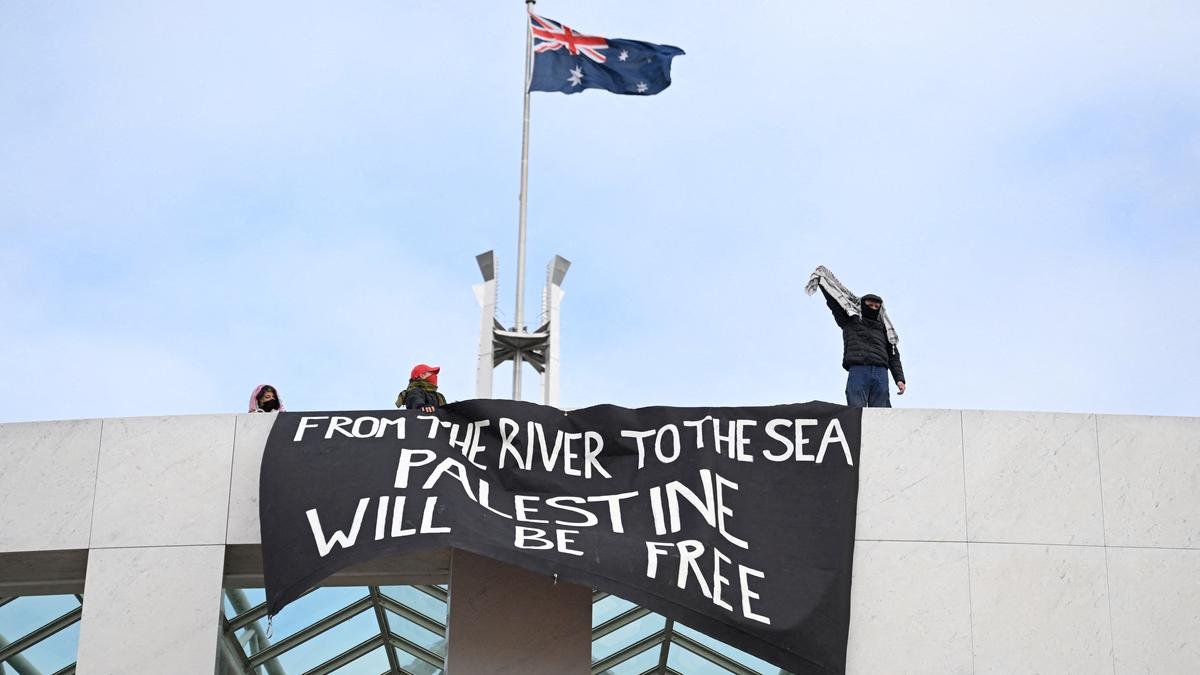






The most memorable moment of King Charles and Queen Camilla’s recent royal tour of Australia and Samoa was Australian indigenous senator Lidia Thorpe’s insult to the monarchy. She was escorted out of Canberra’s Parliament House after she heckled the King and accused him of genocide. The British media was incensed, calling her “outburst” simply “rude” and “ill-mannered”.
True, Senator Thorpe’s behaviour may be unwarranted. However, it ensured that the royal visit was anything but forgettable. A couple of days later, the issue of reparations raised by the former British colonies at the two-day biennial Commonwealth Summit in Samoa was another rough treatment the British royalty received in quick succession.
A Direct Message In Samoa
Set roughly midway between New Zealand and Hawaii, the summit in Samoa last month saw King Charles and UK Prime Minister Keir Starmer join leaders from 56 Commonwealth nations. It coincided with the BRICS Summit in Kazan and therefore received little coverage in India. Anyway, the setting may have been remote, but the message on reparations was direct and one that won’t be easy to ignore. Good that the leaders of two heavyweight Commonwealth countries, Indian Prime Minister Narendra Modi and South African President Cyril Ramaphosa, were attending the BRICS summit. Their presence would have made things more difficult for the UK government. India was represented at the summit by Union Minister of Parliamentary Affairs, Kiren Rijiju.
Nevertheless, calls for the UK to pay monetary compensation and extend a formal apology over its role in the trans-Atlantic slave trade resurfaced with fresh urgency at the summit. The UK, expectedly, had vetoed the proposal to directly address reparations in the summit’s final communique. Instead, the document tiptoed around the issue, referencing only the possibility of “future discussions” on “reparatory justice” regarding the trans-Atlantic trade in enslaved Africans.
Prime Minister Keir Starmer rejected calls for an apology and reparations, telling delegates that it was futile to have “very long, endless discussions” about the past. Instead, he urged the former colonies to focus on issues of the present, such as climate change, which his government could help. Speaking at the summit in Samoa, King Charles sounded more conciliatory: “None of us can change the past. But we can commit, with all our hearts, to learning its lessons and to finding creative ways to right the inequalities that endure.”
For the leaders of former colonies, however, this side-step will not likely put the topic to rest anytime soon
Apologies From Just A Few
Privately, some families who owned thousands of slaves have apologised for their part in the slave trade. For example, last year, descendants of the family of 19th-century British Prime Minister William Gladstone visited Barbados, St. Lucia and other Caribbean islands to acknowledge and apologise for their ancestor’s involvement in slavery. John Gladstone, William’s father, owned slaves on plantations in the Caribbean. William Gladstone, however, was a prominent abolitionist. Caribbean leaders welcomed the apology, calling it a step towards healing and reconciliation.
Like Britain, most European colonial powers have expressed regret over their past sins. But they have not formally apologised for it. The only notable exceptions are the Netherlands and Belgium. They have apologised for both colonial atrocities and slave trade involvement, though no monetary compensation has been promised.
Britain Owes Former Colonies $24 Trillion
Patrick Robinson, a UN judge, indicated last year that the United Kingdom may owe over $24 trillion in reparations for its role in the trans-Atlantic slave trade. In a report co-authored by him and published last year in June, he says he considers this figure a conservative assessment, noting the vast and lasting damage inflicted by the slave trade. The report calculates that in total, reparations to be paid by 31 former slaveholding colonial powers—including Spain, the United States and France—amount to $107.8 trillion. Expressing astonishment, Robinson remarked that certain states involved in slavery appear to ignore their obligations, stating, “Once a state has committed a wrongful act, it’s obliged to pay reparations.”
Robinson, known for presiding over the trial of former Yugoslav President Slobodan Milosevic, emphasised the principle that reparations are a duty, not an option. He has been a member of the International Court of Justice (ICJ) since 2015 and has been researching reparations as part of his honorary presidency of the American Society of International Law. It is nearly obvious that the former colonial powers, who are among some of the richest countries in the world, thanks to their colonial exploits, appear to be in no mood to pay compensation packages to the nations affected by the slave trade
“Am I Not A Man And A Brother”
The expansionist British Empire’s exploitative system was based on three sins against humanity—colonisation, slave trade and indentured labour. Indentured labour was targeted against India more specifically.
One of the most enduring symbols from the 19th century’s abolitionist movement is the sketch of a Black man in chains. If you take a closer look, it shows an enslaved Black man, kneeling in chains, with the words “Am I not a man and a brother” encircling him. The image and the plea punch a deep yearning for the enslaved African and Caribbean man’s freedom and equality. This emblem challenged the cruelty of slavery and called for justice.
The British Empire bears a dark legacy as one of the largest forces in the trans-Atlantic slave trade, a tragedy that caused immense suffering and disruptions. Yet, it is only fair to acknowledge at the outset that Britain was also home to a powerful abolitionist movement that rallied the public at the grassroots level and pushed Parliament to abolish slavery in 1833. The Slavery Abolition Act undoubtedly marked a significant turn in the global fight against enslavement. It outlawed slavery in most of the British Empire.
But the abolition of one sin gave birth to another, equally evil in nature, indentured labour, which directly impacted India.
Slaves vs Coolies
Which is worse: the brutal reality of the slave trade or the ruthless grind of indentured labour—the so-called “coolies” of the British Raj? Each system wore a different mask, but all served the same purpose: to sustain the empire on the backs of exploited labour. The slave trade was raw oppression, tearing people from their homelands, stripping them of their identity and treating them as property. Then came indentured labour, not quite as blatant, but equally unforgiving. This “sanitised” slavery trapped workers in harsh conditions with barely a trace of freedom—a palatable replacement for the colonial conscience.
The British Empire ended the slave trade with the 1833 Abolition Act, yet hardly skipped a beat before instituting indentured labour the very next year, in 1834. Records show that private plantation owners actively lobbied the Empire for cheap labour from India, which soon became the backbone of colonial projects in far-flung corners of the Empire. Hundreds of thousands of Indian labourers—mostly poor, unlettered and desperate—were ‘contracted’ to work on plantations in the Caribbean countries and railroads, especially in East Africa. Many were coerced into these agreements, often only needing to affix a thumbprint to a piece of paper they couldn’t read. What they signed away was their freedom, shackled to a five-year contract with slim hope for escape from abusive conditions. The British National Library has huge archives of papers pointing to several incidents of revolt by the labourers, many of whom were killed or maimed as punishment.
So, which system bears the greater sin? Hard to say. But perhaps the most enduring sin is the claims by a few apologists in the West—which include some right-wing politicians—that these practices helped famine-stricken Indians improve their lives and that the entire colonial project was part of “civilising” the coolies.
(Syed Zubair Ahmed is a London-based senior Indian journalist with three decades of experience with the Western media)
Disclaimer: These are the personal opinions of the author




