



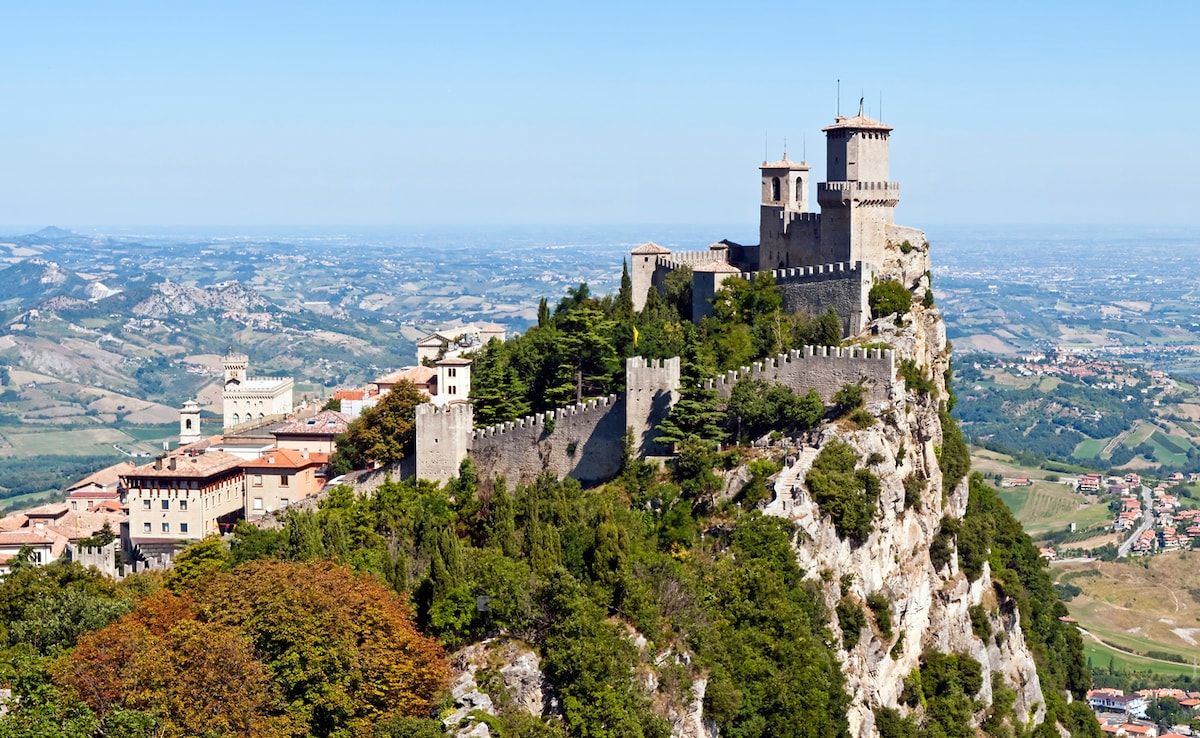
Continental Europe is home to four microstates with populations of between 30,000 and 80,000 people: Andorra, on the border between France and Spain; Liechtenstein, nestled between Switzerland and Austria; Monaco, which sits on the French Riviera; and San Marino, which is surrounded by northern Italy.
These states have existed since the medieval period and their tiny size has enabled them to develop and maintain singular constitutional arrangements. They have all developed original solutions to the problems of state architecture, many of which survive today.
All four of these microstates participate in the Council of Europe (Europe’s human rights organisation) and have therefore had to modernise to meet international standards of governance. This includes the independence of the judiciary.
However, all four have also implemented these reforms without altering their institutional identity. Their commitment to preserving their distinctiveness from other countries prevents wider reform to their institutions. For them, the protection of national tradition and identity is a form of self-preservation rather than a mere expression of ideology.
The distinctiveness of the four microstates lies in the survival of institutional arrangements that can no longer to be found practically anywhere else in the world. In the principalities of Liechtenstein and Monaco, for example, the monarchy still has a central role in the constitution.
Unlike in most European states with a monarchy, in Liechtenstein and Monaco, the royal head of state continues to exercise meaningful power. Andorra and San Marino, meanwhile, operate under a dual head of state arrangement. They effectively have two monarchs.
Institutional arrangements in these principalities has been shaped by their diminutive size, both in terms of territory and population, and their geographical location. And these arrangements have survived since the middle ages because they have become their identity. While national tradition is an ideological debate in other nations, in these, preserving the past is a survival mechanism.
Liechtenstein and Monaco
Liechtenstein and Monaco are constitutional monarchies of the kind that offer substantial power to the royal family. Everything is organised around a prince, who exercises the executive power. Contemporary monarchies in the western legal tradition generally have a ceremonial king or queen but the executive power is held by an elected government. Liechtenstein and Monaco have maintained their historical organisation of government, centred on a very powerful monarch.
Although his powers are not unlimited, in Monaco, the prince is not even accountable to the parliament for the powers he does hold. Liechtenstein’s prince enjoys even more powers, including the right to appoint half of the members of the constitutional court.
However, the prince of Liechtenstein’s sovereign power is held in partnership with the people of Liechtenstein. The institutional architecture is built as to allow a system of checks and balances between the prince and the people.
Since a 2003 constitutional amendment, for example, the people can table a motion of no-confidence in the prince if more than 1,500 citizens are in agreement to do so, which triggers a referendum on confidence in him. The same number of citizens can mount an initiative to abolish the monarchy entirely, should they choose to do so.
Andorra and San Marino
The principality of Andorra should more properly be called co-principality, because of its co-princes arrangement. One of the princes is the bishop of Urgell – from Catalonia – and the other is the president of the French Republic (and previously the French king or emperor). So another Andorran peculiarity is that neither of the princes are Andorran nationals.
Following a 1993 reform that established a fully fledged constitution, neither prince holds sovereign power. Their present constitutional role is almost entirely ceremonial. However, concerns remain over the fact that they are not nationals of the state and that the heads of state are selected neither by the Andorran people nor by their representatives. The historical reason for a foreign head of state is the geographical location of Andorra – wedged between Catalonia and France. Allowing itself to be put under this double sovereignty was a guarantee of survival.
San Marino also has a two-headed state but both leaders, called the Captains Regent, are Sammarinese nationals. They are elected by the Grand and General Council (the Sammarinese legislative body) and their distinctive trait is that they serve only a six-month term of office.
The reason for such a short tenure is that San Marino has a population of just under 34,000 people. Everyone knows everyone else, which is a situation that can be detrimental to the independence of elective offices.
Captains Regent can’t shore up enough power in their short time in office to be able to overthrow the republic. The Captains Regent were first established in 1243, shortly before a number of Italian republics were overthrown by wealthy families. One of the reasons why San Marino has been able to survive is because it has prevented one family from being more powerful than the others for centuries.
Microstates are, therefore, not like Europe’s regular-sized states. They have distinctive institutional architectures – and often for understandable reasons.
(Author: Elisa Bertolini, Associate Professor of Comparative Public Law, Bocconi University)
(Disclosure Statement: Elisa Bertolini does not work for, consult, own shares in or receive funding from any company or organisation that would benefit from this article, and has disclosed no relevant affiliations beyond their academic appointment)
This article is republished from The Conversation under a Creative Commons license. Read the original article.
(Except for the headline, this story has not been edited by NDTV staff and is published from a syndicated feed.)