

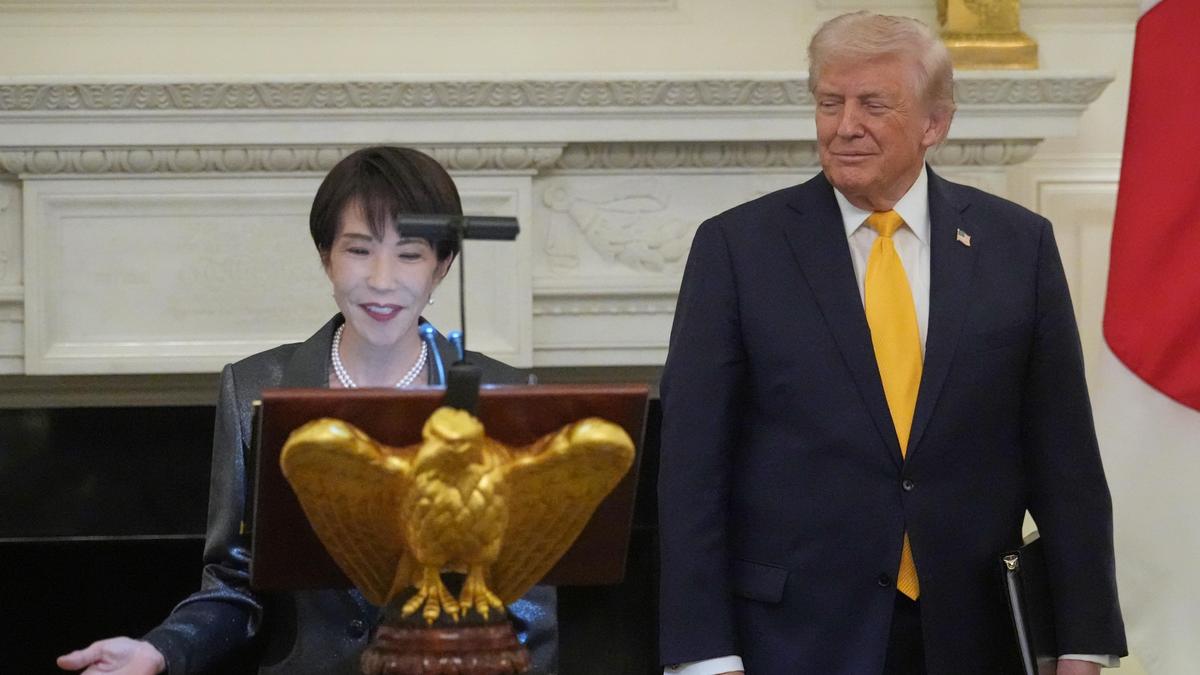
Japanese Prime Minister Sanae Takaichi has sought to reaffirm her alliance with President Donald Trump after the president this week seemed to complain that Japan was among the nations that did not quickly join his call to help protect the Strait of Hormuz.
Ms. Takaichi, who met with Mr. Trump at the White House, told the Republican President that Japan has opposed Iran’s development of its nuclear programme and appealed to his desire to be seen as a peacemaker, despite his launching a war of choice with Iran.
She told the U.S. President through an interpreter that in the West Asia and around the world now, there was “a very severe security environment,” but said, “Even against that backdrop, I firmly believe that it is only you, Donald, who can achieve peace across the world.” The two leaders had warm words for each other, including Trump calling the prime minister a “popular, powerful woman,” but there appeared to be some tension as they faced repeated questions from reporters about Japan’s support for the Iran war.
As Mr. Trump took questions from reporters during the roughly 30-minute public appearance with the Prime <inister in the Oval Office before their closed-door meeting, Ms. Taikaichi could be seen checking her watch. And then Mr. Trump made a particularly uncomfortable remark — invoking Japan’s 1941 attack on Pearl Harbor — when he was asked why the U.S. didn’t notify allies like Japan ahead of the strikes on Iran.
“We didn’t tell anybody about it because we wanted surprise. Who knows better about surprise than Japan? Why didn’t you tell me about Pearl Harbor, OK?” Mr. Trump joked.
As Mr. Trump said that, Ms. Takaichi’s slight smile appeared to drop, and she raised her eyebrows.
Earlier Thursday (March 19, 2026), the leaders of five European countries and Japan issued a joint statement demanding that Iran stop attacks on the Strait of Hormuz that block commercial shipping, and said they are ready to contribute to “appropriate efforts” to ensure ships can pass safely through the strait, though it is not clear what that entails.
Mr. Trump told reporters that he and Ms. Takaichi would be discussing in their meeting Japan’s level of support for the U.S. in the Iran war, saying, “They are really stepping up to the plate.” He did not offer details.
He later said that much of the oil Japan relies on passes through the Strait of Hormuz and said, “so that’s a big reason to step up. He also mentioned US spending in Japan and the number of troops it has stationed there.
“I expect Japan to step up, you know, because we have that kind of relationship,” Mr. Trump said.
A nuclear reactor deal announcement is expected
Ms. Taikaichi’s meeting at the White House, followed by a dinner Thursday (March 19, 2026) night, was supposed to give Japan’s new Prime Minister a prime opportunity to have Trump’s ear before he embarked on a trip to China.
But now, the war in Iran and Mr. Trump’s call for Japan and other nations to help protect the vital Strait of Hormuz means the China trip has been delayed. Trump had repeatedly complained on camera and online this week that US allies, including Japan, did not heed his request to help safeguard the critical waterway for oil and gas transport. He later declared the help wasn’t needed, but made other comments indicating he still expected help.
The Prime Minister acknowledged before she left Japan that she expected her meeting with Trump would be “very difficult.” Beyond facing questions about Iran, Ms. Takaichi and Mr. Trump on Thursday (March 19, 2026) are expected to announce a $40 billion nuclear reactor deal, according to a White House official, who was not authorized to speak publicly and spoke on the condition of anonymity to share details before the announcement.
Under the deal, U.S.-based GE Vernova Inc. and Japan-based Hitachi Ltd. will build advanced small modular reactors in Tennessee and Alabama, the official said. The deal aims to help stabilise electricity prices and expand power generation in the U.S.
The meeting carries high stakes
Kurt Campbell, the former US deputy secretary of state in the Biden administration and now chair of The Asia Group, said that to press for Japan’s interests, Takaichi needed to find a way to suggest that Japan is part of the U.S. plan in the West Asia.
“She’s going to want to come out of that as a partner in this case and realize that if she can do that, that she can translate that potentially into the president listening more to Japanese concerns about Taiwan or other issues,” Mr. Campbell said.
The constraints on Japan’s involvement in Iran include a provision in its post-World War II constitution that bans the use of force except to defend its territory. The country’s military is called the Self-Defense Force.
Christopher Johnstone, a partner and chair of the defense and national security practice at The Asia Group, said Japan could help with minesweeping and has had “a small naval presence” in the region as part of an anti-piracy mission for at least a decade. But to join the U.S. mission would require Ms. Takaichi to clear “an exceptionally high bar politically to invoke collective self-defense” that has never been done before.
Published – March 20, 2026 05:56 am IST