


The story so far: The Interim Agreement between India and the U.S. on trade has buoyed investor sentiment in India, especially because of the prospect of tariffs on Indian exports to the U.S. reducing to 18%. However, since the deal was announced through a joint statement on February 7, the contours of what it could include have been the source of much ambiguity. This is especially true in four broad areas: oil, agriculture, textiles, and the value of overall imports from the U.S.
Also Read | U.S. removes references to pulses, changes tone on $500 billion investments from India
What does the joint statement say?
The joint statement said that the U.S. has agreed to apply a reciprocal tariff of 18% on imports from India. This would entail a reduction from the existing 25%. The statement itself did not mention the additional 25% penal tariff the U.S. had levied on India for its imports of Russian oil. However, U.S. President Donald Trump took to social media saying that Prime Minister Narendra Modi had agreed to stop importing Russian oil. Further, on February 6, Mr. Trump issued an executive order removing the 25% penal tariff saying that “India has committed to stop directly or indirectly importing Russian Federation oil”. Commerce Minister Piyush Goyal has said that he expects the executive order reducing the remaining 25% reciprocal tariffs to 18% to be issued this week.
In return for this reduction in reciprocal tariffs, the joint statement said India has agreed to remove tariffs on U.S. exports of “all U.S. industrial goods and a wide range of U.S. food and agricultural products”, which includes Dried Distillers’ Grains (DDGs), red sorghum for animal feed, tree nuts, fresh and processed fruit, soybean oil, wine and spirits, and “additional products”. Further, the joint statement said that India “intends to” buy $500 billion worth of U.S. energy products, aircraft and aircraft parts, precious metals, technology products, and coking coal over the next five years.
Also Read | U.S. trade deal compromises India’s energy and data security, farmers’ future: Rahul Gandhi
What is the confusion over oil imports?
The confusion arises from the fact that the Indian government has refused to categorically deny the repeated statements by Mr. Trump and senior officials of his administration that India has agreed to stop buying oil from Russia. A factsheet on the India-U.S. deal issued by the White House also says the same.
While an analysis of government data up to December 2025 shows that India’s imports of Russian oil had fallen to a 38-month low that month, the government has not made clear its position on Russian oil imports since then. When asked about the issue, both Commerce Minister Piyush Goyal and Petroleum Minister Hardeep Puri have directed all questions to the Ministry of External Affairs. In repeated press conferences, officials of the Ministry of External Affairs have not answered direct “yes or no” questions on whether India has committed to reducing its Russian oil imports. In a public statement, Foreign Secretary Vikram Misri said earlier this week that India’s energy sourcing is guided by pricing, availability, and risks but did not directly address the Russian issue.
Also Read | Rahul Gandhi meets farm union leaders, talks on nationwide movement against India-U.S. trade deal
How will agriculture be affected?
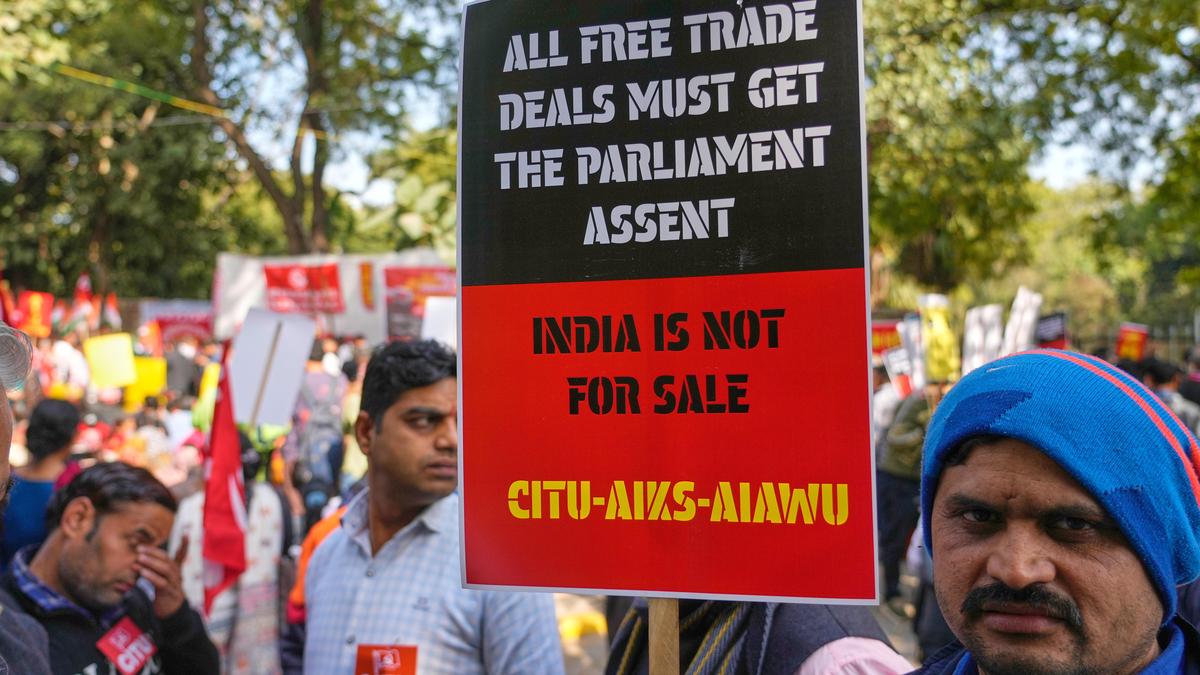
The agriculture sector is another area that has created a lot of controversy. Opposition parties have taken the wording of the joint statement, which said India has agreed to eliminate tariffs on “a wide range of U.S. food and agricultural products”, to attack the government for hurting the interests of India’s farmers. Mr. Goyal, through various press briefings and interviews, including to The Hindu, made assurances that Indian farmers had no reason to worry and that all sensitive agricultural items and dairy would be kept out of the deal.
While listing the various agricultural items that were excluded from the deal, Mr. Goyal told The Hindu that this would include “pulses in which we are self-sufficient in India, like green peas, kabuli chana, moong”. The question of what happens to other pulses again came to the fore when the White House uploaded its fact sheet. In the original version, the list of items on which India had agreed to eliminate or reduce tariffs included pulses. That version has since been updated, with the reference to pulses being removed.
On Friday, both Mr. Goyal and Agriculture Minister Shivraj Singh Chouhan released separate video messages assuring farmers that their interests would not be compromised in the U.S. deal.
Also Read | India-U.S. deal does not include any item that would hurt Indian farmers, says Piyush Goyal
What about India’s purchase of U.S. goods?
Mr. Trump’s original post on Truth Social said that Prime Minister Modi had committed to “buy American” in addition to $500 billion worth of energy, technology, agricultural, coal, and “many other products”.
The joint statement, while clarifying that these purchases were to be spread over five years, also said that it was an intention and did not use the word commitment. However, the White House factsheet again said that India had committed to buying $500 billion worth of goods from the U.S. The amended version now also says this is an “intention”.
The $500 billion of imports of goods from the U.S. will not overly concentrate on India’s supply chains towards the U.S., Mr. Goyal said in his interview to The Hindu. He said that India currently imports about $300 billion of electronics, energy, parts for data centres and semiconductors, and airplanes and their parts from across the world. This amount, he said, is expected to grow to $2 trillion in five years. So, he argued that importing $500 billion of this from the U.S. would not entail any concentration of India’s supply chains.
COMMENT | India tested, from U.S. sanctions to one-sided trade deal
Why is there ambiguity over textile exports?
Once Mr. Trump signs the executive order lowering India’s reciprocal tariffs to 18% from 25%, the tariff on India’s textile exports too will fall to 18%. The sector welcomed this with great enthusiasm since the U.S. is a major export destination for the sector and the earlier 50% tariffs were hurting the industry.
However, just days after India and the U.S. announced their deal, the U.S. and Bangladesh also announced a trade deal. Under this deal, Bangladesh’s exports to the U.S. would face tariffs of 19%. In addition, the agreement included a clause that specified that if Bangladesh imports cotton from the U.S., then the textiles exported using that cotton would face 0% duties in the U.S.
Opposition parties were quick to point out that this would render Indian textile exporters relatively uncompetitive even before India’s deal with the U.S. has been signed.
Now, however, Mr. Goyal has said that Indian textile exporters will receive the same benefits as Bangladeshi textile exporters. That is, under the Interim Agreement, if Indian textile makers import American cotton, then their exports to the U.S. would attract 0% tariffs. This had not been mentioned by him earlier. Mr. Goyal and other officials of the Commerce Ministry have said that the formal agreement is expected to be signed in mid-March. It is only after that that more details will be made clear.
Published – February 15, 2026 02:04 am IST