



On February 5, the New Strategic Arms Reduction Treaty (New START) officially expired, marking the end of the last remaining bilateral agreement constraining the nuclear arsenals of the U.S. and Russia. The New START treaty emerged from a period of diplomatic reset between Washington and Moscow in the late 2000s. Its predecessor, START I, was signed in 1991 and expired in December 2009. While the 2002 Moscow Treaty was still in effect, it lacked the rigorous verification and monitoring mechanisms typically of the START era.
Negotiations for a successor began in earnest in April 2009 after a meeting between then U.S. President Barack Obama and his Russian counterpart Dmitry Medvedev in London. The drafting process involved several rounds of talks in Geneva and Moscow. In April 2010, the two leaders signed the treaty in Prague and, after a contentious ratification process in the U.S. Senate and approval by the Russian Federal Assembly, entered into force on February 5, 2011.
Nuclear limits
New START set up verifiable limits on the strategic offensive arms of both nations and mandated that both parties reach these limits within seven years (by February 5, 2018) and maintain them thereafter. It capped the number of deployed strategic warheads to 1,550 and imposed similar limits on the numbers of heavy bombers, ICBMs, and SLBMs, allowed 18 on-site inspections a year, prohibited each party from interfering with the other’s National Technical Means (e.g. satellites), mandated data exchange, and setup a bilateral commission to resolve issues.
However, throughout its existence, New START faced several hurdles that eventually contributed to its demise. Perhaps foremost: Russia often argued that U.S. missile defence systems undermined the strategic balance, suggesting that if one side could neutralise the other’s retaliatory strike, the ‘mutually assured destruction’ dynamic would be broken. Conversely, the U.S. expressed concerns over conventional prompt global strike capabilities, where precise conventional warheads are placed on ballistic missiles — systems that New START counted under its nuclear limits.
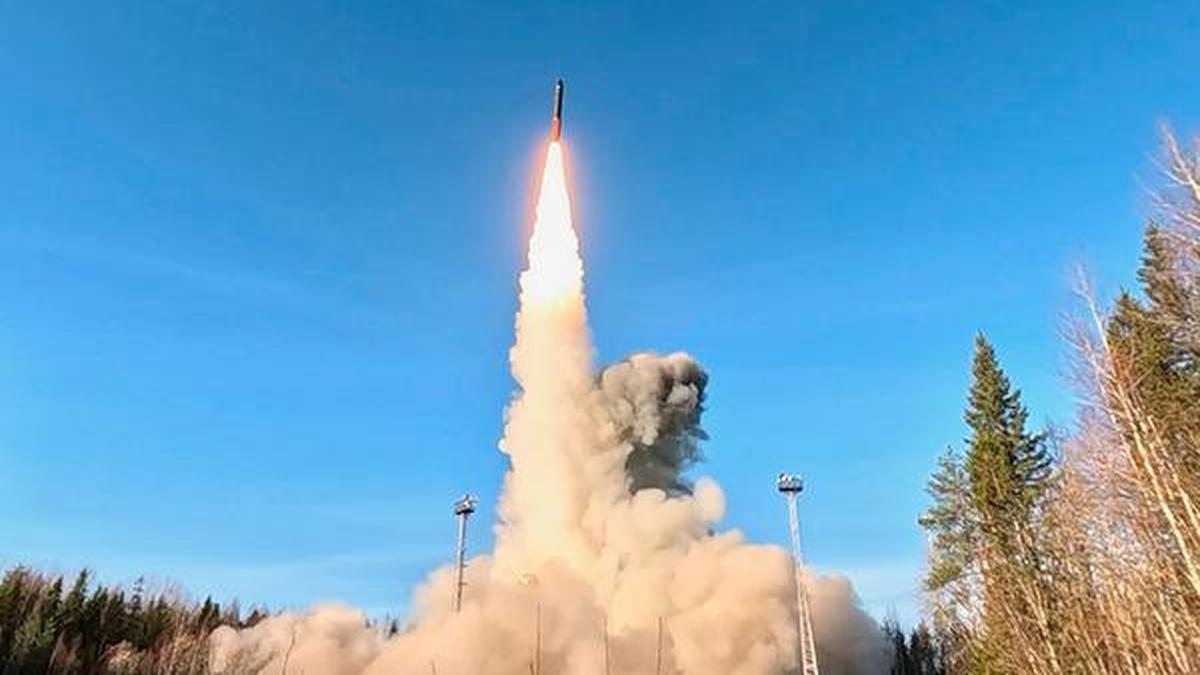
In the latter half of the treaty’s life, Russia also unveiled several novel strategic systems, including the Sarmat heavy ICBM and the Avangard hypersonic glide vehicle. While the U.S. successfully argued that these should be counted under New START, other systems like the nuclear-powered underwater drone Poseidon and nuclear-powered cruise missile Burevestnik remained outside the treaty’s technical definitions, creating friction.
The treaty was originally set to expire in 2021. Just days before the deadline, the Biden administration and the Kremlin agreed to a one-time, five-year extension, moving the expiration date to February 5, 2026. But in February 2023, after the conflict in Ukraine escalated and undermined bilateral relations, President Vladimir Putin said he was suspending Russia’s participation in New START because, Moscow said, the U.S. was seeking a “strategic defeat” of Russia and that western aid to Ukraine made on-site inspections in Russia impossible. The U.S. soon followed by withholding its own data and notifications.
Negotiations for a successor treaty, often called Post-New START, have been stalled throughout 2024 and 2025. In late 2025, a Russian proposal for a voluntary one-year informal adherence to the 1,550 limit was met with scepticism in Washington, where the Trump administration signalled a preference for a “better deal” instead.

Logic of deterrence
Thus, today, the legal constraints on the world’s two largest nuclear arsenals have dissolved. For the first time since 1972, there are no legally binding limits on the number of strategic nuclear weapons the U.S. and Russia can deploy. The formal channels to verify the locations and status of nuclear forces have ceased to exist, forcing intelligence agencies to rely entirely on satellite imagery and other unilateral methods. And sans the 1,550 cap, both nations possess the technical capability to move thousands of stored warheads to existing missiles, an action previously prohibited by the treaty.
As a result, while the classical logic of deterrence, that each side refrains because it expects a catastrophic response, still holds, the environment in which each government assesses the credibility of the other stands to change. Without the New START infrastructure, both sides will fall back to unilaterally collecting and interpreting data, which is more error-prone and easier to politicise.
This uncertainty also interacts with contemporary deterrence problems that weren’t there during the early Cold War, when deterrence took shape: the entanglement of nuclear and non-nuclear strategic systems and the premium both sides place on non-contact options like precision conventional strikes and cyberattacks, which can threaten nuclear command and control without crossing a nuclear threshold. This is why analysts such as Karim Haggag of the Stockholm International Peace Research Institute have stressed the loss of predictability rather than the appearance of new warheads alone.
You do it first
Second, the expiry of New START makes the prospect of including China and other nuclear states in a larger nonproliferation regime harder in practice. Washington can now argue that it shouldn’t be the only state constrained while Beijing grows, and Moscow can argue that it shouldn’t accept constraints while NATO’s aggregate capabilities shape its security environment. Exactly these arguments have been the stumbling block for the Post-New START talks.
It’s also harder because China’s public line has been that its arsenal isn’t comparable in size to those of the U.S. and Russia and that therefore it’s “not fair or reasonable” to demand it enter their disarmament framework at this stage. Without an active U.S.-Russia treaty that demonstrates reciprocal restraint, China’s incentive to accept intrusive transparency measures is also weak. Beijing can plausibly argue that the two largest arsenals first need to reestablish verifiable limits and only then can they ask others to take on similar obligations. The same logic already complicates the involvement of other nuclear-armed states, including India, Pakistan, Israel, and North Korea.
In 2025, Arms Control Association board chairman Thomas Countryman argued that the most realistic near-term path is a regime with three prongs: the U.S. and Russia establishing measures to restore a basic level of transparency, even informally at first; the P5 group standardising definitions and modest transparency practices; and setting up of nonproliferation tools such as hotlines, launch notifications, incident prevention, and fissile material security, to involve more states without immediately forcing them to count each other’s warheads.
In fact the existing P5 process is often cited as one of a few standing forums for this kind of incrementalism even though its output and momentum have been uneven in recent years.
Published – February 05, 2026 11:37 am IST