



Skip to content
  • Facebook
  • X
  • Linkedin
  • WhatsApp
  • Associate Journalism
  • About Us
  • Privacy Policy
  • 033-46046046
  • editor@artifex.news
Artifex.News

Artifex.News

Stay Connected. Stay Informed.

  • Breaking News
  • World
  • Nation
  • Sports
  • Business
  • Science
  • Entertainment
  • Lifestyle
  • Toggle search form
  • Pace Legend Blasts BCCI’s Scheduling, Finds India vs Australia ODIs ‘Unnecessary’
    Pace Legend Blasts BCCI’s Scheduling, Finds India vs Australia ODIs ‘Unnecessary’ Sports
  • India’s Defence Exports Cross Rs 21,000 Crore-Mark For First Time
    India’s Defence Exports Cross Rs 21,000 Crore-Mark For First Time Nation
  • Stock markets bounce back in early trade amid rally in global peers, buying in blue-chips
    Stock markets bounce back in early trade amid rally in global peers, buying in blue-chips Business
  • Access Denied
    Access Denied Nation
  • Russia Says ‘Thwarts’ Attempt By Ukrainian Incursion Trying To Cross Border
    Russia Says ‘Thwarts’ Attempt By Ukrainian Incursion Trying To Cross Border World
  • U.S. strike on alleged drug boat off Venezuela kills six, says Trump
    U.S. strike on alleged drug boat off Venezuela kills six, says Trump World
  • Amid Rohit Sharma-Hardik Pandya Equation Talk, Ex-India Star Shows ‘Heartening’ Exchange
    Amid Rohit Sharma-Hardik Pandya Equation Talk, Ex-India Star Shows ‘Heartening’ Exchange Sports
  • Diogo Jota Rescues 10-Man Liverpool In Fulham Draw, Arsenal Frustrated
    Diogo Jota Rescues 10-Man Liverpool In Fulham Draw, Arsenal Frustrated Sports
Jabarkhet: can private reserves restore wildlife and keep tourism gentle?

Jabarkhet: can private reserves restore wildlife and keep tourism gentle?

Posted on January 8, 2026 By admin


“A pathway to the left leads up to a rather extensive plateau for the hills, and forms a very pleasant resort for picnics… There is plenty of room for a good foot-race, and the scenery around, from most points, magnificent. Ponies … can go up all the way.”

— Guide to Masuri, Landour, Dehra Dun, John Northam, 1884

A bird with a rufous body and a mohawk sings sweetly, the sound wafting over us. Its head is black, its body orange, but despite the colours, it merges seamlessly into the leaves around it. That is because the leaves are thick, their diversity giving them different colours. There are oaks, deodars, rhododendrons, and walnut trees, and on the ground, where the rufous sibia dives after finishing its warbles, there are nodding ferns and thick inches of leaf litter which no one has swept up. Above our heads, there are scythes in the sky: Himalayan griffon vultures soaring slowly, with all the time in the world.

When you think of wildlife tourism in India, the options are pre-determined. There are safaris inside tiger reserves or there are National Parks, where you enter in Gypsy cars, at stipulated times, and never get off. These are the most well-known kinds of wildlife tourism, but crowding of the star animal — such as a tiger or elephant — is not unheard of. Then there are trails and hides where you can walk as part of other guided tours, usually on community land.

This is usually for the hardcore wildlife-lover, out for a particular sighting of a rare bird. Could there also be a third option, where you can amble at your own pace, in restored woodland, and where wildlife always gets the first right of way, away from mass tourism? Could there, in essence, be picnics without trash, and could this be achieved without emptying one’s pockets?

Abounding with wildlife

In 2025, the Jabarkhet Nature Reserve (JNR), near Mussoorie, turned ten years old. This is Uttarakhand’s first privately owned and operated nature reserve, meant to conserve wildlife and habitat as a primary goal.

The 1907 Guide to Mussoorie describes the hills around Dehradun as abounding with wildlife:

“These hills are clad with thick forest composed chiefly of Sal [Shorea robusta] and Sain [this could potentially refer to the crocodile bark tree or the Terminalia tomentosa]. The pine grows on the higher crests, and they were the home of many wild animals; tigers, leopards, sloth-bears, hyenas, deer, pig and porcupine used to abound in the jungles.”

In JNR, similar sightings are possible today: leopard, barking deer, goral, yellow-throated marten, leopard cat, jungle cat, black bear, porcupine, wild boar, red fox, jackal, black-naped hare, civet, and sambar. But this was not an easy journey.

Private reserves are popular in Africa. In India, however, with ‘eco-tourism’ labels being used in arbitrary ways, perhaps responsible private reserves are more about potential than reality. In dissecting how wildlife returned to JNR and how it has balanced tourism needs with conservation, it is possible to trace a model for private reserves in India.

A slowing form of taking

More than 40 years ago, alarmed by massive deforestation in the hills, the government called for a ban on tree-cutting above 1,000 metres in (then) Uttar Pradesh. In the 1960s, the Jain family, owners of the Jabarkhet Estate, created a working plan for the area with the forest department. The forest was divided into compartments, dead trees were logged, and new ones were planted. Over the years, even this was discontinued and the Estate lay unused and largely unmanaged.

In the intervening areas, Jabarkhet, once described as a ‘picnic’ spot by Northam in 1889, became more and more crowded. Many different people used the Jabarkhet Estate then, to collect forest produce, as a recreational site, and also to hunt. In 2010, it was evident the area needed stewardship.

“We removed 500 kg of garbage from the slopes. Three tonnes of the weed Eupatorium were removed,” JNR co-founder Sejal Worah said. “Before we did this, in the intervening years, the forest was badly overused with little management. I was so saddened to see the place which I grew up visiting strewn with rubbish.”

If JNR’s fortunes had to be turned around, it would both benefit as well as suffer from its proximity to tourism-glutted Mussoorie. Mussoorie is so stuffed with hotels and ‘getaways’ that it’s easy to forget its name comes from its natural beauty, the red-berried masuri bush. The challenge then was to create a kind of tourism that didn’t further take from the mountain, that didn’t promise helipads, fake fountains and adventure sports, but a slower form of taking in the Himalayas.

And if it was to be eco-tourism, the benefits had to accrue to the local population. But this wasn’t easy because of the locals’ suspicion; they were used to seeing outsiders coming in and ‘developing’ one natural area after another.

The reserve, which now offers affordable ticketed trails, started with selecting people from the neighbouring villages, training them to be guides, and employing them for restoration and maintenance work. This was new for the area, a combination of traditional skills of deeply knowing the mountains and learning bird names in English.

“I didn’t think my passion for wildlife could become a job. I want to do this always,” Virendra Singh, a naturalist at JNR, said. His favourite wildlife memory is seeing a leopard cat cub sunning itself on a rock in JNR while the world shut down during the COVID-19 pandemic.
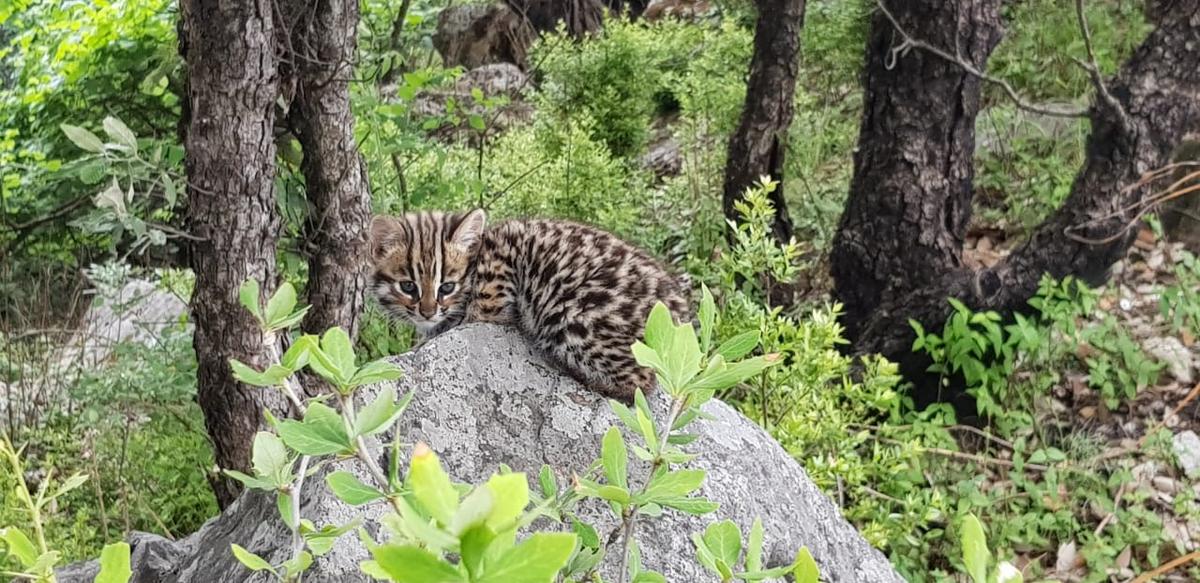
A leopard cub sunning itself.

A leopard cub sunning itself.
| Photo Credit:
Jabarkhet Nature Reserve

An important refuge

There might be a lot more to see, but this can only happen if we protect natural stands of habitat without shears or with artificial beautification. In 1848, malacologist and snail collector William Benson found a brown land snail (Bradybaena radicicola) in the slopes around Jabarkhet. Because JNR could be protected, it can also be studied.

True to its Himalayan roots, the area has incredible diversity: insectivorous sundews, ground orchids, more than 40 species of ferns, and hundred species of fungi, dozens of grass species, over 300 types of flowers, and over 150 bird species in about 100 acres of land.

This is more significant when we realise that places known for their natural beauty, whether the Himalayas or the Aravallis, are increasingly being cut up for mining and other commercial projects.

In the Himalaya, widening roads for activities like tourism causes landslides every year. For the Aravallis, the Supreme Court recently accepted a definition of the hills that would have excluded geologically important slopes and ridges, paving the way for ways to use land that does not respect natural topographies or histories. This means, at the landscape level, every stand of natural habitat we can save will be an important stepping stone or refuge for wildlife.

Can we see a rise of private reserves in India where wildlife gets the right of way, and where natural history can return to the present?

Neha Sinha is a conservation biologist and author of Wild Capital: Discovering Nature in Delhi (2026).



Source link

Science

Post navigation

Previous Post: U.S. to exit 66 international organisations as Trump further retreats from global cooperation
Next Post: Access Denied

Related Posts

  • Why now is the time to address humanity’s impact on the moon
    Why now is the time to address humanity’s impact on the moon Science
  • Science Quiz: On travel health
    Science Quiz: On travel health Science
  • The Science Quiz | How far can you count?
    The Science Quiz | How far can you count? Science
  • Climate change and climate justice: India’s efforts to balance economic growth with green transition
    Climate change and climate justice: India’s efforts to balance economic growth with green transition Science
  • How the 2004 Indian Ocean earthquake transformed tsunami science
    How the 2004 Indian Ocean earthquake transformed tsunami science Science
  • Trio win Chemistry Nobel 2025 for metal-organic frameworks
    Trio win Chemistry Nobel 2025 for metal-organic frameworks Science

More Related Articles

The physics and maths of keeping elections fair and representative | Explained The physics and maths of keeping elections fair and representative | Explained Science
Daily Quiz | On Voyager 1, journey of interstellar pioneer Daily Quiz | On Voyager 1, journey of interstellar pioneer Science
What remote-sensing reveals about plants, forests, and minerals from space What remote-sensing reveals about plants, forests, and minerals from space Science
India-made typhoid vaccine efficacy lasts for four years: study India-made typhoid vaccine efficacy lasts for four years: study Science
Pauling, the (near) perfect man for science Pauling, the (near) perfect man for science Science
Watch: Nobel prize science winners 2024 | All you need to know Watch: Nobel prize science winners 2024 | All you need to know Science
SiteLock

Archives

  • January 2026
  • December 2025
  • November 2025
  • October 2025
  • September 2025
  • August 2025
  • July 2025
  • June 2025
  • May 2025
  • April 2025
  • March 2025
  • February 2025
  • January 2025
  • December 2024
  • November 2024
  • October 2024
  • September 2024
  • August 2024
  • July 2024
  • June 2024
  • May 2024
  • April 2024
  • March 2024
  • February 2024
  • January 2024
  • December 2023
  • November 2023
  • October 2023
  • September 2023
  • August 2023
  • July 2023
  • June 2023
  • May 2023
  • April 2023
  • March 2023
  • February 2023
  • January 2023
  • December 2022
  • November 2022
  • October 2022
  • September 2022
  • August 2022
  • July 2022
  • June 2022
  • May 2022

Categories

  • Business
  • Nation
  • Science
  • Sports
  • World

Recent Posts

  • Access Denied
  • Access Denied
  • Access Denied
  • Jabarkhet: can private reserves restore wildlife and keep tourism gentle?
  • U.S. to exit 66 international organisations as Trump further retreats from global cooperation

Recent Comments

  1. Rhettsoymn on UP Teacher Who Asked Students To Slap Muslim Classmate
  2. Philipaciva on UP Teacher Who Asked Students To Slap Muslim Classmate
  3. JeffreysAm on UP Teacher Who Asked Students To Slap Muslim Classmate
  4. DavidSek on UP Teacher Who Asked Students To Slap Muslim Classmate
  5. CharlesInsew on UP Teacher Who Asked Students To Slap Muslim Classmate
  • Putin, Iran’s Pezeshkian Strengthen Economic Ties, Eye Strategic Partnership
    Putin, Iran’s Pezeshkian Strengthen Economic Ties, Eye Strategic Partnership World
  • AAP’s Atishi To Be Delhi’s New Chief Minister, Name Proposed By Arvind Kejriwal
    AAP’s Atishi To Be Delhi’s New Chief Minister, Name Proposed By Arvind Kejriwal Nation
  • “Will Ask India To Send Back Sheikh Hasina”: Bangladesh’s Muhammad Yunus
    “Will Ask India To Send Back Sheikh Hasina”: Bangladesh’s Muhammad Yunus World
  • Sci-Five | The Hindu Science Quiz: On first human to enter space
    Sci-Five | The Hindu Science Quiz: On first human to enter space Science
  • Poster Of D Fadnavis With Gun Not Linked To Baba Siddique Death
    Poster Of D Fadnavis With Gun Not Linked To Baba Siddique Death Nation
  • China’s Foreign Minister says Xi-Biden meeting in San Francisco would not be ‘smooth-sailing’
    China’s Foreign Minister says Xi-Biden meeting in San Francisco would not be ‘smooth-sailing’ World
  • Ex Porn Star Mia Khalifa Spotted On Religious Hoarding In Tamil Nadu
    Ex Porn Star Mia Khalifa Spotted On Religious Hoarding In Tamil Nadu Nation
  • Missing Dog’s Dramatic Reunion With US Family, 2,000 Miles From Home
    Missing Dog’s Dramatic Reunion With US Family, 2,000 Miles From Home World

Editor-in-Chief:
Mohammad Ariff,
MSW, MAJMC, BSW, DTL, CTS, CNM, CCR, CAL, RSL, ASOC.
editor@artifex.news

Associate Editors:
1. Zenellis R. Tuba,
zenelis@artifex.news
2. Haris Daniyel
daniyel@artifex.news

Photograher:
Rohan Das
rohan@artifex.news

Artifex.News offers Online Paid Internships to college students from India and Abroad. Interns will get a PRESS CARD and other online offers.
Send your CV (Subjectline: Paid Internship) to internship@artifex.news

Links:
Associate Journalism
About Us
Privacy Policy

News Links:
Breaking News
World
Nation
Sports
Business
Entertainment
Lifestyle

Registered Office:
72/A, Elliot Road, Kolkata - 700016
Tel: 033-22277777, 033-22172217
Email: office@artifex.news

Editorial Office / News Desk:
No. 13, Mezzanine Floor, Esplanade Metro Rail Station,
12 J. L. Nehru Road, Kolkata - 700069.
(Entry from Gate No. 5)
Tel: 033-46011099, 033-46046046
Email: editor@artifex.news

Copyright © 2023 Artifex.News Newsportal designed by Artifex Infotech.