

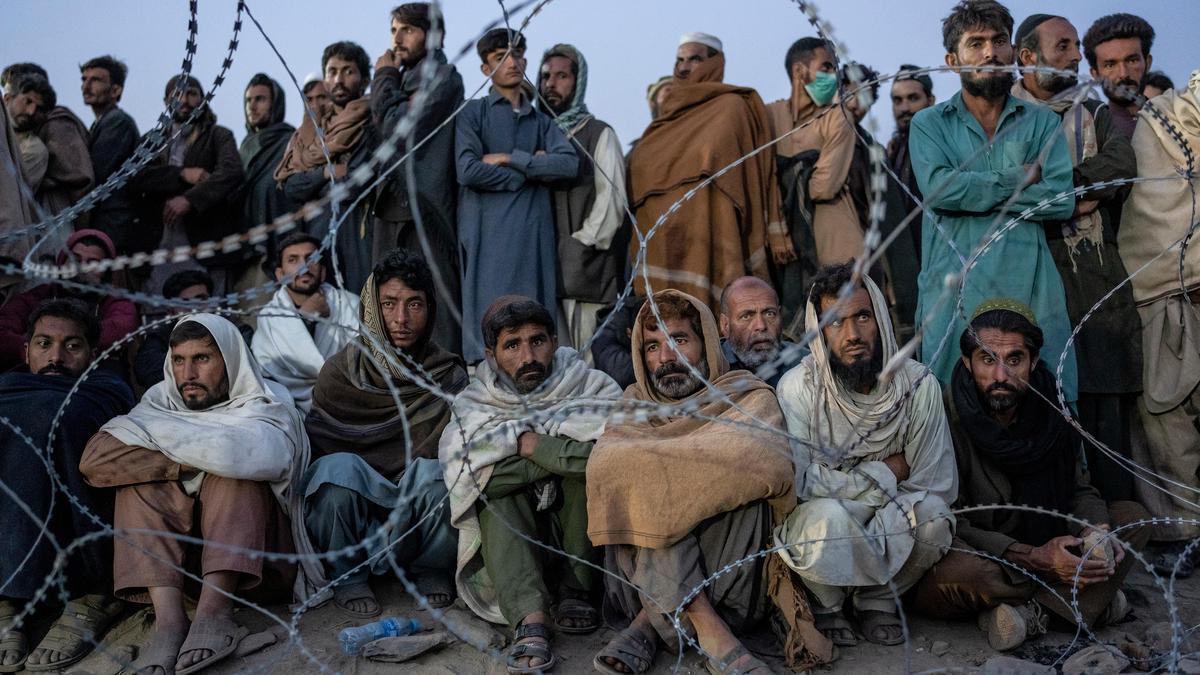
Afghan refugees wait to register in a camp near the Torkham Pakistan-Afghanistan border. File
| Photo Credit: AP
Since closing down its border with Afghanistan, Pakistan has recorded a significant drop in cross-border terrorist attacks and deaths related to violence.
Pakistan shut its border on October 11 last year after clashes with Afghanistan, which were prompted by the allegations that Kabul was not doing enough to stop the use of its soil by terrorists.
Dawn reported from the data collected by the Centre for Research and Security Studies (CRSS), a local think-tank, that terrorist attacks went down by almost 17% in December, preceded by 9% decline in November, while terrorism-linked fatalities among civilians and security officials also fell in the last quarter of 2025, by nearly 4% and 19% each in November and December.
However, the data of CRSS showed that with an almost 34% surge in overall violence, the year 2025 went by as the most violent year for Pakistan in a decade.

The comparative data for 2024 and 2025 reveals a sharp escalation in terrorism and counter-terrorism linked violence nationwide, with fatalities rising from 2,555 in 2024 to 3,417 in 2025, marking an increase of 862 deaths, or a roughly 34% year-on-year surge in violence.
The most significant surge in violence was recorded in Khyber Pakhtunkhwa (KP), where the fatalities rose from 1,620 in 2024 to 2,331 in 2025, an absolute increase of 711 deaths, accounting for over 82% of the net national rise and marking almost a 44% year-on-year surge in violence in the province.
Balochistan also had an upward trend, with fatalities increasing from 787 to 956; an additional 169 deaths, which are nearly 22% higher than the previous year’s figures.
Violence remained heavily concentrated in the country’s northwestern KP and southwestern Balochistan provinces, with both accounting for over 96% of all fatalities and almost 93% of violent incidents recorded during the entire 2025.
KP was the worst-hit region, suffering over 68% (2331) of the total violence-linked fatalities, and around 63% (795) of the incidents of violence, followed by Balochistan, accounting for 28% (956) of the fatalities and over 30% (386) of the incidents of violence.
In contrast, Punjab and Sindh experienced comparatively lower levels of violence. The former recorded 25 incidents of violence resulting in 40 fatalities and 24 injuries, representing just 1.15% of total casualties, while the latter saw 51 incidents causing 56 fatalities and 40 injuries; 1.73% of the total.
Gilgit-Baltistan remained the least affected region. Compared to last year, though small in absolute numbers, the region recorded a four-fold increase from one to four fatalities, according to the report.
Published – January 01, 2026 01:27 pm IST