


It is Friday noon in Dhaka (2:25 p.m. local time), just hours after the announcement of the national election schedule. In the capital’s busy Bijoy Nagar area, Sharif Osman Hadi, a key leader of last year’s uprising and an independent candidate for the Dhaka-8 constituency, was shot in the head by unidentified assailants on a motorcycle in broad daylight. Mr. Hadi remains in a life-threatening condition.
The attack, among several recent incidents, has intensified concerns over security and political stability in the run-up to the polls. Md. Abu Shadik (Kayem), Vice-President of the Dhaka University Central Students’ Union (DUCSU), alleged that elements of the “fallen fascist regime” were attempting to sabotage the upcoming election. He said the ousted group “has already issued threats and launched programs to resist the election,” warning that an attack on a candidate raises serious questions about fairness and safety.
Forty months after the fall of Sheikh Hasina’s government on August 5, 2024, Bangladesh finally announced the schedule for its 13th parliamentary election, an announcement closely watched at home and abroad.

In a televised address on Thursday evening, Chief Election Commissioner (CEC) A.M.M. Nasir Uddin said the election would be held on February 12, 2026, ending months of speculation over whether a timetable would be announced amid political flux. He also declared that a national referendum on implementing the “July Charter” would be held on the same day, marking the first instance in Bangladesh’s history where a general election and referendum will take place simultaneously.
Despite the announcement, some uncertainty lingers over whether the polls will proceed on schedule, although the interim government led by Nobel laureate Dr. Muhammad Yunus has repeatedly assured that the vote will be held.
Warring views
Major political parties welcomed the announcement.
BNP Secretary-General Mirza Fakhrul Islam Alamgir described it as a “day of joy,” saying the schedule demonstrates that political actors and institutions intend to ensure the people’s right to vote. Jamaat Secretary-General Mia Golam Porwar welcomed the announcement, while NCP Chief Coordinator Nasiruddin Patwary raised questions about the Commission’s ability to remain neutral amid political pressure. The Amar Bangladesh Party (AB Party), too, welcomed the schedule but warned that political violence continues to create an unfavourable environment for a free and fair election.
In contrast, the Bangladesh Awami League, the party of ousted Prime Minister Sheikh Hasina, outright rejected the schedule as “illegal.” The party is barred from contesting the polls after its political activities were banned, and its registration cancelled by the Election Commission (EC). In a statement, the party claimed that the current administration “cannot ensure transparency, neutrality, or the reflection of the people’s will”.
Meanwhile, parties have already announced candidates for most constituencies. The BNP, which had earlier declared nominations for 237 seats, has now expanded its list to 272. The NCP has released its first list of 125 candidates, and has sold more than 1,600 nomination forms. Jamaat-e-Islami has also published its candidate list, although many nominations may be revised as the party negotiates a joint platform with other Islamist parties under a “one-box policy” to field unified candidates.
Despite this activity, the usual pre-election buzz remains muted. Many candidates have begun small-scale campaigns, but the atmosphere is subdued.
“I am eagerly waiting to cast my first vote,” Bijoy Talukder, a private sector employee in Dhaka, told The Hindu. “Even though the election is only a few months away, there’s still not much excitement and buzzing in the country,” he added.
Ahsanul Mahbub Jubair, an NCP aspirant from Feni-1, said he was campaigning despite not being confirmed as the official nominee. Commenting on the prevailing uncertainty, Mr. Jubair said, “Of course, some uncertainties and challenges will remain, but they cannot stop the elections from taking place,” he added.
The health of BNP Chairperson and former Prime Minister Khaleda Zia has also emerged as another critical factor shaping the political landscape ahead of the polls. Her condition has deteriorated in recent days, and she has now been placed on ventilator support. BNP acting chairman Tarique Rahman, who has been living in London in political exile and is widely viewed within the party as the frontrunner for the prime ministership if BNP wins, has yet to return to Bangladesh.Although party leaders have repeatedly stated for months that he will return “very soon,” his arrival remains uncertain.
Departing from past practice, the EC has introduced an extended timeline, allowing nearly two months between the schedule announcement and polling day. On voting day, parliamentary ballots will be printed on white paper and referendum ballots on pink paper, with extended polling hours to accommodate the dual process.
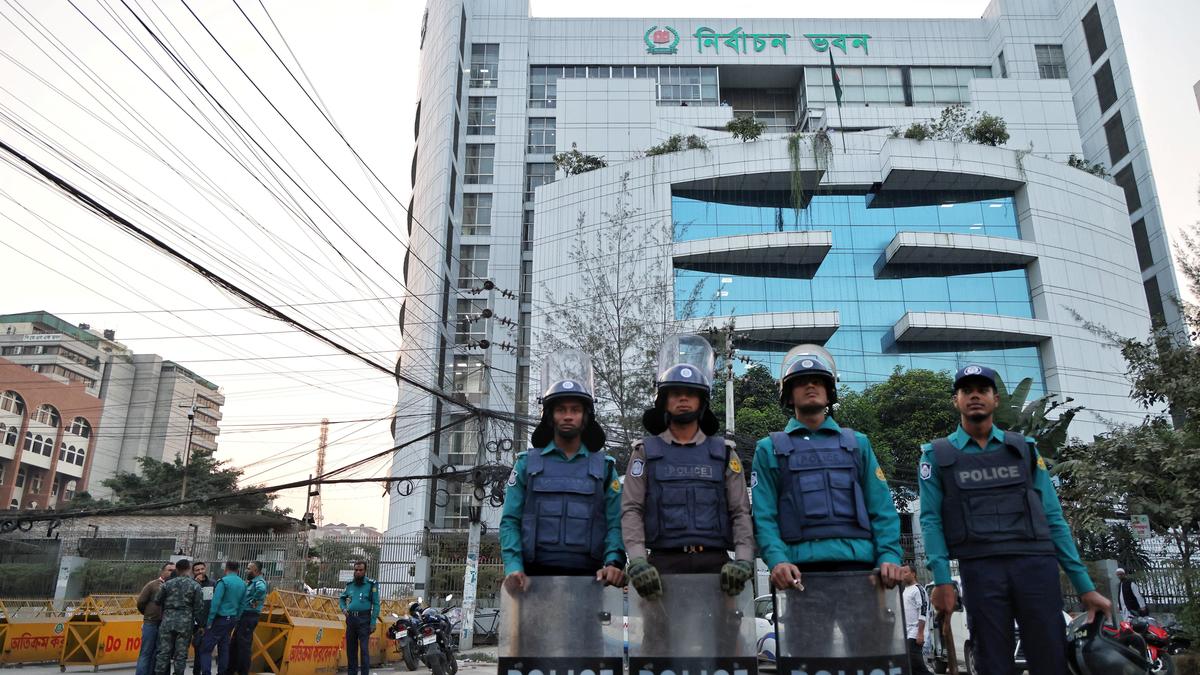
In his address, the CEC urged political actors to participate and asked citizens to vote “without fear,” while acknowledging challenges such as ensuring neutrality, maintaining security, and rebuilding public trust. Akhtar Ahmed, senior secretary of the EC Secretariat, said the Commission is “fully prepared” to conduct both the parliamentary election and the referendum.
Still, conducting two votes simultaneously, managing ballot logistics, maintaining law and order, deploying armed forces, and monitoring social media and AI-driven threats are expected to test the Commission’s capacity.
Business leaders say the announcement has eased immediate uncertainty. Dhaka Chamber of Commerce and Industry president Taskin Ahmed said greater political clarity would help businesses plan, although investor confidence will depend on whether the law and order situation remains stable.
The overall human rights situation in Bangladesh still remains “alarming”. According to Human Rights Support Society (HRSS), at least 107 persons were killed in political violence and 130 others in mob attacks during the first nine months of 2025.
According to sources in EC, 94,000 security personnel will be deployed during the polls
The total number of registered voters stands at 127,695,183 according to the the final voter list published by the EC.
Published – December 17, 2025 02:45 am IST