




When India’s national auditor, the Comptroller and Auditor General (CAG), released a decadal analysis on States’ macro-fiscal health, one headline somehow travelled faster than anything else highlighted in the study — Uttar Pradesh, long labelled as a backward State lagging in fiscal performance, was said to have recorded a revenue surplus of ₹37,000 crore.
This number, which is more than double of Gujarat’s surplus, was hailed as proof that India’s most populous State had turned a corner. However, by merely focussing on the number, one missed the bigger picture. Narrowing down on just arithmetic surpluses may be limiting analytical interpretation if not studied more holistically with the form, operational mechanics and choices made for a State’s governance.
Economists often urge higher capital spending for growth, while keeping routine costs in check. These numbers decide whether one’s neighbourhood hospital has new ventilators; whether a school gets enough teachers; and whether village roads will be repaired this year. India’s States run some of the largest budgets in the world — bigger in real terms than many countries. Cumulatively, owing to the constitutional separation of powers, they spend more than the Union government on health and welfare. One must ask though: do States earn enough to pay their bills? Or are they borrowing?
Uneven revenue
In the early 2000s, States were often deep in deficit, spending much more than they earned. Reforms, better tax collection, and booming growth helped many turn the corner by the late 2010s, with a few even reporting surpluses. But the pandemic was a turning point — tax revenues shrank while emergency spending soared, pushing almost every State back. Today, the picture is mixed. While some States appear comfortable, much of their stability rests on volatile sources such as lotteries, mining royalties or land sales.
India’s States inhabit starkly different fiscal worlds, much like its diverse ethno-linguistic identities. Maharashtra raised nearly 70% of its receipts internally in 2022-23, while Arunachal Pradesh managed only 9%. Uttar Pradesh, despite a surplus, generated just 42% on its own, relying on Union transfers. In economic terms, this is referred to as a vertical imbalance — rich States fund themselves, while poorer ones lean on Delhi.
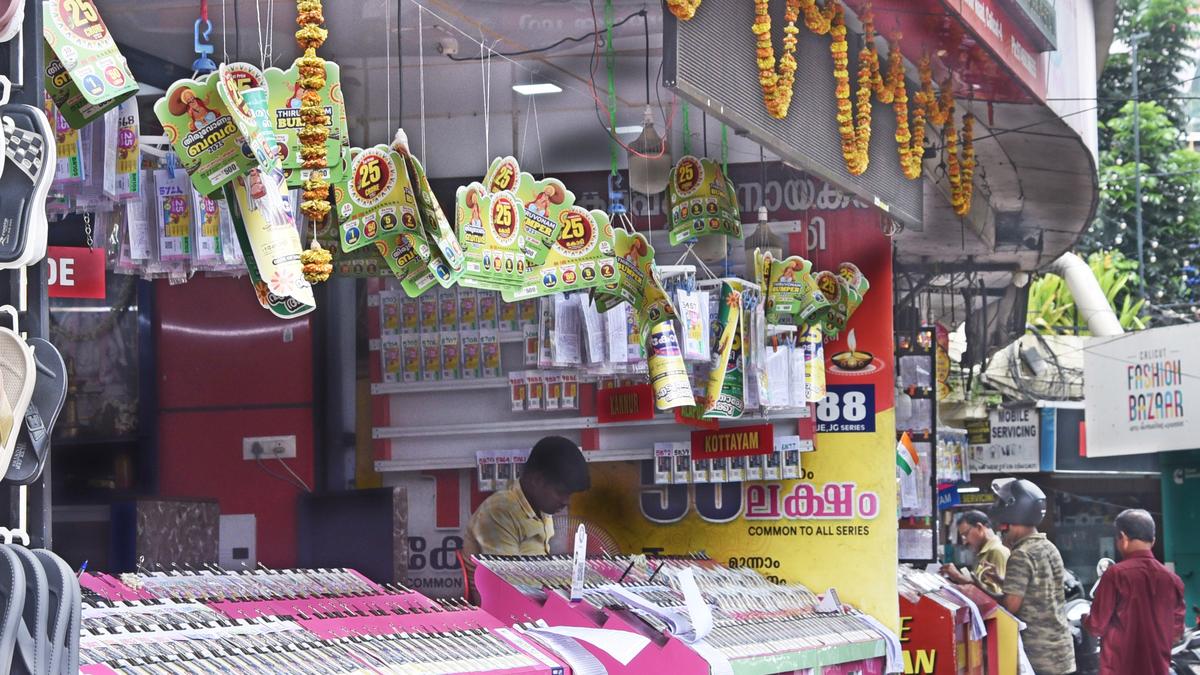
Kerala’s lottery industry earned nearly ₹12,000 crore in 2022-23; Odisha drew 90% of its non-tax income from mining royalties; and Telangana sold land worth ₹9,800 crore. However, lotteries hinge on sales, royalties on global prices, and land can’t be sold twice.
Gross debt borrowings
Let’s analyse the numbers from the CAG’s decadal analysis report. When States spend more than they earn, they tend to borrow more. They finance that deficit mainly through loans or bonds that must be repaid with interest. The CAG, through its audited State Finances reports, brings us a consolidated national picture, while the RBI’s State Finances: A Study of Budgets report provides a consistent framework for comparison. Taken together, these sources show that borrowing patterns between 2016-17 and 2022-23 have diverged sharply in India.
Table 1 deals with States such as Andhra Pradesh, Arunachal Pradesh, Assam, Bihar, Chhattisgarh and Goa. Andhra Pradesh tripled its borrowings to ₹1.86 lakh crore, while Bihar doubled it, making debt a routine tool even for poorer States. By contrast, Goa kept a tight lid on borrowings, standing out as a rare conservative. Yet the liabilities data shows the weight of these choices: Andhra Pradesh’s debt load swelled to 35% of its Gross State Domestic Product (GSDP) by 2023, and Bihar’s hovered around 39%, among the highest in India. Assam’s rapid borrowing was cushioned by growth, with liabilities easing slightly to 22% of GSDP, while Goa stayed at 27%, still high for a small State.
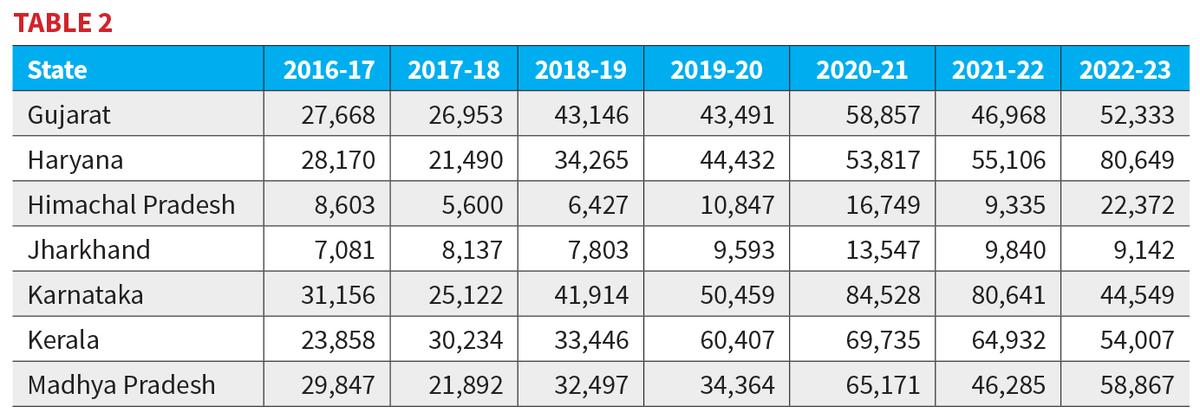
Table 2 deals with Gujarat, Haryana, Himachal Pradesh, Jharkhand, Karnataka, Kerala, and Madhya Pradesh. Here, borrowings rose in a measured but persistent way. Haryana jumped from ₹28,170 crore in 2016-17 to ₹80,649 crore in 2022-23, nearly tripling its borrowings despite being one of the richer States; its liabilities also climbed to about 31% of GSDP. Gujarat moved gradually upward, from ₹27,668 crore to ₹52,333 crore, while keeping its debt burden steady near 19-20% of GSDP. Madhya Pradesh also almost doubled its borrowings, from ₹29,847 crore to ₹58,867 crore, with liabilities rising to around 29%.
The pandemic brought volatility. Karnataka’s borrowings spiked to ₹84,828 crore in 2020-21, before being cut back to ₹44,549 crore; even after retrenchment, its liabilities stood close to 28% of GSDP. Kerala peaked at ₹69,735 crore and later eased to ₹54,007 crore, though its debt burden stayed stubbornly high, at roughly 37% of GSDP. Smaller States remained modest — Himachal Pradesh’s liabilities reached almost 48% of its GSDP, while Jharkhand’s borrowings hovered between ₹7,000–₹13,500 crore with a steadier load of 27% of GSDP.
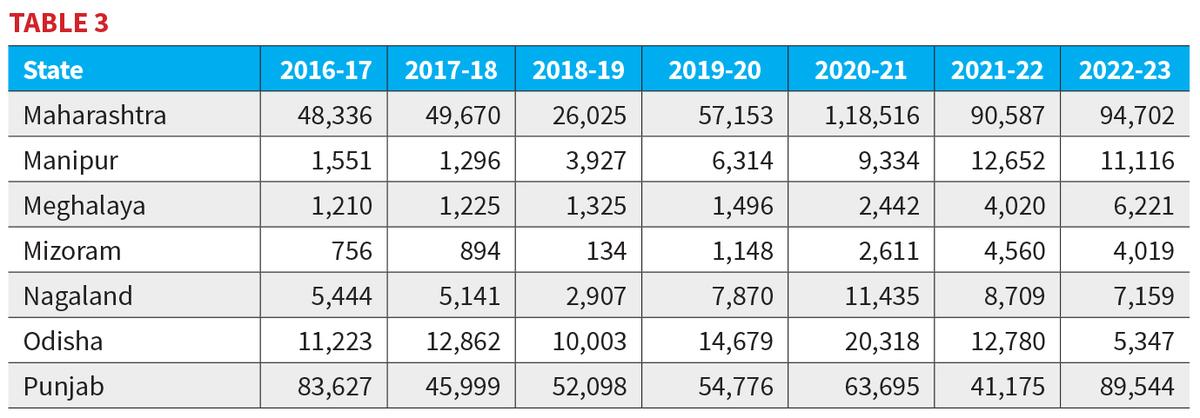
Table 3 deals with Maharashtra, Manipur, Meghalaya, Mizoram, Nagaland, Odisha, and Punjab. This cluster highlights extremes. Maharashtra borrowings bulged from a low of ₹26,025 crore in 2018-19 to a surge of ₹1,18,516 crore in 2020-21, before moderating to ₹94,702 crore in 2022-23. However, its large economy kept the debt burden contained at around 20% of GSDP. Punjab remained persistently high, with borrowings ranging between ₹83,627 crore in 2016-17 and ₹89,544 crore in 2022-23; its liabilities climbed to about 45% of GSDP, showing chronic stress. Odisha bucked the trend, cutting borrowings from ₹11,223 crore to just ₹5,347 crore thanks to mining windfalls, and its liabilities fell to nearly 15% of GSDP, the lowest in India.
Manipur’s borrowings grew from ₹1,551 crore to ₹11,116 crore; Meghalaya from ₹1,210 crore to ₹6,221 crore; Mizoram from ₹756 crore to ₹4,019 crore; and Nagaland from ₹5,444 crore to ₹7,159 crore. Though small in absolute numbers, these States carry some of the heaviest burdens, with liabilities ranging from about 40-60% of GSDP, marking rising fiscal dependence.
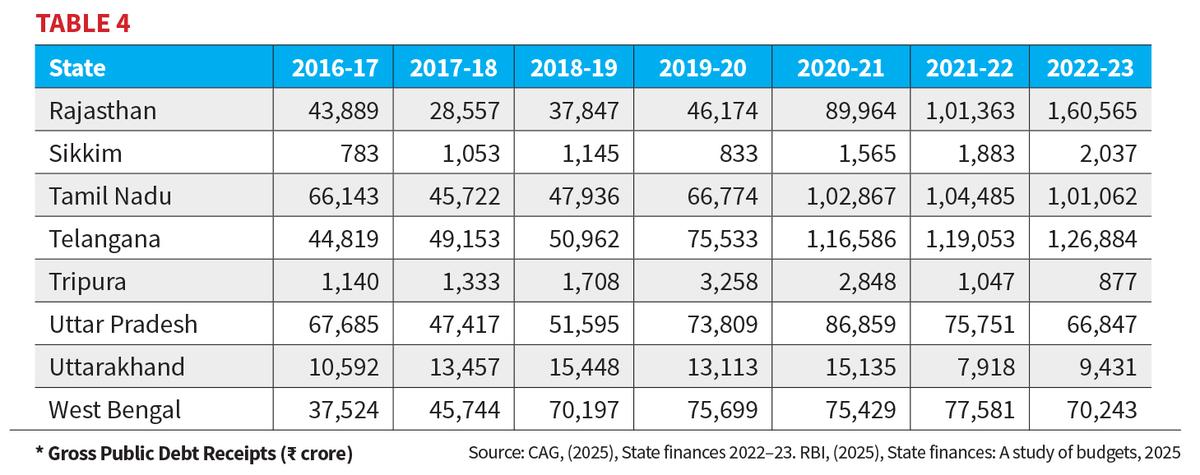
Table 4 showcases Rajasthan, Sikkim, Tamil Nadu, Telangana, Tripura, Uttar Pradesh, Uttarakhand, and West Bengal. Rajasthan and Tamil Nadu emerged as heavy borrowers. Rajasthan quadrupled its borrowings, from ₹43,889 crore in 2016-17 to ₹1,60,565 crore in 2022-23, one of the steepest climbs nationwide, and its liabilities climbed to about 40% of GSDP. Tamil Nadu moved steadily upward from ₹66,143 crore to ₹1,01,062 crore, while its debt ratio rose to around 33%. Telangana surged from ₹44,819 crore to ₹1,26,884 crore, though strong growth kept its liabilities moderate at about 28%.
West Bengal showed moderate growth, from ₹37,524 crore to ₹70,243 crore, with liabilities remaining high at 37% of GSDP. In contrast, Uttar Pradesh slightly reduced borrowings, from ₹67,685 crore in 2016-17 to ₹66,847 crore in 2022-23, holding its liabilities steady at about 31%. Uttarakhand’s borrowings also dipped from ₹10,592 crore to ₹9,431 crore, but liabilities were still over 32% of GSDP, while Tripura shrank from ₹1,140 crore to just ₹877 crore but carried a debt load above 30%. Sikkim remained marginal throughout, under ₹2,100 crore, though its debt stood at about 24% of GSDP.
Borrowings spiked everywhere during the pandemic. But what happened afterwards differed: some States like Andhra Pradesh, Rajasthan, and Telangana kept increasing their borrowings; Karnataka, Kerala, and Maharashtra cut back; and a few like Odisha, Uttar Pradesh, and Tripura reduced their borrowings even further, revealing very different fiscal strategies.
The welfare paradox
While some States show surpluses, in reality, they lean heavily on central transfers, off-budget loans, and delayed GST compensation. A lot of these States aren’t sufficiently spending on welfare priorities and so any reported surplus may have accounting gains without developmental gains. Also, States like Punjab wrestle with chronic debt; Kerala relies on volatile revenues from lotteries; while Andhra Pradesh and Uttar Pradesh, through free power and farm waivers, see their costs deferred into the opaque machinery of guarantees and special purpose vehicles.
Corporate tax cuts, GST cesses, and rebranded social spending mask the true burden, leaving fiscal prudence a mirage. With the recent GST rejig and a higher fiscal revenue loss expected, one can hardly know its broader impact on fiscal spending by States on their already frugal welfare budgets. Yet, within this fragility, welfare schemes in some centralised funding schemes have proliferated: PM-KISAN deposits, Ujjwala cylinders, and Ayushman Bharat cards circulate like tokens of political theatre in projecting the ruling dispensation and its leader as the face of India’s welfare populist base.
It is precisely this tension, of a State that spends lavishly while its revenues strain, that frames India’s current welfare paradox. The nation has constructed one of the largest welfare states in the world while sustaining one of the thinnest fiscal bases among middle-income economies while being excessively dependent on borrowings. The paradox reflects a nation-state projecting extraordinary promise, with constrained and inhibitive fiscal capacity, where, a spectacle of care is built on the brink of fiscal scarcity.
Deepanshu Mohan is Professor and Dean, O.P. Jindal Global University (JGU)and Visiting Professor, LSE and Research Fellow, University of Oxford. Geetaali Malhotra and Aditi Lazarus, research analysts with CNES, JGU respectively, contributed to this article.