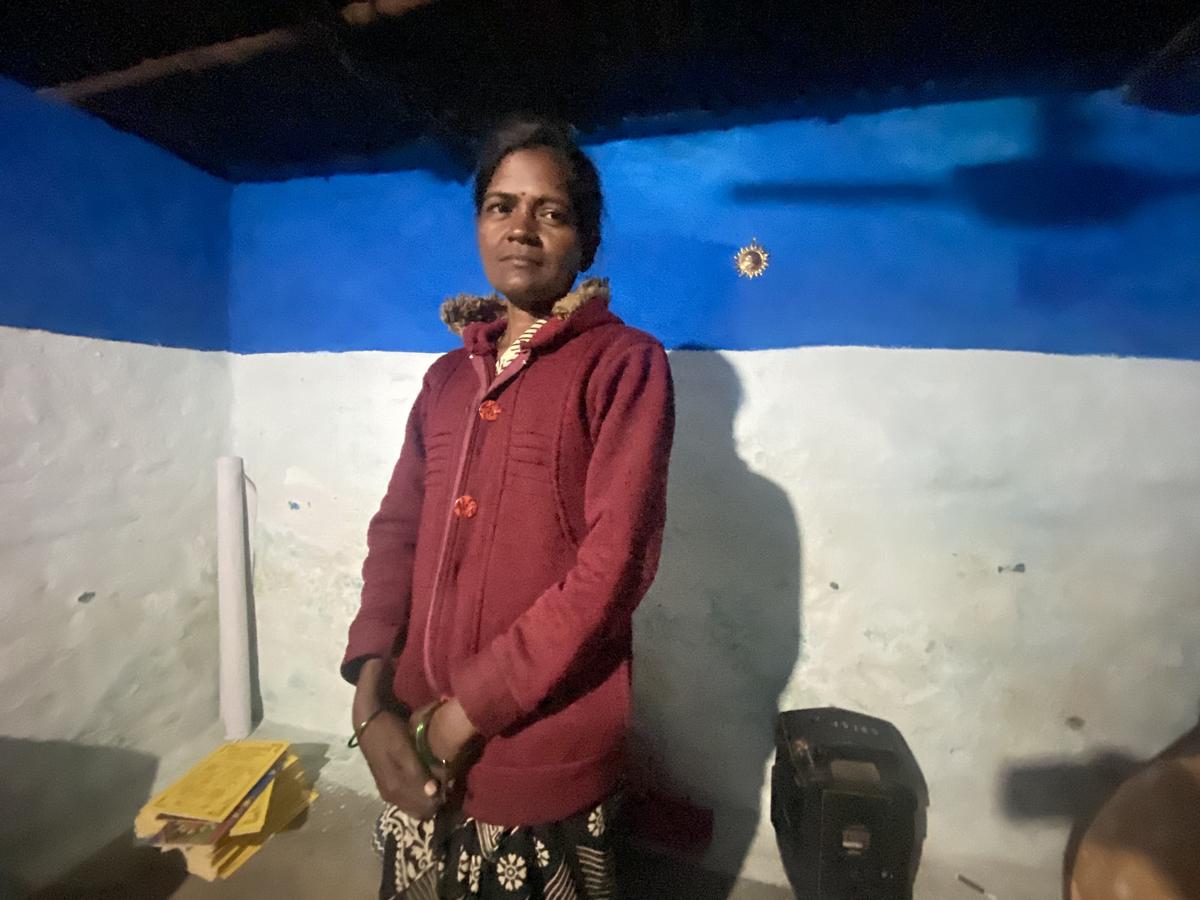





Twenty-year-old Vanaja, a tailor in Tiruppur district of Tamil Nadu, is worried that U.S. President Donald Trump’s tariffs on Indian imports could impact her wages.
Vanaja has been working at RRK Cottons India Private Limited, a garment company in Palladam town in the industrial district, for the last two years. She earns ₹480 a day.
She is among the handful of tailors at work on a Tuesday afternoon at the plant. Both work and workers have reduced drastically over the last few days, she says.
“People are saying there is no work because the U.S. has placed a tax on us. I have informed my parents (who live about 300 kilometres away in Tiruvannamalai district) about the situation at the factory,” she says.
Also Read | Centre working on multi-Ministry export promotion scheme to counter Trump tariff impact
RRK Cottons has been manufacturing T-shirts and underwear for some of the largest U.S. retailers for the last 10 years. Its website says the company takes “immense pride as one of the largest underwear manufacturers in India.” Its customers include eight U.S. brands.
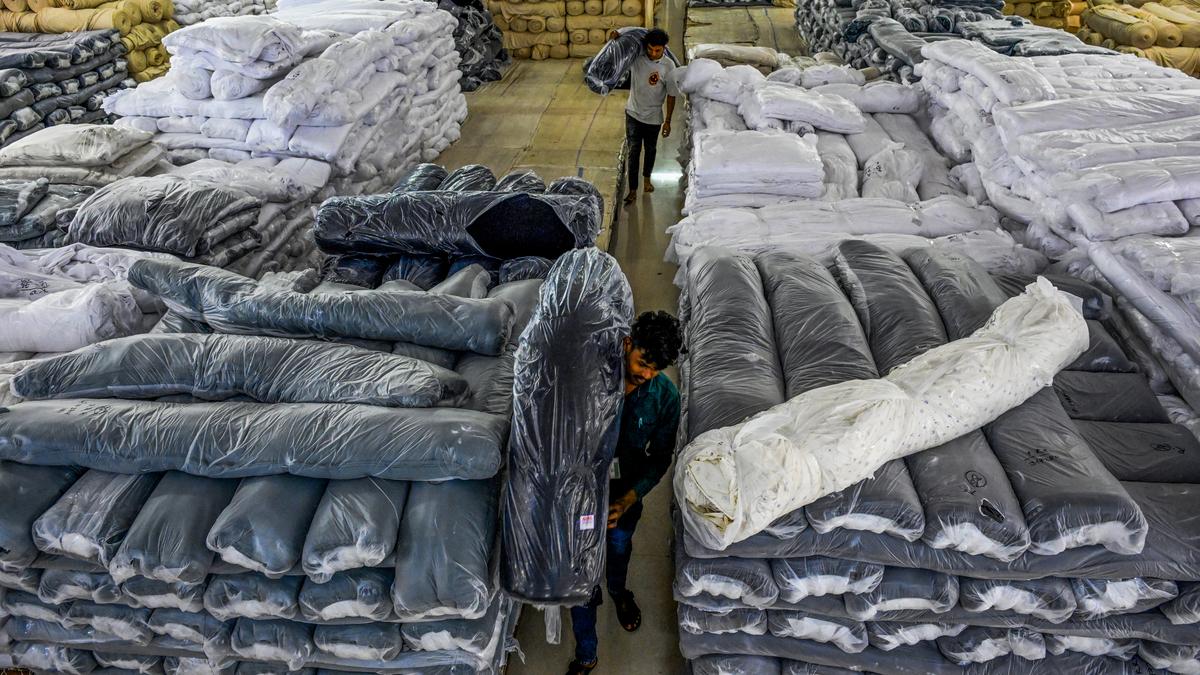
On September 2, less than a week after a 50% tariff imposed by the U.S. on Indian goods came into effect, its Palladam factory, which was buzzing with activity a year ago (the problems started in January when Mr. Trump assumed office) is silent. A few workers move the fabric stocks and a handful of women and men do minimal work at the garment making hall. Only 100 of the 480 sewing machines and one of the five fabric spreader machines are in operation on the sparsely-lit shop floors. Stocks worth ₹65 crore have piled up. Two of the company’s five plants have shut down in the last four months and the workforce of 2,000 has reduced by half, says R. Rajkumar, Managing Director of RRK Cottons.
He has no idea what to do next. “Almost 80% of my business is to the U.S. The trouble started in January when talks of tariffs started. The buyers prioritised China suppliers, delayed our shipments, and then cut back on their orders from us. Now, all the goods that we had produced for orders placed earlier are on hold. I have not received payments for shipments made in the last two months,” he says.
Rajkumar believes he can “manage” for another two weeks. “But after that I will have no option but to shut down operations because I have to make payments to nearly 150 vendors, to banks, for electricity,” he says.
Piles of stocks
India exports $11 billion worth of textiles and apparel to the U.S. each year, of which nearly $4 billion is contributed by Tamil Nadu’s western districts — Coimbatore, Tiruppur, Karur, Erode, and Salem, according to the Southern India Mills Association). Exporters in Tiruppur, Karur, and Coimbatore produce a range of goods for multiple buyers in the U.S., including retail chains such as Walmart, Costco, and Target; fashion brands such as GAP; and smaller retailers and brands. Since these western districts in Tamil Nadu host a dense textile supply chain, even a small dip in exports ripples through the entire ecosystem.
In Tiruppur, popularly known as the ‘dollar city’, R. Gopalakrishnan, chairman of Royal Classic Mills who was on a visit to the Tiruppur Exporters Association, said that 80% of his business is to the U.S. He has stopped work at his factory since August 27 — the day when a punitive 25% tariff imposed by the U.S. on India for its purchases of Russian oil came into effect. That was in addition to Trump’s 25% tariff on many imports from India. The total duties amounting to 50% have been imposed for a variety of goods, including garments, gems and jewellery, footwear, sporting goods, and furniture and chemicals.
“When the tariff was initially 25%, buyers said the cost could be shared between us,” says Gopalakrishnan. “When the U.S. raised it to 50%, a buyer I’ve worked with for 20 years said he would still pay for the fabric since he had committed to it. He said I could ship the fabric to his suppliers in Vietnam, Bangladesh, or Sri Lanka to be made into garments. The buyers don’t want to take completed goods from us for sales in the U.S. because of the 50% tariff.”
According to K.M. Subramanian, president of the Tiruppur Exporters Association, Tiruppur ships garments worth ₹12,000-15,000 crore to the U.S. each year, which makes up 32–35% of its total exports.
He says garment exporters include those who do business only with U.S. buyers; those who export to the U.S. and other countries; and those who export to countries other than the U.S. and the European Union (EU). Among companies that export goods to the U.S., some export basic products or core products that are shipped all through the year and some export high fashion goods that are seasonal in demand.
Also Read | Export units at Tirupur, Noida, Surat halt production amid high U.S. tariffs: FIEO
Subramanian, who has seven factories in Tiruppur district, explains how the situation changed for the worse over the last few months. Before Mr. Trump announced the tariffs, Indian garments faced tariffs ranging from 4% to 16%. When the U.S. imposed 25% tariffs, buyers discussed sharing the costs of orders already placed with exporters, since competing countries faced similar duties. But with tariffs now at 50%, most buyers no longer want the goods though it is not easy for them to quickly find alternative suppliers for high fashion products, he says.
“We fear that Tiruppur may lose ₹3,000 crore-5,000 crore worth of annual business that involves core products as buyers can easily source them from other countries,” says Subramanian.
Displaying some of the garments for children that he has made for a brand based in the U.S., he says he also has stocks worth nearly ₹18 crore that were made for the US buyers. “On average, garment units make only a 5% profit on their sales. We have all been negotiating with the wholesale buyers in the U.S. or the brands for the last few days. We want to ship the goods because if we sell these products in the domestic market, we will get only 20% of the value,” he adds.
The problem is more acute for Siva Subramaniam of Raft Garments, who recently expanded his factory in the hope that India would gain from Trump’s tariffs. He believed that the tariffs would not be as high for India as it has been on countries such as China, Bangladesh, and Vietnam.
“My customers place their orders through wholesalers. I have 25% goods ready for shipment and some in the production stage. One customer demanded a 16% discount and has given me a week’s time to make a decision and ship the garments. Another customer said he could bear 10% of the tariffs. Two other buyers have put the orders on hold. I make less than 10% profit on my sales and employ 350 workers. There are just 40 days to go before the Deepavali season starts and the workers are anticipating a good amount as bonus. Even if the business is disrupted only for a couple of months, we will lose orders for the next six months,” he says.
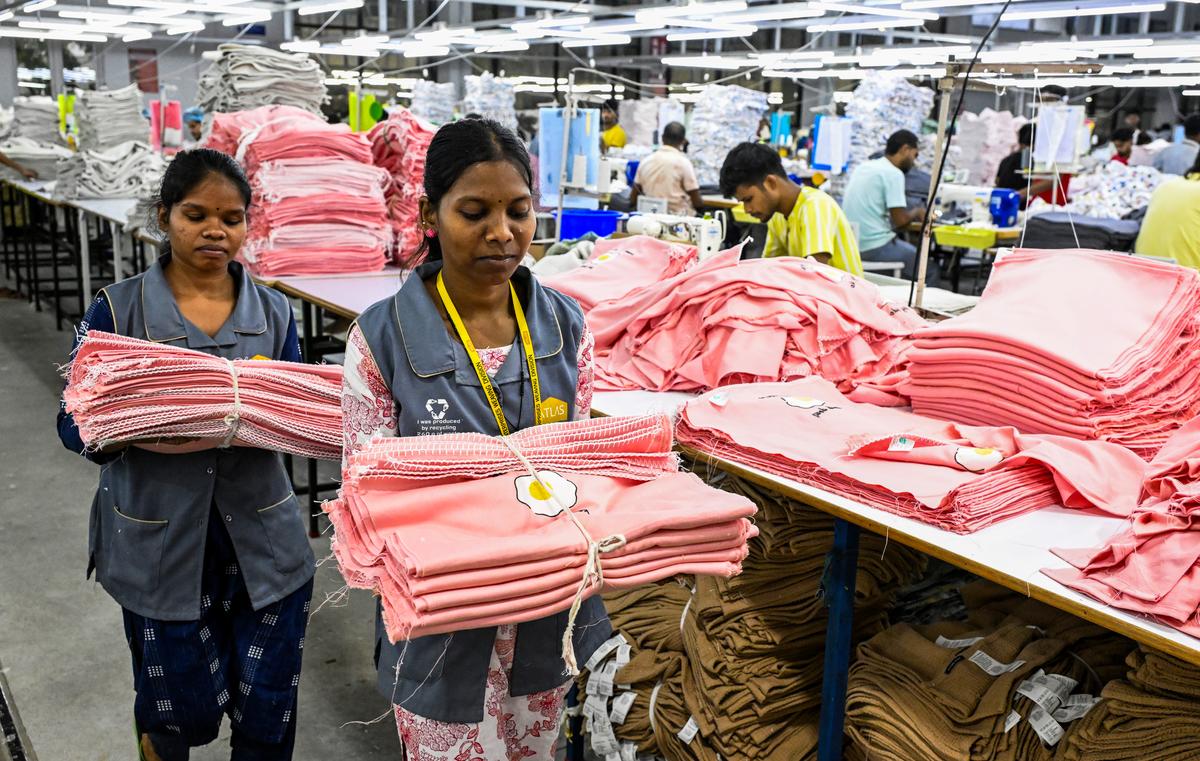
Women workers at a home textiles unit in Karur, Tamil Nadu
| Photo Credit:
M. Periasamy

Impact on MSMEs
The garment export business in Tiruppur is supported by thousands of Micro, Small and Medium-Scale Enterprises (MSMEs) engaged in production and supply of yarn and fabric, textile processing, compacting, printing, embroidery work, and ironing and packing.
Just a few feet off P.N. Road in Tiruppur city, Premier Textile can be located on a narrow lane, among the MSMEs that do sub-contracting work for garment exporters. A few young men from the northern States and women from other districts of Tamil Nadu are busy sorting and folding fabrics.
“I run eight embroidery machines with 80 workers and take on sub-contract work from garment exporters. Now, I have only 50% of the usual workload, and fabric is piling up because the exporter won’t lift it — his American buyer has put the order on hold,” says M. Thirupathy, Managing Director of Premier Textile.
Also Read | Engineering, textile exports continued to grow in July
“About 2,000 embroidery machines supply work worth ₹1,000 crore a year to garment exporters. Even if a portion of the export order is lost, the entire supply chain struggles and that results in job losses,” he says.
One of the dyeing units, which is among the MSMEs in Tiruppur, has decided to stop operations and send home 50 workers as it is not been getting fabrics from exporters.
While about two lakh people are directly employed at the exporting industries in Tiruppur, another two lakh are indirectly employed. This includes workers from 19 States across India.
Though some of the export units have suspended operations, the workers in these units have been able to get jobs because Tiruppur faces a labour shortage. However, the gravity of the situation will be known in another two weeks, say exporters.
EDITORIAL | Calm before the storm: On the economy, impact of U.S. tariffs
Wage worries
Karur, another textile hub in Tamil Nadu with over 800 units, exports kitchen, bed, and bath textiles — such as towels, tablecloths, and cushion covers — worth ₹6,500 crore annually, of which about ₹2,500 crore goes to the U.S.
At one factory, workers troop out at 5.30 p.m. “We do not give overtime for the workers now as there is no work and finished goods worth ₹2 crore are in stock with us,” said Azeem, the factory manager.
“In the last few days, the buyers have just started talking to us. They are asking for huge discounts or threatening to shift the orders to other countries. The immediate impact is for ₹1,500 crore,” says P. Gopalakrishnan, president of the Karur Textile Manufacturers Exporters Association.
Also Read | Indian home textile sector to double its share in the UK market
At the 110-acre Karur Textile Park, Sudhamani, 39, a tailor at a home textile export unit, says she is aware that some of the exporting factories in Karur are reducing workers because of lack of orders from the U.S. “I earn ₹11,000 a month and have a son and daughter to take care of. If work reduces, my wages will also come down,” she says.
Prakash, who is employed at the packing section, harbours the same fear. He earns ₹12,000 a month and lives with his parents and brother. Less work means no overtime, fewer working days, and loss of wages.
“All the workers have this fear. In fact, absenteeism has reduced from 25% to 15% in the last few days because the workers fear that they may lose their job,” says Gopinath, the factory manager at the exporting unit.
The factory has dedicated production lines for each brand that it supplies to. A board in one of the halls in the seven-storeyed building lists the brands that the company supplies to. “Walmart has stopped buying from us and Target has reduced its orders,” says Gopinath.

Planning for the future
“During the COVID-19 pandemic, when orders dipped, we did not send workers home. We reduced the working days and working hours. If the U.S. tariff issue is not resolved, we may have to resort to similar measures. In the long term, we are looking at diversifying to value-added technical textile products,” says Gopalakrishnan.
In recent years, e-commerce shipments from Karur have started picking up. “Not only Amazon; some retailers are also in talks with us, asking us to sell through their platforms,” he adds.
As suggested by some of the American buyers, exporters in Tiruppur and Karur are also wondering whether they can partner with companies in African countries or Sri Lanka for value-additions and shipping from those locations. However, these steps will take time and cannot be decided immediately, they say. “Our buyers have been asking us if we can add value in the African countries as it will reduce the logitics cost too. But we do not know the capabilities in those countries,” says Gopalakrishnan.
If the government announces a package that will meet 25% of the tariffs, exporters will be able to talk to the buyers and get order for the summer season. If those orders do not come, businesses will be in deep trouble, says Raja Shanmugham, founder of Warsaw International at Tiruppur.
Further, the European market slowed down in the last two to three years and buyers there have started asking for reduced prices, say garment exporters.
Also Read | How India’s youth can challenge U.S. tariffs
N. Thirukumaran, secretary of TEA, says that as an immediate relief measure, the government should announce a relief package that will enable the exporters to negotiate with buyers. And for the long-term, exporters will start studying new markets. “The India-EU Free Trade Agreement is critical,” he says stressing the urgency for an announcement.
Members of the INDIA bloc led a protest in Tiruppur demanding immediate support from the Central government. On the same day, representatives of more than 25 textile associations met Union Finance Minister Nirmala Sitharaman in Chennai and submitted their demands. “We have sought reintroduction of the Focus Market Scheme and at least a one year moratorium,” said A. Sakthivel, vice chairman of AEPC.
“The government is working on a package and has assured us of its support,” said Ravi Sam, vice chairman of the Cotton Textiles Export Promotion Council.
The associations are hopeful of support measures from the government. However, they want the government to continue talks with the U.S. and resolve the tariff issue amicably even as they start exploring new markets.
“My exposure to the U.S. is only 20%. We just had a call with one of the U.S. buyers. If they ask for a discount, the exporter will give it and ship the goods because there is no other option. We need higher duty drawback rates to meet the high tariffs. What is also worrying is the European buyers are also asking for a price cut now because they know our situation,” says C.R. Anandakrishnan, Executive Director of KPR Mill.