


Skip to content
  • Facebook
  • X
  • Linkedin
  • WhatsApp
  • Associate Journalism
  • About Us
  • Privacy Policy
  • 033-46046046
  • editor@artifex.news
Artifex.News

Artifex.News

Stay Connected. Stay Informed.

  • Breaking News
  • World
  • Nation
  • Sports
  • Business
  • Science
  • Entertainment
  • Lifestyle
  • Toggle search form
  • Case Against Puja Khedkar’s Father For Obstructing Government Work Nation
  • China To Develop Strategic Deep Sea Port, Airport In Sri Lanka World
  • After Legal Battle Of 6 Years, Assam Woman Regains Her Indian Citizenship Nation
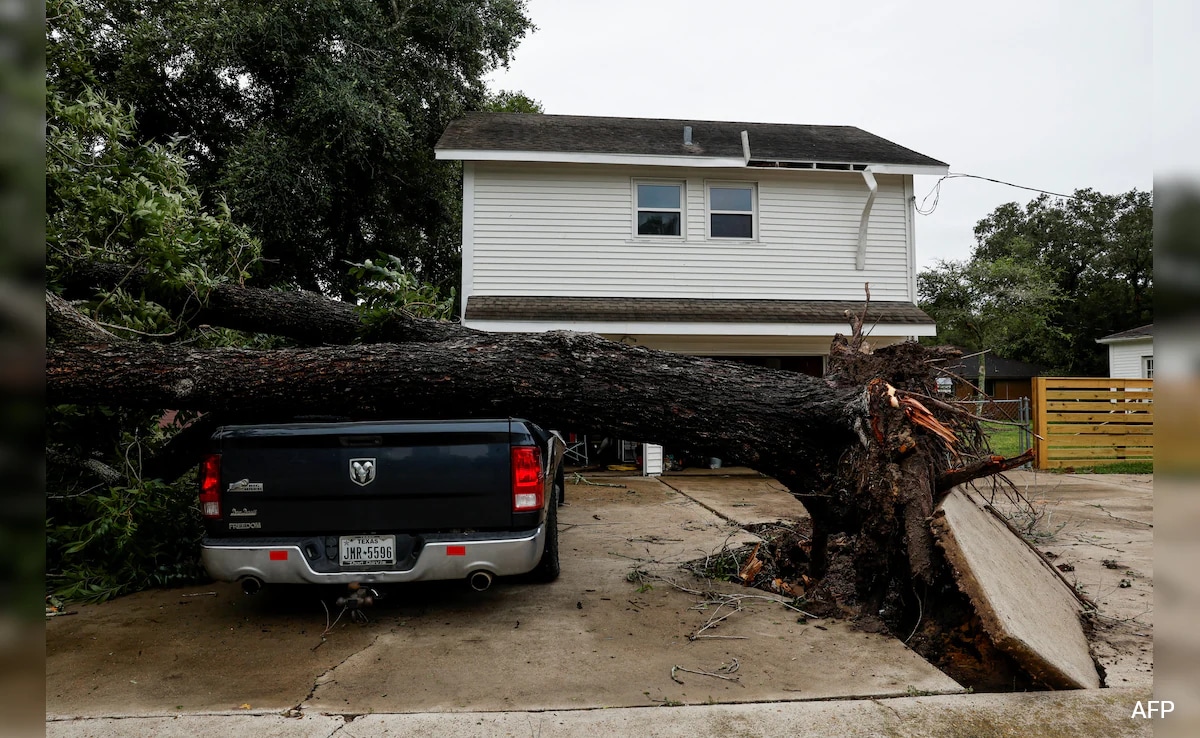
  • Storm Beryl Kills 2, Knocks Out Power As It Churns Across Texas World
  • Israel, Hezbollah, Lebanon: Israel Bombards Lebanon As Hezbollah Launches Rocket Attacks: 10 Facts World
  • India vs Australia: World Cup 2023 Live Cricket Score, Live Score Of Today's Match on NDTV Sports Sports
  • 2-Year-Old Boy Killed In Hit-And-Run In Maharashtra’s Palghar District Nation
  • “They Forgot…”: Sunil Gavaskar’s Blunt Analysis Of Bangladesh’s Collapse vs India In 2nd Test Sports

High-energy cosmic neutrino detected under Mediterranean Sea

Posted on February 13, 2025 By admin


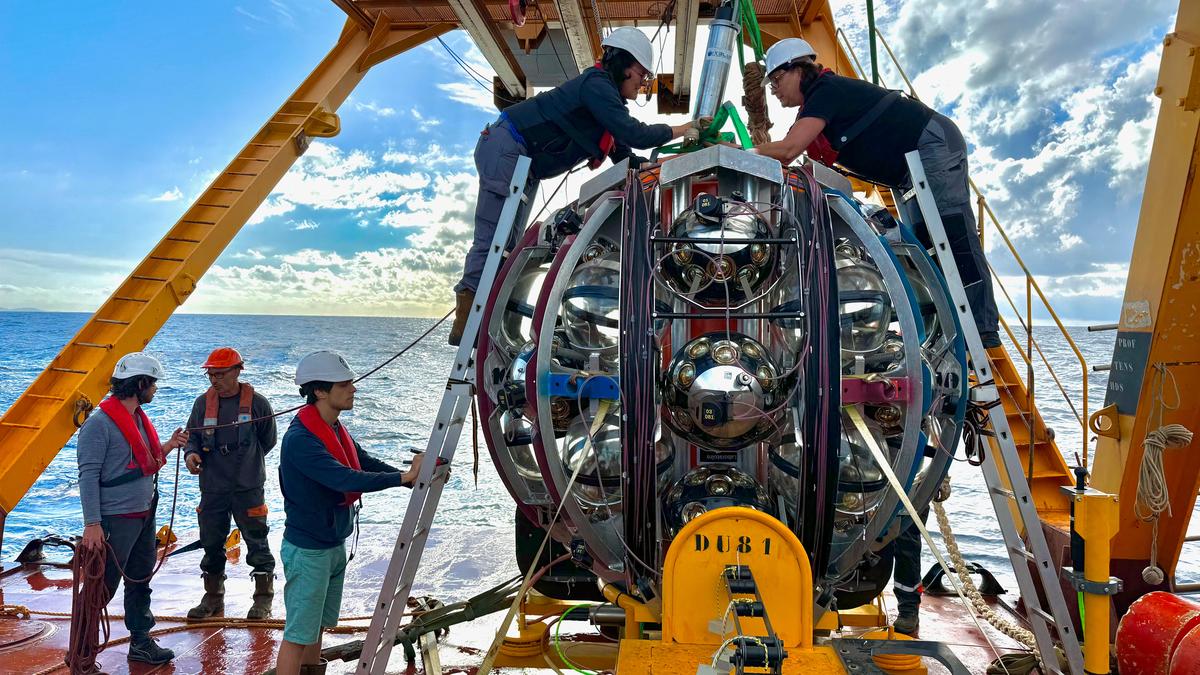
Researchers conduct final inspections on a neutrino detection unit on a launcher vehicle aboard a research vessel to the seafloor in the Mediterranean Sea. Image released on February 12, 2025.
| Photo Credit: Reuters

Using an observatory under construction deep beneath the Mediterranean Sea near Sicily, scientists have detected a ghostly subatomic particle called a neutrino boasting record-breaking energy in another important step toward understanding some of the universe’s most cataclysmic events.

The researchers, part of the KM3NeT (Cubic Kilometre Neutrino Telescope) Collaboration, believe the neutrino came from beyond the Milky Way galaxy. They identified 12 supermassive black holes actively guzzling surrounding matter at the center of distant galaxies as possible origination points, though the neutrino may have arisen from some other source.

KM3NeT comprises two large neutrino detectors at the bottom of the Mediterranean. One called ARCA – 3.4 km deep near Sicily – is designed to find high-energy neutrinos. One called ORCA – 2.4 km deep near Provence, France – is designed to detect low-energy neutrinos.

The newly described “ultra-high energy” neutrino, detected by ARCA in February 2023, was measured at about 120 quadrillion electronvolts, a unit of energy.

It was 30 times more energetic than any other neutrino detected to date, a quadrillion times more energetic than particles of light called photons and 10,000 times more energetic than particles made by the world’s largest and most powerful particle accelerator, the Large Hadron Collider near Geneva.

“It’s in a completely unexplored region of energy,” said physicist Paschal Coyle of the Marseille Particle Physics Centre (CPPM) in France, one of the leaders of the research published on Wednesday in the journal Nature.

“The energy of this neutrino is exceptional,” added physicist Aart Heijboer of the Nikhef National Institute for Subatomic Physics in the Netherlands, another of the researchers.

Neutrinos offer scientists a different way to study the cosmos, not based on electromagnetic radiation – light. Many aspects of the universe are indecipherable using light alone.

Neutrinos are electrically neutral, undisturbed by even the strongest magnetic field, and rarely interact with matter. As neutrinos travel through space, they pass unimpeded through matter – stars, planets or anything else.

That makes them “cosmic messengers” because scientists can trace them back to their source, either within the Milky Way or across galaxies, and thus learn about some of the most energetic processes in the cosmos.

“Neutrinos are ghost particles. They travel through walls, all the way through the Earth, and all the way from the edge of the universe,” Coyle said. “Neutrinos have zero charge, zero size, almost zero mass and almost zero interaction. They are the closest thing to nothing one can imagine, but nevertheless they are key to fully understanding the universe.”

Other high-energy cosmic messengers zipping through space are not as reliable. For instance, the path of cosmic rays gets bent by magnetic fields, so they cannot be traced back to their place of origination.

Detecting neutrinos is not simple, requiring large observatories located deep underwater or in ice. These mediums offer an expansive and transparent volume where a passing neutrino may interact with a particle, producing a flash of light called Cherenkov radiation.

The researchers concluded that the one spotted at ARCA – which was a type of neutrino called a muon – was of cosmic origin based on its horizontal trajectory and the fact that it had traversed through about 140 km of rock and seawater before reaching the detector.

The KM3NeT detectors are still under construction and have not yet reached their full capabilities.

Neutrinos are produced through various astrophysical processes at various energy levels. For instance, low-energy neutrinos are born in nuclear fusion processes inside stars.

High-energy neutrinos arise from particle collisions occurring in violent events such as a black hole greedily eating infalling matter or bursts of gamma rays during the explosive deaths of stars. They also can be produced by interactions between high-energy cosmic rays and the universe’s background radiation.

The study of neutrinos is still in its formative stages. “So why it matters? It’s basically just trying to understand what is going on in the cosmos,” Heijboer said.

Published – February 13, 2025 05:30 pm IST


Source link

Science

Post navigation

Previous Post: Delhi High Court Issues Notice To AAP MLA Amanatullah Khan In Waqf Money Laundering Case
Next Post: Turkiye’s Erdogan urges India, Pakistan to resolve Kashmir issue through dialogue

Related Posts

  • IISc researchers develop machine learning models for designing next generation nuclear reactor materials Science
  • Parched Philippine dam reveals centuries-old town, luring tourists Science
  • V. Narayanan | Rocket scientist Science
  • Warming-induced glacier retreat could create novel ecosystems Science
  • Russian space agency chief blames decades of inactivity for Luna-25 lander’s crash on the moon Science
  • The Hindu Daily Quiz, April 8 2024 | On Superconductors Science

More Related Articles

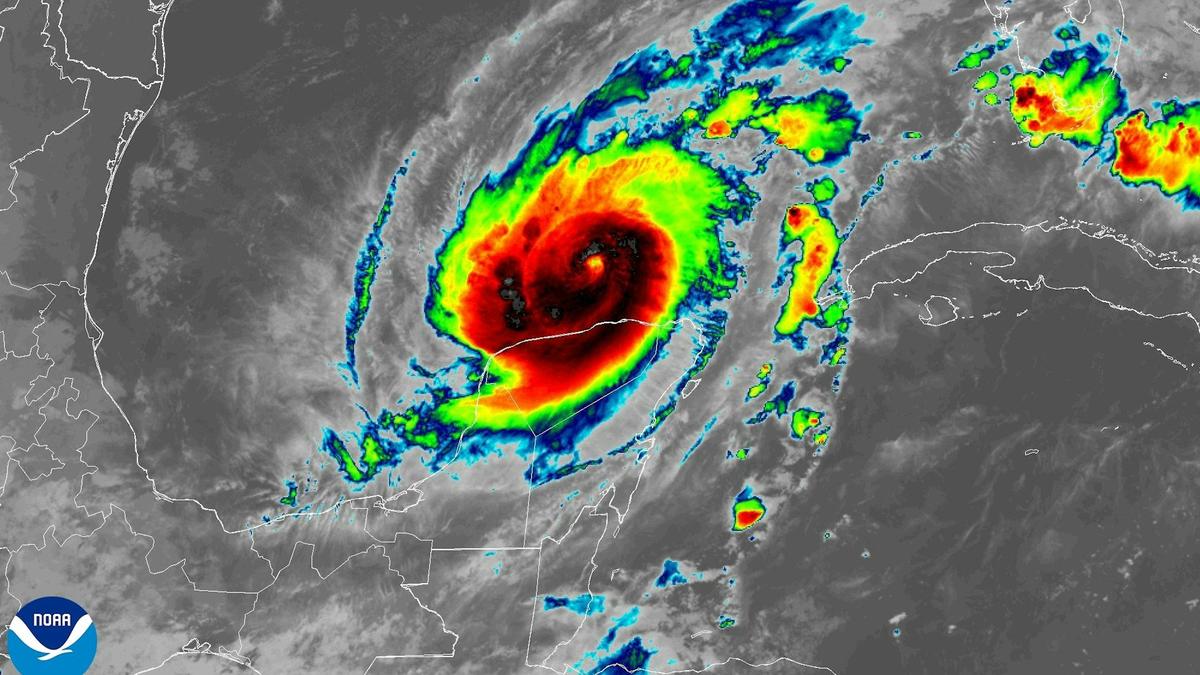
Climate change and how hurricane Milton became a Category 5 storm Science
Sci-Five | The Hindu Science Quiz: On Printing Science
From analysis to action: should climate scientists engage in activism? Science
India’s ‘heat trap’ cities make summers worse, says government official Science
Writing by hand is better for learning, memory Science
WHO says droplets a ‘minor’ route of mpox transmission Science
SiteLock

Archives

  • February 2025
  • January 2025
  • December 2024
  • November 2024
  • October 2024
  • September 2024
  • August 2024
  • July 2024
  • June 2024
  • May 2024
  • April 2024
  • March 2024
  • February 2024
  • January 2024
  • December 2023
  • November 2023
  • October 2023
  • September 2023
  • August 2023
  • July 2023
  • June 2023
  • May 2023
  • April 2023
  • March 2023
  • February 2023
  • January 2023
  • December 2022
  • November 2022
  • October 2022
  • September 2022
  • August 2022
  • July 2022
  • June 2022
  • May 2022

Categories

  • Business
  • Nation
  • Science
  • Sports
  • World

Recent Posts

  • Odisha tribal healer’s remedies for chronic diseases to undergo scientific validation under Ministry of Ayush initiative
  • Odisha tribal healer’s remedies for chronic diseases to undergo scientific validation under Ministry of Ayush initiative
  • Trump tariffs loom large in South Korea’s ‘steel city’
  • This Shivamogga-based winery is giving paan a premium makeover
  • New Zealand Captain Sophie Devine To Miss Sri Lanka Home Series. The Reason Is…

Recent Comments

  1. dfb{{98991*97996}}xca on UP Teacher Who Asked Students To Slap Muslim Classmate
  2. "dfbzzzzzzzzbbbccccdddeeexca".replace("z","o") on UP Teacher Who Asked Students To Slap Muslim Classmate
  3. 1}}"}}'}}1%>"%>'%> on UP Teacher Who Asked Students To Slap Muslim Classmate
  4. bfg6520<s1﹥s2ʺs3ʹhjl6520 on UP Teacher Who Asked Students To Slap Muslim Classmate
  5. pHqghUme9356321 on UP Teacher Who Asked Students To Slap Muslim Classmate
  • Taylor Swift At Boyfriend’s Game Instead Of Harris Rally. She Has A Message World
  • Over-The-Top Celebrations After Bail Land Father, Son Behind Bars Again Nation
  • Finance Ministry should identify high risk taxpayers in GST composition scheme: CAG Business
  • India Takes Steps To Prevent Carcinogen, Contamination In Exported Spices Nation
  • Sri Lanka Cabinet did not discuss Katchatheevu issue: spokesman World
  • Imran Khan Seeks Contempt Proceedings Against Pak Jail Official: Report World
  • Farmers Block Roads At Many Places, Traffic Hit Nation
  • Israel’s Netanyahu warns strikes in Lebanon ‘not the final word’ World

Editor-in-Chief:
Mohammad Ariff,
MSW, MAJMC, BSW, DTL, CTS, CNM, CCR, CAL, RSL, ASOC.
editor@artifex.news

Associate Editors:
1. Zenellis R. Tuba,
zenelis@artifex.news
2. Haris Daniyel
daniyel@artifex.news

Photograher:
Rohan Das
rohan@artifex.news

Artifex.News offers Online Paid Internships to college students from India and Abroad. Interns will get a PRESS CARD and other online offers.
Send your CV (Subjectline: Paid Internship) to internship@artifex.news

Links:
Associate Journalism
About Us
Privacy Policy

News Links:
Breaking News
World
Nation
Sports
Business
Entertainment
Lifestyle

Registered Office:
72/A, Elliot Road, Kolkata - 700016
Tel: 033-22277777, 033-22172217
Email: office@artifex.news

Editorial Office / News Desk:
No. 13, Mezzanine Floor, Esplanade Metro Rail Station,
12 J. L. Nehru Road, Kolkata - 700069.
(Entry from Gate No. 5)
Tel: 033-46011099, 033-46046046
Email: editor@artifex.news

Copyright © 2023 Artifex.News Newsportal designed by Artifex Infotech.