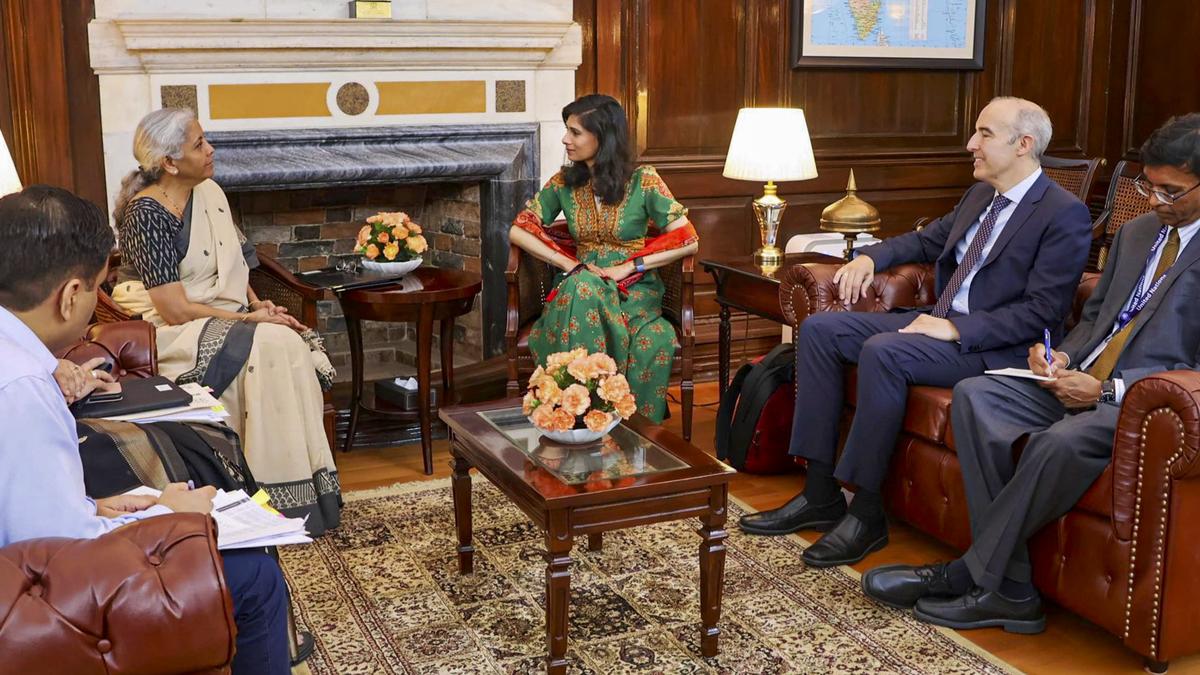







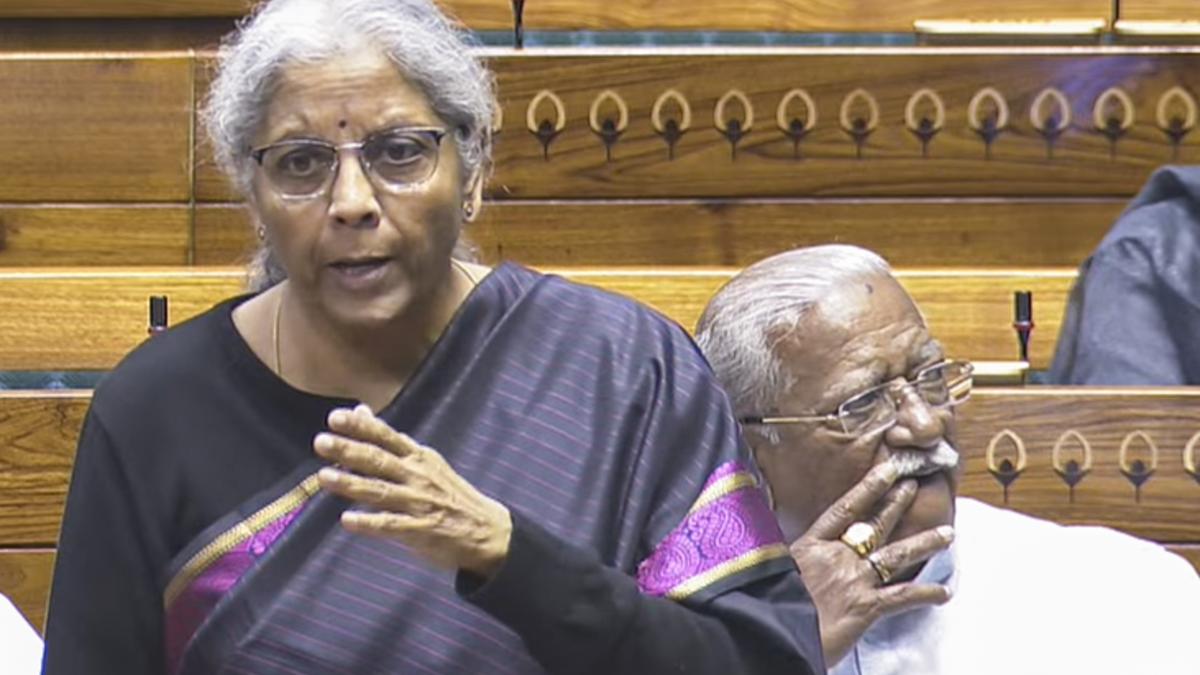
The Centre’s proposal to set up an Urban Challenge Fund of ₹1 lakh crore is an interesting idea to push urban infrastructure build-out. Finance Minister Nirmala Sitharaman spelt it out in the Lok Sabha during the Budget session of Parliament, in New Delhi, Saturday, Feb. 1, 2025.
| Photo Credit: Sansad TV
The Union Budget unveiled on February 1, 2025, has come at a time of unprecedented global uncertainty and a flagging domestic economy. The real GDP growth is estimated at 6.4% for 2024-25 and between 6.3-6.8% for 2025-26, a far cry from >8 percent growth required annually to make India a developed nation by 2047. While much attention has been devoted to the demand stimulus through income tax cuts, not enough is said about the proposed reforms in urban development, tariff rationalisation, and regulatory simplification aimed at making Indian cities and corporates more competitive. Since the majority of economic activity is located in cities (urban areas account for ~55% of GDP) and produced by large corporates (~40% of the national output and 55% of India’s exports), the above-mentioned reforms have a pivotal role in improving India’s trend growth rate. Below we unpack each reform.
The government has identified “urban development” as one of the key growth pillars. World over, urbanisation and economic growth go hand in hand, and India is no exception. What makes prioritising cities important now is that the urban share of GDP has remained stagnant between 52-55% from 2000-2020. Given that the urban share of the population has continued to increase during this period, this implies that per capita urban income grew slower than rural during this period. Since our cities are at least 3 times more productive than their rural counterparts, deceleration in their productivity growth does not augur well for overall growth. Poor growth performance in urban areas could be directly related to the quality of life our cities offer. For example, though 95% of municipal waste is collected, only about 50% is treated. Water availability is about 115 lpcd (litre per capita per day) in big cities compared to the benchmark of 135-150 lpcd. And the price-to-income ratio (PTI)–the price to buy a 950 sq. feet apartment by the median earning household–is 11 in our cities as opposed to the affordability benchmark of 5.
Inadequate service delivery
Sub-optimal service delivery is due to many factors, with lack of funds being one of them. Indian cities spend about a quarter on urban infrastructure of what needs to be spent. The Centre’s proposal to set up an Urban Challenge Fund of ₹1 lakh crore is an interesting idea to push urban infrastructure build-out. The proposed Fund should incorporate elements of expenditure efficiency, transparent planning, and stable governance to move the needle on service delivery. Our analysis of expenditure and outcomes of 27 big municipalities on solid waste management (SWM) indicated that 19 of them were spending significantly more than the norm and yet none had a perfect score under the Swachh Bharat rankings. Spending accounted for about 23% of the variation in cleanliness services, the remainder attributable to non-monetary dimensions like stable leadership, citizen involvement, etc. Thus, together with more resources, there is also a crying need for better expenditure efficiency.
Not just inadequate delivery of civic services, Indian cities also suffer from high house prices. Globally, housing affordability moves together with the degree of transparency in the real estate industry. India is currently part of the ‘semi-transparent’ set of countries and its PTI of 11 is consistent with this level of transparency. One of the key reasons for the semi-transparent market is the lack of credible and rigorous land use planning and implementation. Improving house price affordability requires releasing (developable) land supply transparently. This will increase competition in the sector by enabling and encouraging the entry of new real estate developers, putting pressure on prices, and in turn, improving affordability. This begs the next question, who will implement these reforms? Since all of the above (and more) fall under the domain of the Third tier, the obvious answer is the city leadership. However, in reality, it falls through the crack given that the average tenure of a municipal commissioner is just 10 months, leaving little time or incentive for any meaningful contribution. There is a dire need for governance reform, beginning with a stable mayoral-commissioner system.
Maximising the agglomeration effect
Having understood the multiple dimensions that the Challenge Fund should embrace, it still leaves out one existential issue–which among the ~8000 towns and cities should be chosen for the first brush of urban renewal? Maximising the agglomeration effect of the state capitals coupled with million-plus cities makes up for a good choice. This cohort accounts for close to 35% of India’s GDP; is the fastest-growing component for most Indian states; and is regionally distributed. Creating new cities is a time-consuming and uncertain endeavour, not required when we already have a cohort of cities forming the nucleus of economic activity. It took Gurugram 20 years (1991-2011) to become one of India’s key economic centers with its population increasing from 2,00,000 to 1 million despite having all the favourable conditions like land availability, proximity to an international airport, and a skilled workforce from Delhi.
Together with the urban push, the Budget has also reduced the Basic Customs Duty (BCD) on imports to increase competition in the domestic economy. By reducing the BCD on a range of products like chemicals and pharmaceuticals, and capital goods used in lithium-ion battery production, the average tariff rate has gone down from more than 13 to about 10.5%. This again is a welcome step. High tariffs raise costs and thus counterproductive, as it increases the price for domestic consumers and producers, making it difficult for them to join the global value chain. For example, an Apple phone costs about 20% more in India due to a tariff of a similar level on imports of such phones. However, a lot more remains to be done; the corresponding tariffs range between 1-3% for countries like Vietnam, the Philippines, and China. An equally important step would also be to consider removing the AIDC (Agriculture Infrastructure Development Cess) that is imposed on several products to keep the effective rate of protection the same as before. Finally, despite India improving significantly in the ease of doing business ranking between 2014 to 2019, there is still a lot of scope for further simplification. The proposal to constitute a High-Level Committee for Regulatory Reforms is just a step in the right direction and should be implemented in a time-bound manner.
The FM has outlined the right key areas to improve India’s competitiveness and accelerate growth. The Budget represents a good first step, but we have miles to go.
(Shishir Gupta is a Senior Fellow and Rishita Sachdeva is a Research Associate at the Centre for Social and Economic Progress. Views are personal)
Published – February 11, 2025 06:34 am IST