






More than half a million years ago, one of humans’ ancestors took a bold step and ventured beyond Africa, the cradle of humankind, in search of greener pastures. Since then humans have explored every habitable corner of the globe, often driven by the need to find new sources of food and to escape diseases and natural disasters.
Researchers have documented many migrations in great detail in the historical and archaeological records — but even now, some chapters are missing from this epic tale.
One part of the missing story was recently published in the European Journal of Human Genetics. Scientists from India have reported finding the genetic heritage of the people of the Nicobar Archipelago in the Indian Ocean.
The team conducted a detailed analysis of genetic data collected from 1,559 individuals across South and Southeast Asia. They found ancestral ties between the Nicobarese and the Htin Mal community, a population from the Laos-Thailand region.
The Nicobarese were also found to have retained their Austroasiatic language roots — a language family spanning Southeast Asia — of the Khmuic branch.
“Almost 20 years ago, we collected DNA from tribes in the Andaman and Nicobar region. We could not gather much information from DNA for the Nicobarese population but we related them to some South Asian groups and estimated their age to be around 11,500 years,” Kumarasamy Thangaraj, of the CSIR-Centre for Cellular and Molecular Biology, Hyderabad.
He co-led the study with Gyaneshwer Chaubey of Banaras Hindu University.
“Since then, we [have] analysed many people within India and saw many advancements in technology,” including the sequencing of one million human genomes. “Using these new techniques, we found that the Nicobarese are closer to Southeast Asian groups who migrated approximately 5,000 years ago.”
Uncovering the ancestry trial
The Andaman and the Nicobar Islands are separated by the Ten Degree Channel, which is around 150 km wide. Though they’re close to each other, the peoples of the two islands have significantly different physical features, which also differ from those of the people of mainland India. These differences have stoked scientists’ curiosity about where the Nicobarese people originated.
In 2005, one research team that included the co-leads of this study investigated the origins of Andaman Islanders by analysing mitochondrial DNA, which is passed down by mothers to their children. They discovered that the Indigenous tribal groups Onge and Great Andamanese preserved two ancient maternal genetic lineages called M31 and M32, meaning they had a common ancestor.
These lineages likely evolved in isolation for a long time, with a genetic history found to date back to humans travelling along the Indian Ocean coast 50,000 to 70,000 years ago.
The study also revealed the Nicobarese were closely linked to Southeast Asian populations.
However, it couldn’t say when exactly they set foot on Nicobar.
In the new study, rather than mitochondrial DNA, the researchers analysed biparental and uniparental genetic markers from 1,554 previously studied individuals and five newly collected samples from the Nicobarese population. Biparental genetic material is inherited from both parents and uniparental is from one parent.
Biparental genetic material in particular is more instructive than mitochondrial DNA because it contains the complete genome (DNA contributed by both parents), paving the way for researchers to uncover more clearly relationships and differences between populations.
Equipped with their data, the team carried out an admixture analysis, a method for estimating how much of an individual’s genetic makeup comes from different ancestral populations. The team also used principal component analysis, a statistical tool that can assess complex genetic datasets and create simple visualisations that elucidate the genetic similarities and differences.
The results confirmed previously suggested links between the Nicobarese and Southeast Asian populations and also provided a higher-resolution view of their genetic stories by pinpointing their ancestral links to the Htin Mal.
Correcting the timeline
For a long time, scientists believed the Austroasiatic ancestors of the Nicobarese migrated to the island more than 11,000 years ago. The new study corrected this impression by taking a closer look at DNA mutations.
Some sections of human DNA can evolve and mutate over centuries, often under the influence of environmental factors — e.g. when a population moves to a new land with different weather conditions. These mutations can provide clues about when a population might have migrated to a region.
Due to its geographical isolation, the ancient Nicobarese tribe has preserved its genetic identity without significant admixture with different populations. So by comparing the differences in mutations between the genetic ancestors and the migrated populations, the scientists were able to trace their time of arrival at the Nicobar Islands: approximately 5,000 years ago, according to Thangaraj.
Future ventures
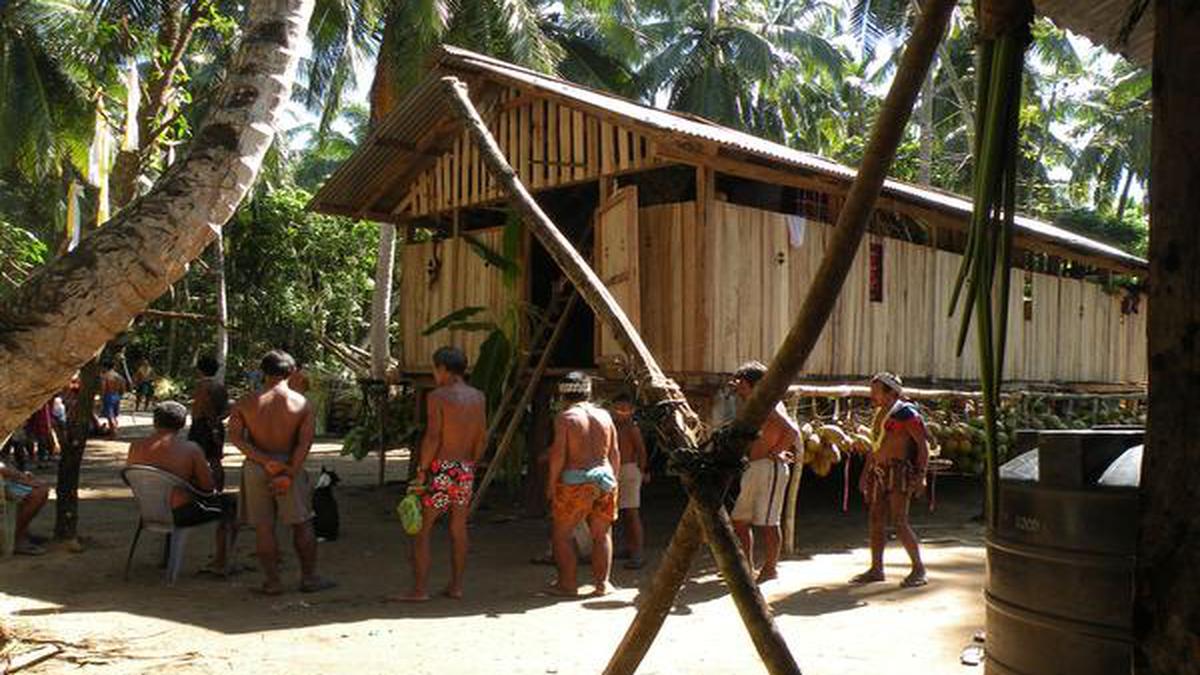
Despite bearing genetic similarities with Southeast Asian groups, the lifestyle of the Nicobarese is entirely different, Thangaraj said. “I have visited the Andaman and Nicobar Islands and collected samples from the Nicobarese, so I’ve seen their lifestyle first-hand. It is fascinating to compare them with linguistically similar groups elsewhere.”
Indeed, the unique societal dynamics of the Nicobarese people are still largely uncharted.
Thangaraj also singled out their isolation from pathogens. “For example, during COVID, [the Nicobarese] were protected unless someone from the mainland brought the virus,” he said. “Unlike us, who have adapted to polluted and pathogen-filled environments, they might struggle with infections if exposed to other regions.”
The team plans to dive further into the genetic adaptations of these isolated populations to uncover how natural selection and environmental factors have shaped their survival strategies and immune response to diseases.
Sanjukta Mondal is a chemist-turned-science-writer with experience in writing popular science articles and scripts for STEM YouTube channels.
Published – January 29, 2025 05:30 pm IST